Pakistan deputy PM to attend today OIC’s extraordinary meeting on Palestine

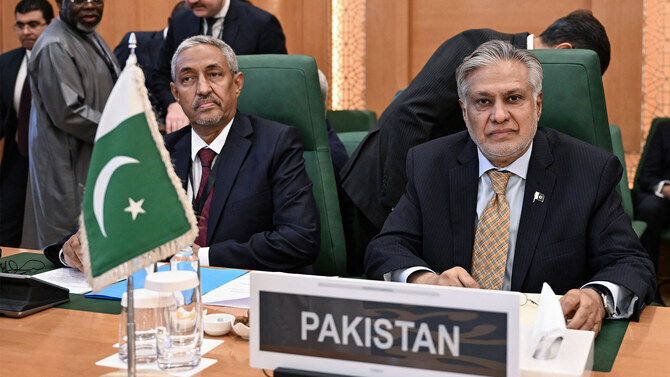
Pakistani Deputy Prime Minister Ishaq Dar (right) attends the Organization of Islamic Cooperation (OIC) meeting in Jeddah, Saudi Arabia, on August 7, 2024. (AFP/File)
Short Url
Updated 07 March 2025
Follow

Pakistan deputy PM to attend today OIC’s extraordinary meeting on Palestine

  • Shortly after assuming office, US President Trump had announced a plan to permanently uproot more than 2 million Palestinian people from Gaza
  • The OIC says its meeting underscores firm rejection of displacement policies, reaffirming the Palestinian cause remains central to the Muslim world

ISLAMABAD: Pakistan’s deputy prime minister and foreign minister, Ishaq Dar, will be attending an extraordinary meeting of the Organization of Islamic Cooperation (OIC) today, Friday, to discuss the situation in Palestine, according to the Pakistani foreign office.
US President Donald Trump announced a plan to permanently uproot more than 2 million Palestinians from Gaza after assuming office, saying his country would turn the area into an international beach resort.
The plan was widely denounced by majority-Muslim nations and global rights organizations as the US president suggested that the Palestinian population could relocate to neighboring Egypt and Jordan.
Dar will discuss the deteriorating situation in Palestine, the ensuing humanitarian crisis, and the “illegal and immoral” proposals for the displacement of Palestinians at the OIC meeting in Jeddah, according to Pakistan’s foreign office.
“The DPM/FM will reaffirm Pakistan’s unwavering support for the Palestinian people and their just cause,” the foreign office said on X.
In a post on X, the OIC said the meeting underscores the firm rejection of policies of displacement, annexation, aggression and destruction, while reaffirming that the Palestinian cause remains the central issue of the Islamic world.
The meeting comes days after Arab leaders adopted an Egyptian reconstruction plan for Gaza worth $53 billion, which seeks to avoid Palestinian displacement in contrast to Trump’s “Middle East Riviera” vision.
Egyptian President Abdel Fattah El-Sisi said on Tuesday Egypt, in cooperation with Palestinians, had worked on creating an administrative committee of independent, professional Palestinian technocrats to govern Gaza after the Israel-Gaza war ends.
Pakistan Prime Minister Shehbaz Sharif welcomed the Arab League’s approval of the Egyptian plan, urging the United Nations to ensure the implementation of its resolutions calling for a two-state solution in the Middle East.
Islamabad does not recognize nor have diplomatic relations with Israel and calls for an independent Palestinian state based on “internationally agreed parameters.”
Pakistani state media reported that Dar would advocate for Israel’s full withdrawal from all occupied territories, including Jerusalem, at the OIC meeting.


Pakistan to maintain hard line on Afghanistan after strikes as Taliban vows military response

Updated 5 sec ago
Follow

Pakistan to maintain hard line on Afghanistan after strikes as Taliban vows military response

  • Islamabad blames Afghanistan’s ‘guerrilla mindset’ for escalating tensions between the two countries
  • Afghan Taliban spokesperson denies militant presence in his country, accuses Pakistan of hitting civilians

ISLAMABAD: Pakistan vowed on Wednesday to continue its current policy toward Afghanistan unless the Taliban leadership abandons its “guerrilla mindset,” days after Islamabad carried out airstrikes inside Afghan territory, sharply escalating tensions between the two neighbors once again.

Pakistan conducted intelligence-based strikes overnight into Sunday in Afghanistan’s eastern Nangarhar and southeastern Paktika provinces, saying it had targeted camps of the banned Tehreek-e-Taliban Pakistan (TTP), its affiliates and Daesh-linked fighters.

Islamabad has long accused Kabul of allowing militant groups to use Afghan soil to launch attacks on Pakistani civilians and security forces, a charge the Taliban deny. The two sides also clashed in October last year, leading Pakistan to close key border crossings for bilateral and transit trade.

State Minister for Interior Talal Chaudhry told Geo News that Pakistan had attempted dialogue but would now persist with practical measures if the Taliban failed to change course.

“They call themselves a state, but they have not yet emerged from their guerrilla mindset,” he said.

“Now, with the practical steps we are taking, we want to change their behavior and see them in the form of a state,” he added.

Pakistan blamed a string of recent suicide bombings in Islamabad, Bajaur and Bannu on militants operating from Afghan territory before launching the latest strikes.

Chaudhry said Afghanistan had been acting like “an irresponsible neighbor,” warning that his country’s current approach would continue if attacks inside Pakistan persisted.

“This war will be won, and all this will end,” he said. “If it is not resolved the straight way, then it will be completely ended by a hard-line approach.”

Meanwhile, Kabul has condemned the airstrikes as violations of its sovereignty and said civilians were killed.

In an interview with Al Arabiya, Taliban government spokesman Zabihullah Mujahid also pledged to respond militarily.

“It would be a military response, but its details are confidential and I cannot explain further,” he said.

Mujahid rejected Pakistan’s allegations that TTP or Daesh militants operate from Afghan soil, saying security problems inside Pakistan were domestic in nature.

“Afghan soil is not allowed to be used against anyone,” he said, adding that Kabul had carried out extensive operations against Daesh and eliminated its presence in Afghanistan.

The 2,600-kilometer border between the two countries remains a vital trade and transit route, but crossings have faced repeated closures amid rising tensions, disrupting commerce and humanitarian movement.

Several regional countries, including Saudi Arabia, Türkiye and Qatar, have sought to mediate between the two countries, though their military exchanges risk further destabilizing their ties.