Pakistan power regulator cuts tariff on account of fuel price adjustment

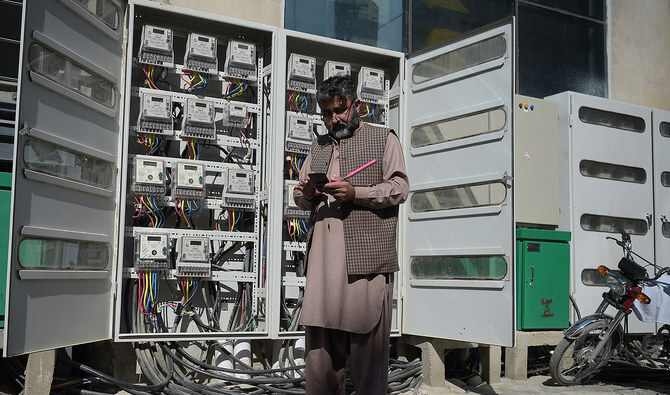
In this file photo, taken on November 7, 2018, a Pakistani employee of the state-run Islamabad Electric Supply Company (IESCO), takes a meter reading with his smartphone at a commercial building in Islamabad. (AFP/File)
Short Url
Updated 07 March 2025
Follow

Pakistan power regulator cuts tariff on account of fuel price adjustment

  • The National Electric Power Regulatory Authority makes adjustments in power tariff on account of any variations in fuel charges on a monthly basis
  • The South Asian country produces electricity with the help of imported fossil fuels, amid underutilization of domestic resources like hydropower, coal

ISLAMABAD: Pakistan’s national power regulator has cut the prices of electricity by Rs2.12 per unit on account of fuel adjustment charges, it said on Thursday.
The National Electric Power Regulatory Authority (NEPRA) has to make adjustments in the power tariff on account of any variations in fuel charges on a monthly basis.
The reduction in electricity prices followed a request by the Central Power Purchasing Agency (CPPA), which had worked out the fuel cost for the month of January.
“The authority... has reviewed and assessed a National Average Uniform decrease of (Rs2.1240/kWh) in the applicable tariff for XWDISCOs on account of variations in the fuel charges for January 2025,” NEPRA said in a notification issued late Thursday.
“XWDISCOs (distribution companies) shall reflect the fuel charges adjustment in respect of January 2025 in the billing month of March 2025.”
The development comes more than a week after Pakistan’s Power Minister Awais Leghari announced a reduction in power tariff for households consuming up to 300 units of electricity and those using agricultural tube-wells.
“By waiving these charges for low-usage consumers and agricultural tube-wells, the government aims to ease the financial burden on farmers and households with limited electricity consumption,” Leghari was quoted as saying by the state-run APP news agency.
Pakistan produces expensive electricity due to a combination of factors including high reliance on imported fossil fuels, inefficient energy mix, substantial transmission and distribution losses and chronic issues like circular debt and regulatory inefficiencies.
The country’s outdated infrastructure and inadequate power plants further exacerbate costs, while underutilization of domestic resources such as hydropower and coal add to the problem.
Additionally, fluctuations in foreign exchange rates and complex tariff structures contribute to higher electricity prices. High power cost is one of the key factors that lead to inflation in the country.


Pakistan, ADB sign $730 loan agreements to boost SOE reforms, energy infrastructure

Updated 25 December 2025
Follow

Pakistan, ADB sign $730 loan agreements to boost SOE reforms, energy infrastructure

  • Both sign $330 million Power Transmission Strengthening Project and $400 million SOE Transformation Program loan agreements
  • Economic Affairs Division official says Transmission Project will secure Pakistan’s energy future by strengthening national grid’s backbone

KARACHI: Pakistan and the Asian Development Bank (ADB) on Thursday signed two loan agreements totaling $730 million to boost reforms in state-owned enterprises (SOEs) and energy infrastructure in the country, the bank said.

The first of the two agreements pertains to the SOE Transformation Program worth $400 million while the second loan, worth $330 million, is for a Power Transmission Strengthening Project, the lender said. 

The agreements were signed by ADB Country Director for Pakistan Emma Fan and Pakistan’s Secretary of Economic Affairs Division Humair Karim. 

“The agreements demonstrate ADB’s enduring commitment to supporting sustainable and inclusive economic growth in Pakistan,” the ADB said. 

Pakistan’s SOEs have incurred losses worth billions of dollars over the years due to financial mismanagement and corruption. These entities, including the country’s national airline Pakistan International Airlines, which was sold to a private group this week, have relied on subsequent government bailouts over the years to operate.

The ADB approved the $400 million loan for SOE reforms on Dec. 12. It said the program seeks to improve governance and optimize the performance of Pakistan’s commercial SOEs. 

Karim highlighted that the Power Transmission Strengthening Project will enable reliable evacuation of 2,300 MW from Pakistan’s upcoming hydropower projects, relieve overloading of existing transmission lines and enhance resilience under contingency conditions, the Press Information Department (PID) said. 

“The Secretary emphasized that both initiatives are transformative in nature as the Transmission Project will secure Pakistan’s energy future by strengthening the backbone of the national grid whereas the SOE Program will enhance transparency, efficiency and sustainability of state-owned enterprises nationwide,” the PID said. 

The ADB has supported reforms by Pakistan to strengthen its public finance and social protection systems. It has also undertaken programs in the country to help with post-flood reconstruction, improve food security and social and human capital. 

To date, ADB says it has committed 764 public sector loans, grants and technical assistance totaling $43.4 billion to Pakistan.