

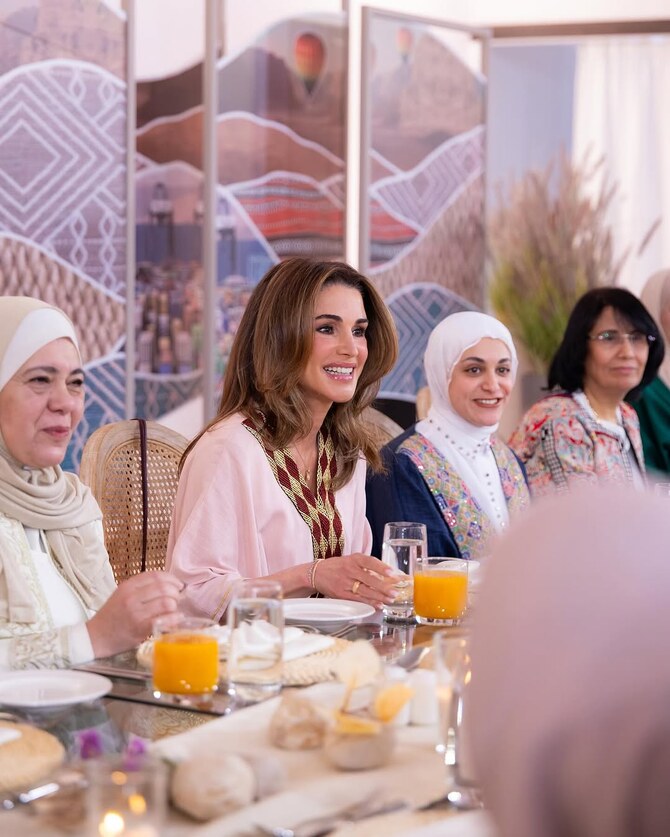
Queen Rania of Jordan hosts Ramadan iftar for women leaders in Aqaba

Queen Rania praised the contributions of Jordanian women in the workforce and the labor market. (Petra)
Short Url
Updated 07 March 2025
Follow

Queen Rania of Jordan hosts Ramadan iftar for women leaders in Aqaba

  • Attendees congratulated on occasions of Ramadan, International Women’s Day
  • Governor of Aqaba welcomes queen, expresses gratitude for her efforts to empower women

LONDON: Queen Rania of Jordan hosted a Ramadan iftar banquet on Thursday at the Prince Rashid Club in Aqaba.

Women leaders and activists from various sectors in Aqaba, a governorate on the Red Sea in southern Jordan, attended the event.

Queen Rania congratulated the attendees on Ramadan and the upcoming International Women’s Day, which will be marked on March 8, the Jordan News Agency reported.

She praised the contributions of Jordanian women in the workforce and the labor market, as well as their roles in caring for their families to provide comfort and reassurance at home.

Khaled Al-Hajjaj, the governor of Aqaba, welcomed the queen to the city and expressed gratitude for her efforts to empower women.

Mahmoud Khalifat, the director general of Aqaba Ports Corporation, and Muhannad Al-Naser, director of Prince Rashid Club, were also present.


Prime minister’s visit to southern Lebanon promotes trust in state

Lebanon's Prime Minister Nawaf Salam speaks to residents and press corps. (AFP)
Updated 4 sec ago
Follow

Prime minister’s visit to southern Lebanon promotes trust in state

  • Temporary market officially opened by Nawaf Salam during 2-day tour

BEIRUT: Nearly 15 months on from Israeli airstrikes which reduced Nabatieh’s historic market to rubble during the war between Israel and Iran-backed Hezbollah, local civic leaders have stepped in to provide relief.

The war, which ended with a ceasefire in November 2024, left the southern Lebanese city’s centuries-old souk — a key commercial hub — devastated, displacing shop owners and crippling local trade.

In the absence of swift rebuilding by Hezbollah, which many affected residents had relied on, a group of non-partisan civic figures from Nabatieh launched an initiative about six months ago to establish a temporary alternative market.

The new market was officially opened on Sunday by Lebanese Prime Minister Nawaf Salam during a two-day tour of southern Lebanon.

The visit began in Tyre and Naqoura, continued through Bint Jbeil and Aitaroun, and included stops in devastated border villages before reaching Hasbaya and Marjayoun, and finally concluding in Nabatieh.

Nabatieh’s market has long been one of the region’s most important commercial landmarks.

It served as a vital transit point for traders moving goods between Syria, Lebanon, and Jerusalem in the early 20th century.

It evolved over time into a bustling local marketplace central to the city’s economy and daily life.

The initiative highlights growing frustration among some residents over unfulfilled promises for reconstruction aid from Hezbollah following the conflict’s destruction.

Salam’s opening of the temporary facility underscores government efforts to support community-led recovery amid broader rebuilding challenges in the war-affected region.

The temporary market aims to restore essential commercial activity while permanent reconstruction is underway.

Mahdi Sadeq, executive director of project overseer Nabatieh Emergency Rescue Service Association, told Arab News: “The project is a joint initiative by business people, self-employed professionals, and financiers, some of whom belong to non-Muslim sects.”

Sadeq, who is the son of Sheikh Abdul Hussein Sadeq, Nabatieh’s imam, added: “The project’s significance lies in the fact that it is not tied to any form of patronage that would burden traders with political loyalties.

“This initiative brings 85 owners of destroyed shops, many in dire economic conditions, back to work without imposing any obligations on them — unlike partisan grants.

“It is an initiative that saves the historic market, restores the pulse of life to the people, and sets us on the path to recovery.”

Sadeq added that the importance of the initiative was the fact that Nabatieh “has a moderate and independent religious” character “that has asserted its presence among all forces.”

He said: “No one has been able to eliminate it: not the Palestinian factions that were present in southern Lebanon in the 1960s and 1970s, nor the Lebanese partisan forces that came afterwards. It has remained centrist and has enjoyed broad popular support.

“If people in the south are left without pressure being exerted on them, they are eager to be embraced by the state. The state is the foundation, and everything else is the exception.

“At the same time, there is a degree of caution, because the state has yet to assert its presence after the war and has, in a way, passed judgment on people in advance. Had it moved quickly to take the initiative, it would have reaped greater dividends.”

Architect Samir Ali Ahmad, who is in charge of the implementation of the project, said that “the alternative market was built on Waqf-owned land donated by the imam of Nabatieh for a limited period of no more than four or five years, until the main market is rebuilt.”

Ali Ahmad added: “The new market consists of prefabricated rooms. It also includes courtyards and a Khan-style market complex featuring cafes, restaurants, rest areas, playgrounds, and a parking lot.

“Once the project is completed, these rooms can be donated to the Lebanese army or to the poorest families.

“This market will enable residents to remain on their land and secure their livelihoods without being forced into displacement.”

Engineer Lina Ezzeddine, who contributed to the project through fundraising efforts, said: “Priority was given to destitute individuals who were unable to fend for themselves.”

She noted that “some merchants had succeeded in rebuilding their shops, others had moved to different locations, while some had died of heart attacks due to the shock of what had occurred.”

Ezzeddine stressed that “donors did not consider the political affiliations of the merchants.”

She added: “The only condition was that no political party be allowed to interfere. And, indeed, no party did.

“The people have endured many tragedies, and the prime minister’s participation in the opening of the alternative market sends a clear message that the state stands with them.

“The people of the south love their land and are deeply attached to it. How could they not stand with the state?”

Salam’s visit, which has been marked by numerous public gatherings and meetings with local figures, reflects the people’s renewed support of the state following a devastating war that was the result of Hezbollah’s unilateral move to take decisions on war and peace out of the hands of official authorities.

The scenes witnessed during Salam’s tour of the south have carried exceptional significance.

The scattering of roses and rice, the ululations that have welcomed him, and the banners bearing welcoming phrases to “the state of law and citizenship” indicate the desire of the people of the south to return to the protection of state institutions.

An official source said that they had recognized that “the state is the only safe haven, while all slogans raised outside its framework have brought nothing but destruction, poverty, and displacement.”

Salam reiterated that “the state’s presence in the area is a message in the face of this massive destruction, to which we will never surrender.”

He added: “The state is here to stay, not to visit and leave. The state is responsible for every southern village and for all people, without discrimination.

“The cohesion of southern villages, regardless of their affiliations, protects the entire region.

“The government will continue to exert relief, reconstruction, and economic recovery efforts. The path to recovery and reconstruction is proceeding within an integrated framework.”

Salam said the state’s presence was “a clear message in the face of immense destruction.”

On Saturday, the first day of his tour, Salam announced that $360 million had been secured to help rebuild areas in southern Lebanon, adding that the government would boost reconstruction projects once funding was ensured.