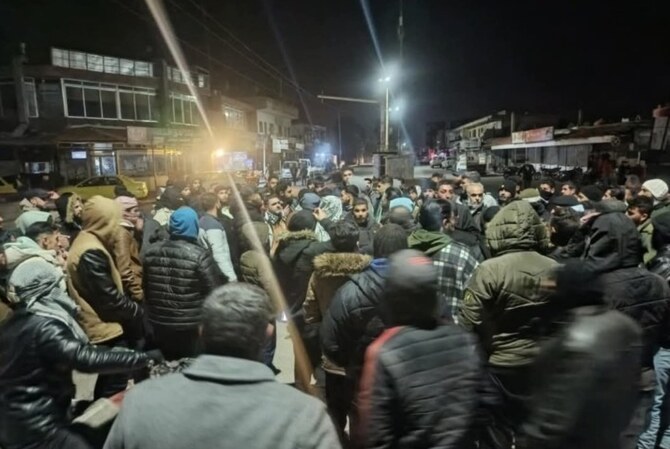
Clashes in Syria’s coastal region between government forces and Assad loyalists kill more than 70

Gunmen loyal to Syria’s Bashar Assad killed 16 security personnel on Thursday, a war monitor said, in attacks it described as the ‘most violent’ since the longtime president’s ouster. (X/@RaymondFHakim)
Short Url
Updated 07 March 2025
Follow

Clashes in Syria’s coastal region between government forces and Assad loyalists kill more than 70

  • Government forces send major reinforcements overnight to the cities of Latakia and Tartus as well as nearby towns and villages
  • The clashes are the worst since Bashar Assad was removed from power in early December

LATAKIA: Clashes between Syrian security forces and gunmen loyal to former President Bashar Assad in the country’s coastal region have left more than 70 people dead and an area outside government control, a war monitor said Friday.
Government forces sent major reinforcements overnight to the cities of Latakia and Tartus as well as nearby towns and villages that are the heartland of the minority Alawite sect and a base of support for Assad, to try to get the situation under control, state media reported.
The clashes are the worst since Assad was removed from power in early December by insurgent groups led by the Islamist Hayat Tahrir Al-Sham, or HTS. Since Assad’s fall, there have been some sectarian attacks against members of his minority Alawite sect. These incidents have occurred despite the fact that officially the new authorities have said they are against collective punishment or sectarian vengeance.
On Friday morning, large numbers of troops were deployed in Latakia and no civilians were seen in the street as a curfew that was imposed in the city and other coastal areas remains in force. Members of the security force said there were some clashes in one of the city’s neighborhoods but most of the city was calm and under government control.
The Britain-based Syrian Observatory for Human Rights, a war monitor, said that since the clashes began on Thursday afternoon, 35 members of government forces, 32 fighters loyal to Assad and four civilians have been killed.
The Observatory’s chief Rami Abdurrahman said the outskirts of the coastal towns of Baniyas and Jableh are still under the control of Assad loyalists. He added that Assad’s hometown of Qardaha and many Alawite villages nearby are also outside government control.
A Qardaha resident told The Associated Press via text messages that The situation “is very bad.” The resident, who asked that his name not be made public for safety reasons, said government forces are firing with heavy machine guns on residential areas in Qardaha.
Another resident said that they have not been able to leave their homes since Thursday afternoon because of the intensity of the shooting.
Abdurrahman said the clashes began when a security force tried to detain a wanted person near Jableh and was ambushed by Assad loyalists.
Syria’s conflict that began in March 2011 has left more than half a million people dead and millions displaced.


Yemeni border security chief reveals drug smuggling networks linked to Houthis

Updated 5 sec ago
Follow

Yemeni border security chief reveals drug smuggling networks linked to Houthis

  • Al-Wadiah security force foils attempt by Houthi leader to enter Saudi Arabia using forged Umrah visa
  • Col. Osama Al-Assad: Saudi security measures are strong, the level of vigilance is high, and we coordinate with them on smuggling cases that are being closely monitored

AL-WADIAH, Yemen: Most of the drug-smuggling networks from Yemen to Saudi territory are directly linked to the preventive security apparatus affiliated with the Houthi terrorist group.

This is according to Col. Osama Al-Assad, commander of Yemen’s Security and Protection Battalion at the Al-Wadiah border crossing.

Al-Assad told Asharq Al-Awsat that the battalion recently arrested a Houthi leader while he was trying to enter Saudi Arabia using a forged passport and Umrah visa, suggesting that the motives for his entry were of a security nature, and not to perform religious rites as he claimed.

Al-Assad said the battalion faced several patterns of smuggling attempts, foremost among them prohibited items, in addition to people smuggling, forgers, and persons of unknown identity.

But, he said, that the battalion’s high cumulative expertise enabled them to thwart these illegal activities.

Al-Assad added that the level of coordination with the Saudi side was conducted at the highest levels. He expressed gratitude to the Kingdom for its continuous support to Yemen in general, and to the battalion in particular, in a manner that contributed to strengthening border security between the two countries.

He said the battalion’s mission was focused on securing and protecting the crossing, and combating various forms of smuggling, whether prohibited items or people smuggling, noting that the battalion apprehended about 10 people a day in possession of forged Umrah visas.

Al-Assad said that the battalion’s security coverage extended to “the crossing and its surroundings for a distance of 30 km westward up to the borders of Al-Rayyan in Al-Jawf.”

He added that among the battalion’s tasks was to arrest wanted members of Al-Qaeda, in addition to persons fleeing the implementation of judicial rulings issued against them.

He said the majority of smuggling operations were directly linked to the preventive security apparatus of the Houthi group in Sanaa, explaining that investigations with the detainees revealed direct connections to this apparatus.

Al-Assad said that “during one operation to stop a smuggling vehicle, a network linked to the Houthis offered a sum of SR1 million ($266,650) in exchange for releasing only the smuggler, while relinquishing the vehicle and the confiscated goods.”

Investigations revealed that smugglers affiliated with the Houthi preventive security apparatus held meetings in the border areas with Oman, indicating that some secret meetings were held in the city of Al-Ghaydah in the Al-Mahra Governorate (eastern Yemen).

He said that a man called Ali Al-Harizi had strong connections to smuggling operations and was considered a leader in this network.

“Saudi security measures are strong, the level of vigilance is high, and we coordinate with them on smuggling cases that are being closely monitored,” he said

He thanked the Kingdom for the “efforts and sacrifices it is making to restore the Yemeni state, combat Persian expansionism, and sever the arms of Iran and its supporters inside Yemen.”

He added: “We particularly appreciate the Kingdom’s backing for the Al-Wadiah security battalion through the support it provides at the logistical, financial, and other levels, which positively reflects on the battalion’s performance and its security tasks.”

Al-Assad revealed that the Al-Wadiah protection battalion recently arrested a Houthi commander who was trying to enter Saudi Arabia with a forged Umrah visa, describing the arrest operation as “dramatic.”

He said: “About a month and a half ago, one of the battalion members recognized the Houthi commander, as the soldier himself was a former prisoner of the Houthis. When he saw him, he asked him: ‘Where to, Abu Assad?’ The Houthi commander was startled and replied fearfully: ‘I’m at your mercy. Watch out for me, and you can have whatever you want.’”

He added: “The soldier firmly replied: ‘You will not advance a single step,’ and he was immediately arrested.”

According to Al-Assad, the Houthi commander was a communications officer in the Central Security prison in Sanaa and was using a forged passport issued by the Houthi-controlled areas themselves.

Al-Assad said Al-Wadiah Battalion also arrested four other Houthi operatives at different times, in addition to apprehending 15 murder suspects. A suspect believed to be affiliated with the terrorist organization Al-Qaeda was also detained.

He said that the Houthi group, acting as an Iranian proxy, had moved toward establishing drug-production facilities in Sanaa and Saada following the fall of the Bashar Assad regime in Syria.

He said Yemen’s Ministry of Interior foiled, several months ago, a drug factory in Al-Mahrah Governorate.

“According to available intelligence, the factory was under the direct supervision of Al-Harizi, with a production capacity of approximately 10,000 pills per hour,” he said.

Al-Assad noted that “the facility was seized after intensive surveillance and precise intelligence operations,” and that “security agencies continue to monitor and investigate the case to uncover further details and links.”

The most significant challenges facing the unit are limited resources and capabilities, he said, underlining that operations rely primarily on manual effort and human expertise.

“Our personnel have years of accumulated experience that enable them to identify suspicion even from the way a person speaks or from subtle features of a vehicle,” he said. “We have requested the provision of heavy machinery and equipment to establish an earthen security belt and to dig trenches to curb internal smuggling activities.”

Of smuggling methods, he said that trafficking networks constantly changed and refined their techniques, yet security forces remained vigilant. “In some cases, smugglers modify the vehicle itself, hiding contraband in the dashboard, beneath seats, between the roof and interior lining, inside pillars, and even in public transport buses, where prohibited items are concealed in places one would never expect,” he said.

“On one occasion, they dismantled the vehicle’s frame, opened the metal rocker panel at the base, hid the goods inside, and then welded everything back together.”

Al-Assad emphasized that operations at the Al-Wadiah border post were characterized by a high level of integration and coordination among all relevant agencies, foremost among them the National Shield Forces, alongside passport and customs authorities, an approach that significantly enhanced the effectiveness of joint security efforts.