

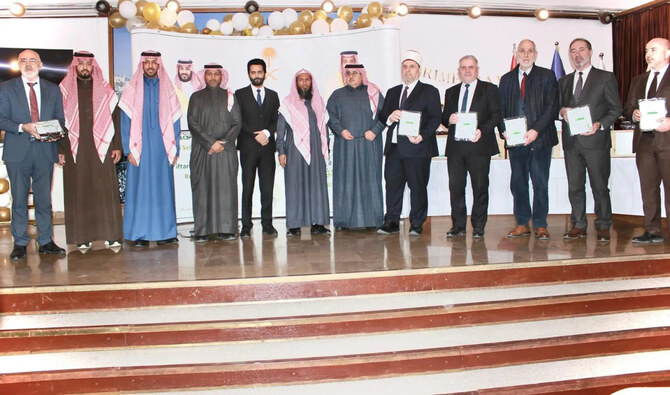
Islamic Affairs Ministry launches programs to distribute dates and serve iftar in Kosovo

The initiative, represented by the religious attache at the Kingdom’s embassy in Bosnia and Herzegovina, took place at Aladdin High School. (SPA)
Short Url
Updated 06 March 2025
Follow

Islamic Affairs Ministry launches programs to distribute dates and serve iftar in Kosovo

RIYADH: The Ministry of Islamic Affairs this week launched the Custodian of the Two Holy Mosques’ gift programs for distributing dates and serving iftar to people fasting in Kosovo, the Saudi Press Agency reported.

The initiative, represented by the religious attache at the Kingdom’s embassy in Bosnia and Herzegovina, took place at Aladdin High School in the capital, Pristina. It was launched in the presence of Consul at the Saudi Embassy in Albania Sultan Al-Sahli, and the Grand Mufti and Head of the Islamic Sheikhdom in Kosovo Sheikh Naim Ternava.

As part of the program, five tonnes of dates will be distributed, benefiting 20,000 individuals, while the iftar initiative will benefit about 6,000 Muslim men and women throughout the holy month of Ramadan.

According to SPA, Sheikh Amer Al-Anzi, the religious attache at the Kingdom’s embassy in Bosnia and Herzegovina, said that the programs reaffirmed the Kingdom’s long-standing commitment to supporting and leading Islamic initiatives.

He described them as a generous gesture by the Kingdom’s leadership, reflecting its dedication to caring for Muslims and highlighting Saudi Arabia’s support for Muslims around the world.

Sheikh Ternava said that the Kingdom had taken great historical and humanitarian stands with Kosovo in the humanitarian, developmental, economic, social and religious fields.

He said that these annual programs were evidence of Saudi Arabia’s dedication to addressing the needs of Muslims, praying that the Kingdom’s leadership would be rewarded for serving Islam and Muslims, particularly the Muslim community in Kosovo.


Saudi Arabia’s story began 49 years before the independence of the US

Updated 5 sec ago
Follow

Saudi Arabia’s story began 49 years before the independence of the US

On Feb. 22, 1727, nearly 300 years ago, the process of establishing the first Saudi state began in Diriyah during the reign of Imam Mohammed bin Saud, founder of the Saudi ruling family.

Diriyah was established by his seventh grandfather, Mana’ Al-Muraidi in the 15th century AD.

Sixteen of his descendants became rulers, known as imams in the first and second Saudi states and as kings in the current Saudi state.

Al-Muraidi’s lineage goes back to Bani Hanifa from the Bakr bin Wael tribe, and he is related to the Prophet Muhammad, peace be upon him, through their common ancestor, Nizar bin Ma’ad bin Adnan.

He moved to the second Diriyah in Najd from the first Diriyah, which was founded by his ancestors in the east of the Arabian Peninsula.

He is the 13th grandfather of the Custodian of the Two Holy Mosques King Salman bin Abdulaziz, and the 14th grandfather of Crown Prince Mohammed bin Salman.

The first Saudi state began 49 years before the independence of the US, and according to Western travelers themselves, it expanded remarkably during the reign of Imam Saud bin Abdulaziz, known as Saud the Great, the third ruler in its history.

According to European documents, what he did was unprecedented in terms of his correspondence with heads of states and empires on behalf of his country, including Napoleon Bonaparte, the emperor of France, and the shah of Iran.

He established a special protocol for correspondence and negotiations, as well as palaces for receiving state guests.

During his reign, the gunpowder industry developed. Imam Saud took power when a man from Iraq assassinated his father, Imam Abdulaziz, while he was leading people in prayer in 1803, shortly after his defeat of the Turks in four campaigns launched against him from Basra.

Saud the Great was known by this compound name because he expanded the size of the state, adding Makkah and Madinah to it, reaching Hodeidah in Yemen and south of Damascus, and stopping at the borders of Basra, adding to the achievements of his forebears.

The state of his grandfather, Imam Mohammed bin Saud, stopped at Sudair, Al-Mahmal, and most of Al-Arad, while the state of his father, Imam Abdulaziz, added Riyadh to it, and reached Dumat Al-Jandal and Wadi Sarhan in the north, along with parts of southern Iraq, Jazan in the south, Taif in the west, and extended his influence over Bahrain, Qatar, Ras Al-Khaimah, Muscat and Al-Hadd in the east, establishing a stability the land had not known for a long time.

During the reign of Imam Saud, which represented the peak of the state’s expansion and dominance, Mohammed Ali Pasha sent an army from Egypt, led by his son Toussaint, and Imam Saud defeated him in the Battle of Wadi Al-Safra.

The shah of Iran too sent an army against him at Muscat, and Imam Saud won another great victory there.

Ras Al-Khaimah, meanwhile, was attacked by British ships coming from India to eliminate Saudi influence there. The Saudi forces suffered severe losses before the ships headed on to Manama and bombarded Saudi forces there as well. The battles ended with a truce between the first Saudi state and Britain.

Elsewhere, quality of life and prosperity prevailed in Diriyah, as evidenced by its hosting of the seasonal market, the largest market on the Arabian Peninsula at that time, with goods coming to it from Iraq, Yemen, Oman and the Levant.

The Diriyah Bathhouse was built, which is a large building that served as a public bathhouse, similar to its counterparts in the Levant and Egypt.

Some historians have reported that a single house in Diriyah during the early days of the Saudi state was worth more than 20 times the value of a house in the rest of the Najd.

This shows that demand for housing was high, as is the case in Riyadh today, where timber prices rose significantly as a result of the urban renaissance and large-scale construction, most notably the 13 km-long Diriyah Wall, which contained 78 defensive towers.

The anniversary of its founding confirms that Diriyah, despite its destruction in 1818, has been brought back to life, thanks to the interest shown by King Salman when he was Prince of Riyadh, with the registration of At-Turaif district in Diriyah on UNESCO’s World Heritage List in 2010.

With the support of the Kingdom’s leadership, and with the Diriyah Gate project in 2019, it has become a global cultural and tourist destination that reflects its identity and ancient details with thoughtful modernity.

It will cost $63 billion and cover an area of 14 km, qualifying Diriyah to become a center of global culture.

After five years, it will include 38 hotels and 19 resorts and will contribute approximately SR27 billion ($7.2 billion), to GDP, in addition to SR20 billion in local content.

It will be ready to receive 50 million visitors annually and will employ approximately 180,000 Saudis.

• Dr. Bader bin Saud is a columnist for Al-Riyadh newspaper, a media and knowledge management researcher, an expert and university professor in crowd management and strategic planning, and the former deputy commander of the Special Forces for Hajj and Umrah in Saudi Arabia. X: @BaderbinSaud.