FBI committed to bringing home American hostages held in foreign countries, director says

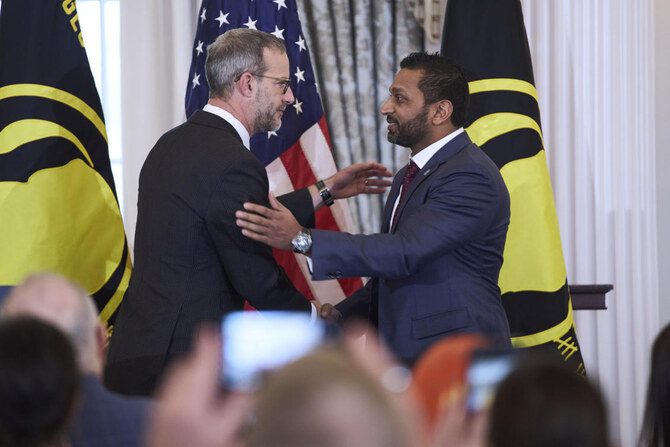
Special Envoy for Hostage Affairs Adam Boehler and Kash Patel during a ceremony to raise the Hostage and Wrongful Detainee flag, State Department, Washington, Mar. 6, 2025. (AP Photo)
Short Url
Updated 07 March 2025
Follow

FBI committed to bringing home American hostages held in foreign countries, director says

  • Trump administration working to bring home Americans from multiple countries, including Russia and Venezuela
  • US government also trying to secure the release of remaining American hostages held by Hamas

WASHINGTON: The FBI will work to “zero out” the population of Americans detained or held hostage in foreign countries, Director Kash Patel said Thursday at a State Department ceremony honoring the hostage community and their families.
“My singular promise to you in this community is that I will do everything as the director of the FBI to marshal the resources necessary to make sure that no other American family feels that pain,” he said during the flag-raising event.
Patel spoke as the Trump administration is working to bring home Americans from multiple countries, including Russia and Venezuela. The government is also trying to secure the release of remaining American hostages held by Hamas, with Adam Boehler, President Donald Trump’s nominee to be special envoy for hostage affairs, leading direct talks with the militant group.
“We still don’t have everybody back,” Patel said. “Whatever lawful authorities we have at the FBI, we are going to give 24/7, 365 days to make sure that we zero out this number and to make sure we prevent others from going into situations that you are now all too familiar with.”
The FBI houses a multiagency fusion cell that handles hostage cases involving Americans in foreign countries. The State Department, meanwhile, relies on a special presidential envoy — the position for which Boehler has been tapped — to negotiate the release of Americans who are wrongfully detained.
“When the president asked me if there was any job that I thought that I wanted to focus on,” Boehler said Thursday, “I told him that this was the only one I would look at because I think there’s nothing more important for this country than for everyone to know that if they’re abroad and they’re taken, that the country has their back.”
The Trump administration last month returned home Marc Fogel, an American schoolteacher jailed in Russia on drug charges, as part of a prisoner swap.


Iran war unsettles India’s packaged water makers as bottles, caps get pricey

Updated 12 March 2026
Follow

Iran war unsettles India’s packaged water makers as bottles, caps get pricey

  • Higher polymer ‌prices hurt bottled water industry
  • Industry worth $5 billion has big multinational players like Pepsi, Coca-Cola

NEW ​DELHI: The Iran war is rattling India’s $5 billion packaged water market just ahead of the sweltering summer season.
One of the world’s fastest growing bottled water markets is seeing some manufacturers hike prices for distributors, as supply disruptions linked to the war fuel higher costs in everything from plastic bottles to caps, labels and cardboard boxes.
Though retail prices are yet to feel the heat and bigger companies are absorbing the pain, about 2,000 smaller bottled water makers have increased rates for their resellers by around 1 rupee per ‌bottle, a ‌5 percent hike, which will rise by a further 10 percent in ​coming ‌days, ⁠according ​to the ⁠Federation of All India Packaged Drinking Water Manufacturers’ Association.
Consumers usually pay less than 20 rupees, or around 20 US cents, for a one-liter bottle.
“There is chaos and within the next 4-5 days, this will start impacting customer prices,” said Apurva Doshi, the federation’s secretary general.
Rising oil prices have increased the cost of polymer, which is made from crude oil and is a key material for the industry’s plastic bottles. The cost of material used in making ⁠plastic bottles has risen by 50 percent to 170 rupees per kilogram, ‌while the price of the caps has more than ‌doubled to 0.45 rupees apiece. Even corrugated boxes, labels and ​adhesive tape are costing much more, ‌industry letters showed.
Clean water is a privilege in the country of 1.4 billion people where ‌researchers say 70 percent of the groundwater is contaminated, leaving people reliant on bottled water. Companies including Bisleri, Coca-Cola’s Kinley, Pepsi’s Aquafina, billionaire Mukesh Ambani’s Reliance and Tata all compete for a share of the $5 billion market. The companies did not respond to Reuters request for comment.
PREMIUM WATER FACES HEAT ‌TOO
Within the broad bottled water market, natural mineral water is a $400 million business in India and a new, fast-growing wellness product for ⁠India’s wealthy.
The premium ⁠water segment accounted for 8 percent of the bottled water market last year in India, compared to just 1 percent in 2021, Euromonitor says.
Aava, which sells mineral water sourced from the foothills of the Aravalli mountains, has increased prices of its water bottles by 18 percent for resellers, Shiroy Mehta, CEO of the company, told Reuters.
“Most manufacturers are absorbing 40-50 percent of the cost to ensure that they don’t lose clients. It’s a poor situation for the beverage industry ahead of the summer season,” he said.
The mass market, however, is dominated by companies that produce “drinking water” to be sold in 1-liter bottles to customers. Clear Premium Water, a brand of India’s Energy Beverages, said in a notice to its distributors there ​had been an “unprecedented and continuous surge” in ​prices of key raw materials used in packaging and production.
“It is no longer possible for us to absorb the escalating costs while maintaining existing product prices,” the notice said.