

Pakistani experts divided over impact of IMF’s ongoing review on cenbank’s interest rate policy 

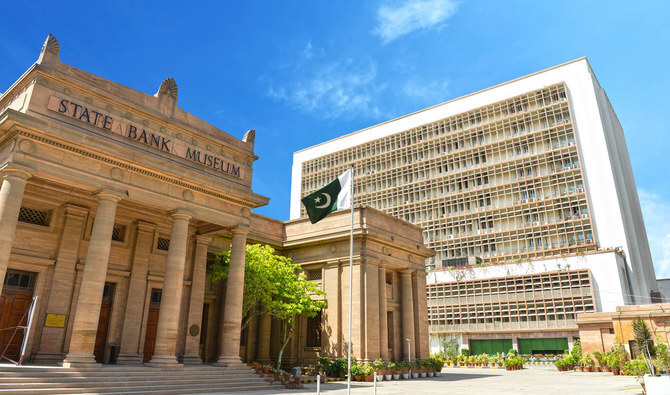
This file photo, posted on August 7, 2023, shows Pakistan’s central bank and State Bank Museum in Karachi. (Photo courtesy: Facebook/SBP)
Short Url
Updated 06 March 2025
Follow

Pakistani experts divided over impact of IMF’s ongoing review on cenbank’s interest rate policy 

  • Pakistani analyst says central bank may maintain policy rate due to IMF’s demand of higher taxes
  • Pakistan’s Monetary Policy Committee (MPC) is set to meet on Mar. 10 to review borrowing rate 

KARACHI: Financial experts on Thursday remained divided over whether the International Monetary Fund’s (IMF) ongoing first review of Pakistan’s $7 billion bailout program will lead to the central bank increasing or decreasing the interest rate next week. 

The central bank’s Monetary Policy Committee (MPC) is set to meet and review the interest rate on Mar. 10. The development takes place as a delegation of the IMF is reviewing Pakistan’s economic performance in Islamabad under its $7 billion Extended Fund Facility program.

The State Bank of Pakistan (SBP) has reduced borrowing rates by a cumulative 1,000 basis points since June 2024 to 12 percent to spur economic growth. Shankar Talreja, director of research at brokerage firm Topline Securities, told Arab News he expected the central bank to maintain the interest rate at 12 percent and not introduce a further cut. 

“We expect the central bank to remain prudent and observe the status quo in upcoming meeting,” Talreja told Arab News. 

Talreja explained that since Pakistan is facing a revenue shortfall and to achieve the desired tax-to-GDP ratio, the IMF can push the government to impose additional tax measures. These in turn can lead to inflation which would cause the SBP to maintain the interest rate at 12 percent rather than slash it further. 

The IMF has expressed concern over Pakistan facing a revenue shortfall of about Rs600 billion in this fiscal year.

The international lender wants cash-strapped Pakistan to increase its revenues by scrapping energy subsidies and imposing taxes on agriculture, real estate and retail sectors.

Talreja said the anticipated tax measures may bring pause to the interest rate easing cycle “for a few months.”

He said certain tax measures were already outlined in the IMF’s detailed report, such as the increase in advance income tax on imports of machinery, withholding tax on supplies and increase in federal excise duty on sugary drinks.

“Any shortfall over and above Rs500 billion will trigger additional tax measures to be taken by the government in its new budget for the financial year 2026,” Talreja explained. 

A majority of market participants said they expected a rate cut ranging from 50 basis points to 150 basis points, a survey conducted by Topline Securities said last week. 

The Federation of Pakistan Chambers of Commerce and Industry (FPCCI), Pakistan’s top trade body, on Wednesday called for a 500-basis-point (bps) cut in the policy rate. The body said businesses remained dissatisfied with monetary policy and demanded a cut due to easing inflation. 

Muhammad Waqas Ghani, head of research at JS Global Capital Ltd., disagreed with Talreja. He said the IMF can set a lower tax target for Pakistan, which would not trigger further inflation. 

“We believe that the IMF review and the miss in tax collection targets will not impact the SBP’s decision,” Ghani told Arab News.

Pakistan’s macroeconomic indicators have gradually improved since it secured the IMF bailout last summer. The country’s consumer price index (CPI) inflation rate, maintaining a downward trend on Monday, hit a more than 9-year low at 1.51 percent year-on-year in February. 

If the IMF approves the first review of the loan, the country is in line to receive about $1 billion as the second installment of the loan package.


US freezes visa processing for 75 countries, media reports Pakistan included

Updated 14 January 2026
Follow

US freezes visa processing for 75 countries, media reports Pakistan included

  • State Department announces indefinite pause on immigrant visas starting Jan 21
  • Move underscores Trump’s hard-line immigration push despite close Pakistan-US ties

ISLAMABAD: The United States will pause immigrant visa processing for applicants from 75 countries starting Jan. 21, the State Department said on Wednesday, with Fox News and other media outlets reporting that Pakistan is among the countries affected by the indefinite suspension.

The move comes as the Trump administration presses ahead with a broad immigration crackdown, with Pakistan included among the affected countries despite strong ongoing diplomatic engagement between Islamabad and Washington on economic cooperation, regional diplomacy and security matters.

Fox News, citing an internal State Department memo, said US embassies had been instructed to refuse immigrant visas under existing law while Washington reassesses screening and vetting procedures. The report said the pause would apply indefinitely and covers countries across Asia, Africa, the Middle East, Europe and Latin America.

“The State Department will pause immigrant visa processing from 75 countries whose migrants take welfare from the American people at unacceptable rates. The freeze will remain active until the US can ensure that new immigrants will not extract wealth from the American people,” the Department of State said in a post on X.

According to Fox News and Pakistan news outlets like Dawn, the list of affected countries includes Pakistan, Afghanistan, Bangladesh, Iran, Iraq, Egypt, Nigeria, Russia, Somalia, Brazil and Thailand, among others. 

“The suspension could delay travel, study, and work plans for thousands of Pakistanis who annually seek US visas. Pakistani consulates in the US are expected to provide guidance to affected applicants in the coming days,” Dawn reported.

A State Department spokesman declined comment when Arab News reached out via email to confirm if Pakistan was on the list. 

The Department has not publicly released the full list of countries or clarified which visa categories would be affected, nor has it provided a timeline for when processing could resume.

Trump has made immigration enforcement a central pillar of his agenda since returning to office last year, reviving and expanding the use of the “public charge” provision of US immigration law to restrict entry by migrants deemed likely to rely on public benefits.

During his previous term as president, Trump imposed sweeping travel restrictions on several Muslim-majority countries, a policy widely referred to as a “Muslim ban,” which was challenged in US courts before a revised version was upheld by the Supreme Court. That policy was later rescinded under the President Joe Biden administration.

The latest visa freeze marks a renewed hardening of US immigration policy, raising uncertainty for migrants from affected countries as Washington reassesses its screening and vetting procedures. 

The freeze on visas comes amid an intensifying crackdown on immigration enforcement by the Trump administration. In Minneapolis last week, a US Immigration and Customs Enforcement (ICE) agent shot and killed 37-year-old Renee Good, a US citizen, during a federal operation, an incident that has drawn nationwide protests and scrutiny of ICE tactics. Family members and local officials have challenged the federal account of the shooting, even as Department of Homeland Security officials defended the agent’s actions. The case has prompted resignations by federal prosecutors and heightened debate over the conduct of immigration enforcement under the current administration.