Grand Mosque authority introduces hair cutting service for exiting ihram

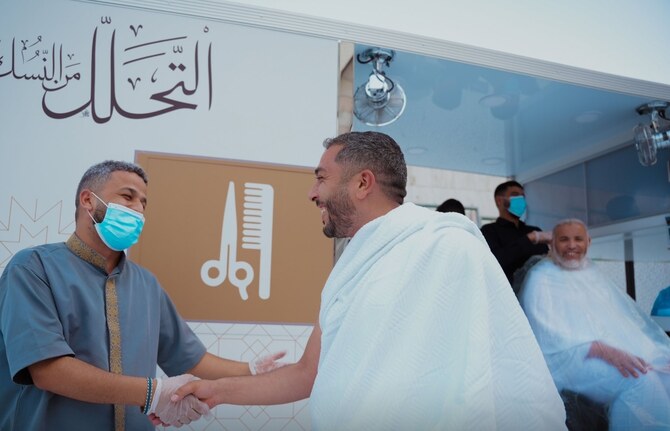
A new service allows pilgrims to exit ihram by shaving their head or cutting their hair at five designated locations around the Grand Mosque. (X.com)
Short Url
Updated 06 March 2025
Follow

Grand Mosque authority introduces hair cutting service for exiting ihram

MAKKAH: The General Authority for the Care of the Grand Mosque and the Prophet's Mosque has launched its first trial operation of the ritual of exiting from the state of Ihram after completion of rituals on the courtyard of the Grand Mosque for the first time during the current holy month of Ramadan. This initiative is part of ongoing efforts to enhance services for pilgrims and improve the Umrah experience.

The new service allows pilgrims to exit from Ihram after completing the rituals through shaving their head or cutting their hair at five designated locations opposite the Marwa area. These stations can be relocated as needed during periods of high congestion. They are staffed by experienced specialists using fully sterilized equipment, ensuring efficient service delivery while maintaining the highest standards of quality and safety.

The authority is working on developing services within the Two Holy Mosques by introducing many new services while maintaining standards of quality and efficiency to provide a distinguished experience for visitors to the Grand Mosque.

Mohammed Asiri, a Hajj and Umrah affairs specialist and religious researcher, explained that exit from Ihram after completing the Umrah rituals is an essential final step in completing Umrah, where pilgrims shave their heads or trim their hair after completing Sa'i between Safa and Marwa.

"This practice follows the Prophetic Sunnah, as Prophet Mohammed instructed his companions to shave or trim their hair after performing Umrah," Asiri noted. He added that men typically prefer complete shaving, while women need only trim a small portion of their hair.

The ritual symbolizes purification and renewal after worship and marks the end of Ihram restrictions that began when pilgrims entered the Miqat.

Fahd Al-Hamidi, who used the service at the Grand Mosque, praised it as "an extension of Saudi Arabia's significant efforts to serve pilgrims from around the world." He explained that the exit from Ihram service is just one of thousands of great services provided by this nation, both people and government, to make the rituals of Umrah performers coupled with ease and simplicity, enriching their experience and providing service to the highest standards.

Al-Hamidi described the exit from Ihram as a joyful moment that brings a sense of relief and spiritual closeness to Allah. He added that this simple procedure carries deep spiritual meanings, symbolizing renewal and purification from sins and beginning a new page full of faith and piety.

"The ritual release is not merely cutting or shaving hair, but a profound spiritual symbol of submission to Allah's commands and the Prophet's Sunnah," Al-Hamidi concluded.

"With these modern solutions like mobile barbershop units, this important final step of Umrah has become more convenient and efficient for pilgrims."


Where to buy the best Ramadan decorations in Saudi Arabia

Updated 6 sec ago
Follow

Where to buy the best Ramadan decorations in Saudi Arabia

RIYADH: As Ramadan approaches, families across Saudi Arabia prepare to welcome the holy month with enthusiasm as they decorate their homes with beautiful lanterns, vibrant table runners and twinkling lights that blend spirituality with hospitality.

In neighborhoods throughout Riyadh, eager shoppers are on the hunt for decorations that knit together tradition and modern style.

One of the standout spots to shop at in East Riyadh is Flaag, which offers a unique collection of Ramadan decorations.

For residents like Fatima Al-Hajj, decorating is a cherished ritual. “Living in East Riyadh, I thoroughly enjoy shopping at Flaag. With its spacious layout and unique items, it’s conveniently close to home.”

Al-Hajj emphasized the emotional aspect of the preparations: “When our homes reflect the spirit of the season, it fosters a sense of connection among family, guests, and even children experiencing it for the first time.”

Retailers are seeing an increase in demand for decorative items during this special month. Shatha Abdulhalim, a shop owner specializing in seasonal decor, said that Ramadan brings a surge in business.

“People are looking to create the right atmosphere,” she explained while gesturing toward shelves filled with brass lanterns, LED crescent lights, and embroidered table runners.

“Some customers favor traditional pieces that stir up nostalgia, while others lean toward contemporary styles that complement modern homes. We do our best to cater to both preferences.”

Shoppers in major Saudi cities are spoiled for choice. Traditional markets attract those seeking handmade goods, while malls and supermarkets provide convenient, ready-made decorations.

In Jeddah, artisan stalls in historic districts remain hotspots for those after distinctive designs.

Layla Bukhari recently acquired hand-painted lanterns and patterned table runners, describing her experience as both culturally enriching and practical. 

“Wandering through these markets immerses you in the spirit of Ramadan even before it begins,” she said, adding that the decorations tell stories of tradition and craftsmanship.

Supermarkets across the Kingdom are also offering seasonal displays, showcasing lanterns, banners, tableware, and lighting.

People observing Ramadan in the Kingdom say that decorating homes carries deeper significance than mere aesthetics.

According to family matriarch Mawia Al-Hazmi, the practice is a way to prepare for a month filled with reflection, generosity, and unity.

“I like to mix it up,” she said. “Some decorations are from local stores, some I order online, you know, some pieces we reuse every year.

“For us, decorating is part of getting into the Ramadan mood. When the house feels ready and prepared, it just feels special.

“Guests feel welcomed, and the kids begin to understand why this month matters.

“It really brings everyone closer, and it builds that sense of excitement and togetherness as a family.”

In the Sharqiyah region, a shop called My Flowers Service provides unique entrance decor for Ramadan, featuring oversized beads, lanterns, and crescents.

They offer rental options, allowing clients to enjoy festive decorations without the hassle of storage year-round.

As homes throughout Saudi Arabia gleam with new lights and thoughtfully arranged decor, these preparations signify the arrival of a month woven with tradition, family bonds, and spiritual reflection.

Amira Amireh on TikTok shared her creative twist on Ramadan decorations: “I take lanterns and make them float in the air, creating a magical atmosphere that my child adores.”

Inspired by Halloween decorations, she repurposed mounting strips to hang mini lanterns easily.

“These battery-operated lanterns from Amazon look stunning in the morning but truly shine at night.

“With clear fishing wire, they become practically invisible, and the flickering light adds a lovely, realistic touch.”

In Saudi Arabia, the preparations for Ramadan represent a rich tapestry of creativity, tradition, and community spirit, imbuing both the process and the aesthetic result with meaning.

There is also a Saudi-based app called Mila that allows clients to order Ramadan decorations for their events with ease, making it a convenient alternative to visiting stores in person, especially for those with busy schedules.

The app offers a variety of categories, including a Ramadan decoration package titled Ramadan Reception Styling.

This option features fully curated reception corners, golden lanterns, elegant floral arrangements and warm ambient lighting, creating a refined and welcoming atmosphere for gatherings throughout the holy month.