

Malala returns to Pakistan hometown 13 years after being shot

This handout picture taken and released by the Malala Fund on March 5, 2025, shows Nobel Peace Prize laureate and education activist Malala Yousafzai posing during a visit to her home village in Shangla. (AFP photo/Malala Fund/Handout)
Short Url
Updated 06 March 2025
Follow

Malala returns to Pakistan hometown 13 years after being shot

  • Yousafzai was a 15-year-old schoolgirl when Pakistan Taliban militants boarded a bus and shot her in the head in Swat Valley 
  • She has made rare visits to the valley since, but it was the first time she returned to her childhood home in Shangla 

PESHAWAR, Pakistan: Nobel Peace Prize laureate and education activist Malala Yousafzai returned to her Pakistan home village on Wednesday, 13 years after surviving an assassination attempt by militants.

Yousafzai was a 15-year-old schoolgirl when Pakistan Taliban militants boarded a bus and shot her in the head in the remote Swat Valley near the Afghanistan border.

She has made rare visits to the valley since, but it was the first time she returned to her childhood home in Shangla since being evacuated to the United Kingdom after the attack.

“As a child, I spent every holiday in Shangla, Pakistan, playing by the river and sharing meals with my extended family,” she said on X.

“It was such a joy for me to return there today — after 13 long years — to be surrounded by the mountains, dip my hands in the cold river and laugh with my beloved cousins. This place is very dear to my heart and I hope to return again and again.”
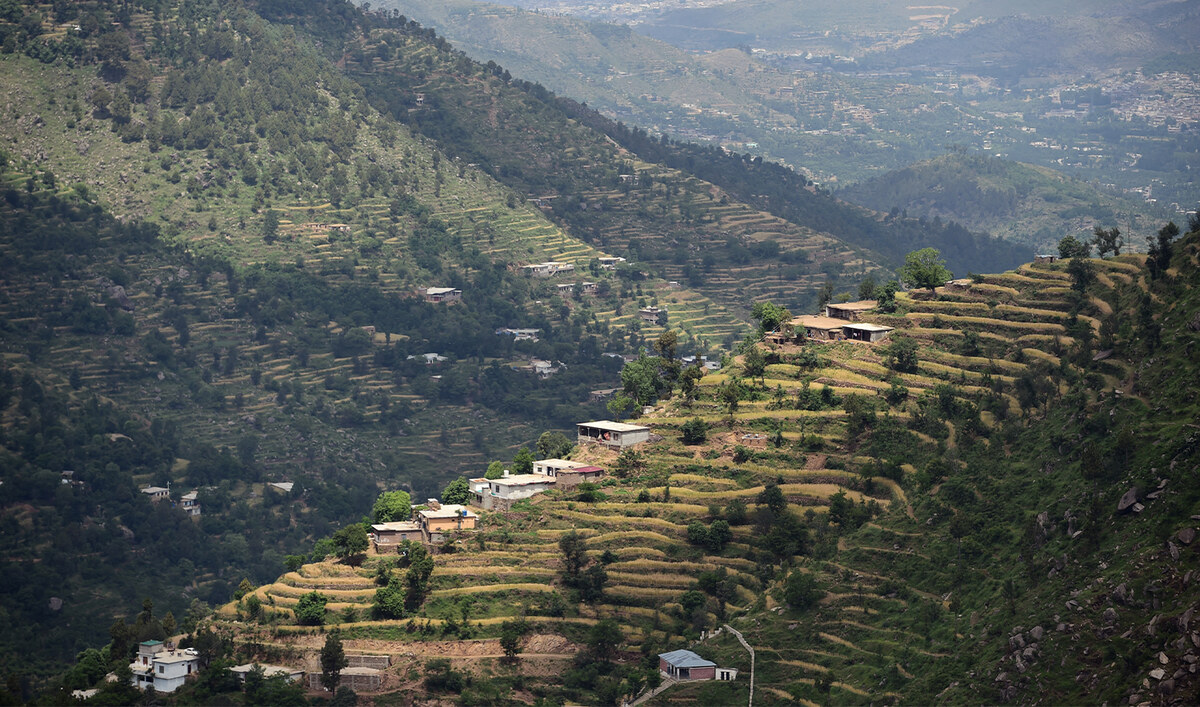


In this picture taken on May 18, 2018, shows houses in a forest area of the Swat valley of Khyber Pakhtunkhwa in northwest Pakistan. (AFP/File)

Yousafzai was accompanied by her father, husband, and brother for the high-security visit by helicopter which lasted just three hours.

Authorities have been cautious in allowing her to return to Shangla district in Khyber Pakhtunkhwa province where militancy has soared following the return of the Afghan Taliban in Kabul in 2021.

The area was sealed off for several hours to provide security for her visit on Wednesday, which included a stop at local education projects backed by her Malala Fund.

“Her visit was kept highly secret to avoid any untoward incidents,” a senior administration official told AFP on condition of anonymity as he was not authorized to speak to the media.

“Even the locals were unaware of her plans to visit.”

The Pakistan Taliban is a separate but closely linked group to the Afghan Taliban and controlled swaths of the border regions at the time Yousafzai was shot.

Militants had ordered girls to stay home, but she continued to secretly go to school and wrote a blog about her experience.

She went on to become an education activist and the world’s youngest Nobel Peace Prize winner at age 17.

In January, she addressed Muslim world leaders at an education conference in Islamabad where she called for action against the Afghan Taliban, who have banned teenage girls from going to school.

Her hometown visit comes in a week marred by violence in Pakistan, with 18 civilians and soldiers killed in an overnight suicide attack on a military compound in the same province.

“I pray for peace in every corner of our beautiful country. The recent attacks, including in Bannu yesterday, are heartbreaking,” Yousafzai said of the attack.


Pakistan secures $1.2 billion as IMF clears reviews, flags gains on stability and reforms

Updated 9 sec ago
Follow

Pakistan secures $1.2 billion as IMF clears reviews, flags gains on stability and reforms

  • IMF praises Pakistan’s policy implementation despite challenging global environment and climate-driven shocks
  • The Executive Board urges faster energy, SOE and governance reforms for macroeconomic and fiscal sustainability

KARACHI: The International Monetary Fund (IMF) approved Pakistan’s second review under its Extended Fund Facility (EFF) and the first review of its Resilience and Sustainability Facility (RSF), said a statement on Tuesday, unlocking about $1.2 billion in new financing while praising the country’s progress in stabilizing the economy despite recent floods.

The decision taken by the IMF Executive Board allows Islamabad to draw $1 billion under the EFF and $200 million under the RSF, bringing total disbursements under both arrangements to about $3.3 billion. The Fund said Pakistan’s policy implementation had improved financing conditions, strengthened reserves and preserved stability even as the country faced a challenging global environment and climate-driven shocks.

Under the 37-month EFF, approved last year in September, the IMF noted strong fiscal performance, including a primary surplus of 1.3 percent of GDP, a rebound in gross reserves to $14.5 billion by end-FY25 from $9.4 billion a year earlier and progress on rebuilding confidence. It noted a surge in inflation due to flood-related food price spikes but said it was expected to ease.

“Pakistan’s reform implementation under the EFF arrangement has helped preserve macroeconomic stability in the face of several recent shocks,” IMF Deputy Managing Director Nigel Clarke said. “Real GDP growth has accelerated, inflation expectations have remained anchored, and fiscal and external imbalances have continued to moderate.”

Clarke said Islamabad’s commitment to meeting its FY26 primary balance target while also addressing urgent post-flood relief signaled strong fiscal intent. He urged continued tax policy simplification and base broadening to build space for climate resilience, social protection and public investment.

The IMF official maintained a tight monetary stance should be continued to keep inflation within the State Bank Pakistan’s target range, while allowing exchange-rate flexibility and deepening the interbank market.

Additionally, he said financial regulation enforcement and capital market development were essential for a resilient financial sector.

The IMF also flagged energy sector reforms as “critical to safeguarding viability,” noting that timely tariff adjustments had helped curb circular debt but that Pakistan must now focus on reducing electricity production and distribution costs and addressing operational inefficiencies in both the power and gas sectors.

The statement also welcomed the publication of Pakistan’s Governance and Corruption Diagnostic report, a detailed IMF-supported assessment that maps out where government systems are vulnerable to inefficiency or misuse and recommends reforms to improve transparency, accountability and service delivery.

Further priorities include the privatization of state-owned enterprises and strengthening economic data quality.
Clarke said reducing Pakistan’s climate vulnerability was vital for long-term stability, referring to the RSF, a financing tool that provides long-term, low-cost loans to help countries address climate risks.

“The RSF arrangement is supporting efforts to strengthen natural disaster response and financing coordination, improve the use of scarce water resources, raise climate considerations in project selection and budgeting, and improve the information on climate-related risks in financing decisions,” he said.

Pakistan faced a prolonged economic crisis in recent years before it began implementing stringent IMF-recommended reforms, which have driven a gradual improvement in macroeconomic indicators over the past two years.

The country also remains one of the world’s most climate-vulnerable nations despite contributing less than one percent of global greenhouse-gas emissions.

It has endured a series of extreme weather events in recent years, most notably the 2022 super-floods that submerged one-third of the country, displaced millions and caused an estimated $30 billion in losses.

This year’s floods killed over 1,000 people and caused at least $2.9 billion in damage to agriculture and infrastructure, underscoring the scale of climate pressures facing the economy.

Economic experts told Arab News a day earlier that the Fund’s disbursements under the two loan programs would support the cash-strapped nation, which has relied heavily on financing from bilateral partners such as Saudi Arabia, China and the United Arab Emirates, as well as multilateral lenders.

“It obviously will help strengthen the external sector, the balance of payments,” said Samiullah Tariq, group head of research at Pakistan Kuwait Investment Company.

Another analyst, Shankar Talreja, head of research at Karachi-based Topline Securities, said the move was likely to send a positive signal to domestic and international investors about the government’s commitment to its reform agenda.

“This will help strengthen reserves and will eventually help a rating upgrade going forward,” he said.