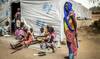
BARDALA, West Bank: Just meters from the last houses in Bardala, a Palestinian village at the northern end of the occupied West Bank, Israel’s army has been bulldozing a dirt road and ditch between the community and open grazing land on the hills behind it.
Israel’s military said the works were for security and to allow it to patrol the area following the killing of an Israeli civilian in August near the village by a man from another town. It did not detail what it was building there.
Farmers from the fertile Jordan Valley village fear the army patrols and Israeli settlers moving in will exclude them from pastures that feed around 10,000 sheep and goats, as has happened in other parts of the West Bank, undercutting their livelihoods and eventually driving them from the village.
Israeli settler outposts have appeared around the village since last year, with clusters of blue and white Israeli flags fluttering from nearby hilltops.
The settlers intimidated semi-nomadic Bedouin shepherds to abandon their camps in the area last year, four Bedouin families and Israeli human rights NGOs said.
The tighter military control in the Jordan Valley and the arrival of settler outposts in the area over the past months are new developments in a part of the West Bank that had mostly avoided the build-up of Israel’s presence on the ground in central areas of the Palestinian territory.
With each advance of Israeli settlements and roads, the territory becomes more fractured, further undermining prospects for a contiguous land on which Palestinians could build a sovereign state. Most countries consider Israel’s settlements in the occupied West Bank to be illegal.
Over recent weeks, caravans and shelters have begun appearing on the scrub-covered hills a few hundred meters west of Bardala, on land behind the new track, Reuters reporters saw. Such temporary shelters have been the first signs of new outposts being built.
Ibrahim Sawafta, a member of the Bardala village council, said two dozen farmers would be prevented from reaching grazing land if soldiers and settler outposts obstruct their free movement. Unable to keep their large flocks in pens within the village itself, they would be forced to sell.
“Bardala would be a small prison,” he said, sitting on a bench outside his house in the village. He said the overall goal was “to restrict people, to force them to leave the Jordan Valley.”
The army said the area behind the dirt road outside Bardala was designated as a live fire zone but included “a passage” manned by Israeli soldiers, suggesting limitations on free movement in the area.
It said the passage would allow for “the continuation of daily life and the fulfillment of residents’ needs,” without giving further details.
The office of Prime Minister Benjamin Netanyahu as well as the Yesha Council and the Jordan Valley Council, that represent settlers in the West Bank did not reply to requests for comment for this story.
Sawafta said gunmen had been known to come into the area from towns to the west and the barrier appeared intended to make access more difficult and force traffic through main roads with security checkpoints under Israeli control.
But he said the effect of the move would be to obstruct access to the land, which in some cases was owned by villagers. The activity around Bardala is part of a wider Israeli effort to reshape the West Bank.
Over the year and a half since war broke out in Gaza, settlement activity has accelerated in areas seen as the core of a future Palestinian state.
Meanwhile, Israel’s pro-settler politicians have been emboldened by the return to the White House of Donald Trump who has already proposed that Palestinians leave Gaza, a suggestion widely condemned across the Middle East and beyond as an attempt to ethnically cleanse Palestinian territories.
In recent weeks, army raids in refugee camps near volatile West Bank cities, including Jenin, Tulkarm and Tubas, near Bardala, have sent tens of thousands of people fleeing their homes, fueling fears of permanent displacement.
The raids come amid a renewed push to formally absorb the West Bank as part of Israel, a proposal supported by some of US President Donald Trump’s aides. Israel’s military has occupied the West Bank since the 1967 Middle East war.
Bardala, with a population of about 3,000, lies a few meters from the pre-1967 line separating the West Bank from Israel. It prospered quietly over the past 30 years as Israel’s settlement movement swallowed up thousands of hectares of land in other parts of the West Bank.