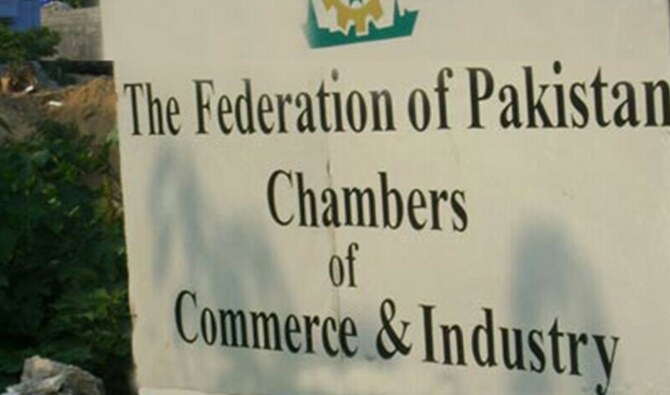
KARACHI: Pakistan’s top trade and industry body on Wednesday called for a 500-basis-point (bps) cut in the policy rate, saying businesses remained dissatisfied with monetary policy and viewed interest rates as excessively high despite inflation hitting a nine-year low.
Earlier this month, the government announced inflation had fallen to 1.5 percent in February, down from 2.4 percent in January. However, the Federation of Pakistan Chambers of Commerce and Industry (FPCCI) noted the policy rate remained at 12 percent following what it called a “grossly-insufficient reduction of merely 100 bps” in the January 27 Monetary Policy Committee (MPC) meeting.
“After deliberations across all industries and sectors, FPCCI demands an immediate and single-stroke rate cut of 500 basis points in the upcoming MPC meeting on March 10, 2025, to rationalize the monetary policy,” FPCCI President Atif Ikram Sheikh said in a statement.
He added the country’s monetary policy should align with the Special Investment Facilitation Council (SIFC) and the government’s broader vision for economic and export-led growth.
Sheikh said industry estimates suggest core inflation will remain between 1-3 percent in the fourth quarter of FY25 (April-June 2025) due to declining prices and easing inflationary pressures.
He argued with international oil prices expected to stay stable, the government had the conditions necessary to announce a substantial rate cut.
FPCCI Senior Vice President Saquib Fayyaz Magoon also urged policymakers to bring interest rates into single digits to allow Pakistani exporters to compete internationally.
He added that a rate cut should be accompanied by the government’s promised rationalization of electricity tariffs for industries to ensure sustainable growth.
Pakistan has historically maintained a tight monetary stance to curb inflation and stabilize the economy, but the latest calls for aggressive easing highlight growing concerns from businesses over stagnating investment and sluggish industrial activity.

Pakistan’s top trade body demands 500 bps interest rate cut as inflation hits nine-year low
https://arab.news/bmr6n
Pakistan’s top trade body demands 500 bps interest rate cut as inflation hits nine-year low
- FPCCI says businesses are dissatisfied with monetary policy since interest rates remain excessively high
- It says monetary policy should be aligned with government’s vision for economic and export-led growth
Pakistan reports current account surplus in Jan. owing to improved trade, remittances
- Pakistan’s exports crossed the $3 billion mark in Jan. as the country received $3.5 billion in remittances
- Last month, IMF urged Pakistan to accelerate pace of structural reforms to strengthen economic growth
ISLAMABAD: Pakistan recorded a current account surplus of more than $120 million in January, the country’s finance adviser said on Tuesday, attributing it to improved trade balance and remittance inflows.
Pakistan’s exports rebounded in January 2026 after five months of weak performance, rising 3.73 percent year on year and surging 34.96 percent month on month, according to data released by the country’s statistics bureau.
Exports crossed the $3 billion mark for the first time in January to reach $3.061 billion, compared to $2.27 billion in Dec. 2025. The country received $3.5 billion in foreign remittances in Jan. 2026.
Khurram Schehzad, an adviser to the finance minister, said Pakistan reported a current account surplus of $121 million in Jan., compared to a current account deficit of $393 million in the same month last year.
“Improved trade balance in January 2026, strong remittance inflows, and sustained momentum in services exports (IT/Tech) continue to reinforce the country’s external account position,” he said on X.
Pakistan has undergone a difficult period of stabilization, marked by inflation, currency depreciation and financing gaps, and international rating agencies have acknowledged improvements after Islamabad began implementing reforms such as privatizing loss-making, state-owned enterprises (SOEs) and ending subsidies as part of a $7 billion International Monetary Fund (IMF) loan program.
Late last month, the IMF urged Pakistan to accelerate the pace of these structural reforms to strengthen economic growth.
Responding to questions from Arab News at a virtual media roundtable on emerging markets’ resilience, IMF’s director of the Middle East and Central Asia Jihad Azour said Islamabad’s implementation of the IMF requirements had been “strong” despite devastating floods that killed more than 1,000 people and devastated farmland, forcing the government to revise its 4.2 percent growth target to 3.9 percent.
“What is important going forward in order to strengthen growth and to maintain the level of macroeconomic stability is to accelerate the structural reforms,” he said at the meeting.
Azour underlined Pakistan’s plans to privatize some of the SOEs and improve financial management of important public entities, particularly power companies, as an important way for the country to boost its capacity to cater to the economy for additional exports.
“This comes in addition to the effort that the authorities have made in order to reform their tariffs, which will allow the private sector of Pakistan to become more competitive,” the IMF official said.


