

Pakistan to denounce proposal to displace Palestinians at OIC FMs session in Jeddah

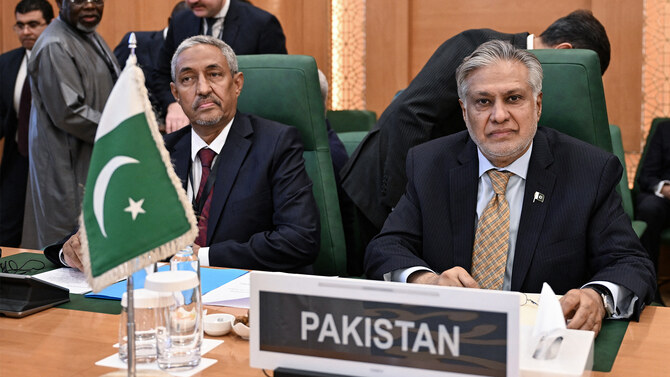
Pakistani Deputy Prime Minister Ishaq Dar (right) attends the Organisation of Islamic Cooperation (OIC) meeting in Jeddah, Saudi Arabia, on August 7, 2024. (AFP/File)
Short Url
Updated 05 March 2025
Follow

Pakistan to denounce proposal to displace Palestinians at OIC FMs session in Jeddah

  • Deputy PM Ishaq Dar will attend meeting of OIC member state foreign ministers on Friday
  • Joint actions in response to the deteriorating conditions in Palestine at center of agenda

ISLAMABAD: Pakistani Deputy Prime Minister Ishaq Dar will participate in a special meeting of foreign ministers of OIC member states set to take place in Jeddah on Friday, Radio Pakistan reported this week, where he will denounce an “unacceptable” proposal to displace Palestinians from Gaza.

US President Donald Trump has angered the Muslim world with a plan to permanently displace the population of more than 2 million Palestinians from Gaza, assert US control over the territory and turn it into an international beach resort. The plan has echoed long-standing Palestinian fears of being permanently driven from their homes.

On Friday, the OIC will hold an Extraordinary Session of the Council of Foreign Ministers to discuss joint actions in response to the “deteriorating conditions” in Palestine due to ongoing Israeli aggression, continued violations of Palestinian rights, and calls for their displacement.

“At the session, Ishaq Dar will reaffirm Pakistan’s steadfast support for the Palestinian cause and emphasize its principled position,” Radio Pakistan reported on Tuesday. “He will advocate for the full withdrawal of Israel from all occupied territories, including Jerusalem, denounce the unacceptable proposal for further displacing Palestinians.”

Dar will also call for the restoration of the “inalienable rights” of the Palestinian people such as their right to return to their homeland and the establishment of a viable, contiguous, and sovereign Palestinian state based on the pre-June 1967 borders, with Al-Quds Al-Sharif as its capital.

This week, Arab leaders adopted an Egyptian reconstruction plan for Gaza that would cost $53 billion and avoid displacing Palestinians from the enclave, in contrast to Trump’s “Middle East Riviera” vision.

Egyptian President Abdel Fattah El-Sisi said on Tuesday Egypt had worked in cooperation with Palestinians on creating an administrative committee of independent, professional Palestinian technocrats entrusted with the governance of Gaza after the end of the Israel-Gaza war. The committee would be responsible for the oversight of humanitarian aid and managing the Strip’s affairs for a temporary period, in preparation for the return of the Palestinian Authority (PA), he said.

The other critical issue is the fate of the Palestinian group Hamas, the PA’s rival, whose October 7, 2023, attack on Israel killed 1,200 people with more than 250 taken as hostages, according to Israeli tallies.

The attack led to the Israel’s military latest assault on Gaza, that has killed more than 48,000 Palestinians, according to the local health ministry. The assault has also displaced nearly Gaza’s entire population and led to accusations of genocide and war crimes that Israel denies.

Hamas, which has run Gaza since 2007, said in a statement it agrees to the Egyptian committee proposal.

Palestinian territory – encompassing the Gaza Strip and West Bank, including East Jerusalem – has been occupied by Israel since 1967. Pakistan does not recognize Israel and has consistently called for an independent state of Palestine based on “internationally agreed parameters” and the pre-1967 borders with Al-Quds Al-Sharif as its capital.


EU, Pakistan sign €60 million loan agreement for clean drinking water in Karachi

Updated 17 December 2025
Follow

EU, Pakistan sign €60 million loan agreement for clean drinking water in Karachi

  • Project will finance rehabilitation, construction of water treatment facilities in Karachi city, says European Investment Bank
  • As per a report in 2023, 90 percent of water samples collected from various places in city was deemed unfit for drinking

ISLAMABAD: The European Investment Bank (EIB) and Pakistan’s government on Wednesday signed a €60 million loan agreement, the first between the two sides in a decade, to support the delivery of clean drinking water in Karachi, the EU said in a statement. 

The Karachi Water Infrastructure Framework, approved in August this year by the EIB, will finance the rehabilitation and construction of water treatment facilities in Pakistan’s most populous city of Karachi to increase safe water supply and improve water security. 

The agreement was signed between the two sides at the sidelines of the 15th Pak-EU Joint Commission in Brussels, state broadcaster Radio Pakistan reported. 

“Today, the @EIB signed its first loan agreement with Pakistan in a decade: a €60 million loan supporting the delivery of clean drinking water for #Karachi,” the EU said on social media platform X. 

Radio Pakistan said the agreement reflects Pakistan’s commitment to modernize essential urban services and promote climate-resilient infrastructure.

“The declaration demonstrates the continued momentum in Pakistan-EU cooperation and highlights shared priorities in sustainable development, public service delivery, and climate and environmental resilience,” it said. 

Karachi has a chronic clean drinking water problem. As per a Karachi Water and Sewerage Corporation (KWSC) study conducted in 2023, 90 percent of water from samples collected from various places in the city was deemed unsafe for drinking purposes, contaminated with E. coli, coliform bacteria, and other harmful pathogens. 

The problem has forced most residents of the city to get their water through drilled motor-operated wells (known as ‘bores’), even as groundwater in the coastal city tends to be salty and unfit for human consumption.

Other options for residents include either buying unfiltered water from private water tanker operators, who fill up at a network of legal and illegal water hydrants across the city, or buying it from reverse osmosis plants that they visit to fill up bottles or have delivered to their homes.

The EU provides Pakistan about €100 million annually in grants for development and cooperation. This includes efforts to achieve green inclusive growth, increase education and employment skills, promote good governance, human rights, rule of law and ensure sustainable management of natural resources.