MANNHEIM, Germany: The suspect in a car-ramming in the German city of Mannheim that killed two people gave no information about his motive Tuesday as he appeared before a judge who ordered him held pending a possible indictment, investigators said.
The 40-year-old German man was arrested shortly after the car-ramming Monday at around noon on a busy pedestrian street in downtown Mannheim in southwestern Germany. Eleven people were injured, five of them seriously, and the latter were still being treated in hospitals on Tuesday.
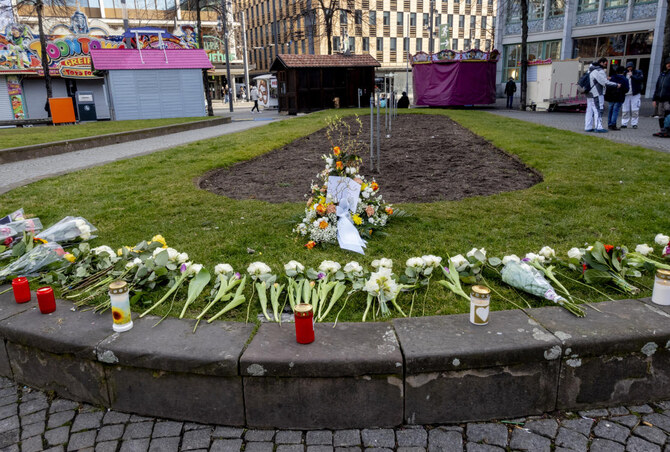
Mourners laid flowers in the city center to honor the victims.
Mannheim prosecutors and state police said a district court in the city ordered the man kept in custody pending possible formal charges on suspicion of two counts of murder, five of attempted murder and 11 of bodily harm.
The investigators said in a statement that the suspect gave no information in his appearance before a judge, “so that his motive for the act is still unclear.” A search of his apartment in nearby Ludwigshafen also turned up no clues as to a motive.
The investigation so far points to mental illness, the statement added. The suspect is believed to have acted alone. Prosecutors and police said that objects the man had in his car and his home — including a blank gun and written documents — were being evaluated.
The suspect tried to kill himself by shooting himself in the mouth before he was arrested, Tuesday’s statement said. He was initially taken to a hospital but subsequently handed over to police.
Officials said on Monday that they had no indication of an extremist or religious motivation.
Prosecutors have said the man, whose identity was not revealed in line with German privacy rules, has previous convictions.
He served a short prison sentence for assault more than 10 years ago and was convicted for drunken driving. He had also been investigated for a hate speech offense on Facebook in 2018, for which he was fined, prosecutors said without giving further details.
Cars have been used as deadly weapons in other acts of violence in recent months in Germany.
Last month, a 2-year-old girl and her mother died two days after they were injured in a car-ramming attack on a union demonstration in Munich. A 24-year-old Afghan man who came to Germany as an asylum-seeker was arrested. Prosecutors said he appeared to have an Islamic extremist motive.
In December, six people were killed and more than 200 injured when a car slammed into a Christmas market in the eastern city of Magdeburg. The suspect is a 50-year-old doctor who had expressed anti-Muslim views and support for the far-right, anti-immigrant Alternative For Germany party.

Suspect in deadly German car-ramming gives no information on motive and is ordered held in custody
Short Url
https://arab.news/mve6j
Suspect in deadly German car-ramming gives no information on motive and is ordered held in custody
- The suspect gave no information in his appearance before a judge, “so that his motive for the act is still unclear”
- A search of his apartment in nearby Ludwigshafen also turned up no clues as to a motive
Trump’s new tariffs shift focus to balance of payments; economists see no crisis
President Donald Trump’s temporary 15 percent tariffs to replace those struck down by the US Supreme Court are meant to resolve a problem that many economists say does not exist: a US balance of payments crisis, making them potentially vulnerable to new legal challenges.
Hours after the high court on Friday struck down a huge swath of tariffs Trump had imposed under the International Emergency Economic Powers Act, the president announced the new duties under Section 122 of the Trade Act of 1974 — a never-used statute that even his own legal team dismissed as irrelevant months ago.
Collections of the new 15 percent tariffs began at midnight on Tuesday as IEEPA tariff collections of 10 percent to 50 percent halted.
The Section 122 law allows the president to impose duties of up to 15 percent for up to 150 days on any and all countries to address “large and serious” balance-of-payments deficits and “fundamental international payments problems.”
Trump’s tariff order argued that a serious balance of payments deficit existed in the form of a $1.2 trillion annual US goods trade deficit and a current account deficit of 4 percent of GDP and a reversal of the US primary income surplus.
Some economists, including former International Monetary Fund First Deputy Managing Director Gita Gopinath, disagreed with the Trump administration’s alarm.
“We can all agree that the US is not facing a balance of payment crisis, which is when countries experience an exorbitant increase in international borrowing costs and lose access to financial markets,” Gopinath told Reuters.
Gopinath rejected the White House’s claim that a negative balance on the US primary income for the first time since 1960 was evidence of a large and serious balance of payment problem.
She attributed the negative balance to a large increase in foreign purchases of US equities and risky assets over the past decade, which outperformed foreign equities over this period.
Mark Sobel, a former US Treasury and IMF official, said that balance of payments crises are more associated with countries that have fixed exchange rates, and noted that the floating-rate dollar has been steady, the 10-year Treasury yield fairly stable, with US stocks performing well.
Josh Lipsky, chair of international economics at the Atlantic Council think tank, agreed, noting that a balance of payments crisis occurred when a country could not pay for what it was importing or was unable to service foreign debt. That was fundamentally different from a trade deficit, he added.
Brad Setser, a currency and trade expert at the Council on Foreign Relations who served as a senior adviser to the US Trade Representative in the Biden administration, took a somewhat contrarian view, arguing in lengthy X posts on Sunday that the Trump administration may have a reasonable case that there is a “large and serious” balance of payments deficit.
He noted that the current account deficit was far higher than when then-president Richard Nixon erected tariffs in 1971 to address a balance of payments crisis, and the US net international investment position is much worse. This “gives the administration a real argument,” in favor of its tariffs, Setser wrote.
The White House, US Treasury and US Trade Representative did not immediately respond to requests for comment about the use of Section 122.
WRONG STATUTE FOR THE JOB
Despite the Trump administration’s new focus on balance of payments, the Justice Department had previously argued that Section 122 was the wrong statute to handle a national emergency over the trade deficit.
In court filings in its defense of IEEPA tariffs, the Justice Department said Section 122 would not have “any obvious application here, where the concerns the president identified in declaring an emergency arise from trade deficits, which are conceptually distinct from balance-of-payments deficits.”
Neal Katyal, who argued at the Supreme Court on behalf of plaintiffs challenging the IEEPA tariffs, told CNBC that the Trump administration’s stance against the use of Section 122 for a trade deficit will make those tariffs vulnerable to litigation.
“I’m not sure it will necessarily even need to get to the Supreme Court, but if the president adheres to this plan of using a statute that his own Justice Department has said he can’t use, yeah, I think that’s a pretty easy thing to litigate,” Katyal said.
It is unclear who might take the lead in challenging the Section 122 tariffs.
Sara Albrecht, chair of the Liberty Justice Center, a nonprofit, public-interest law firm representing several small businesses that challenged the IEEPA tariffs, said the group would closely monitor any new statutes being invoked.
Albrecht did not reveal any future litigation strategy, adding: “Our immediate focus is simple: making sure the refund process begins and that checks start flowing to the American businesses that paid those unconstitutional duties.”
In its ruling, the Supreme Court did not give instructions regarding refunds, instead remanding the case to a lower trade court to determine next steps.
Hours after the high court on Friday struck down a huge swath of tariffs Trump had imposed under the International Emergency Economic Powers Act, the president announced the new duties under Section 122 of the Trade Act of 1974 — a never-used statute that even his own legal team dismissed as irrelevant months ago.
Collections of the new 15 percent tariffs began at midnight on Tuesday as IEEPA tariff collections of 10 percent to 50 percent halted.
The Section 122 law allows the president to impose duties of up to 15 percent for up to 150 days on any and all countries to address “large and serious” balance-of-payments deficits and “fundamental international payments problems.”
Trump’s tariff order argued that a serious balance of payments deficit existed in the form of a $1.2 trillion annual US goods trade deficit and a current account deficit of 4 percent of GDP and a reversal of the US primary income surplus.
Some economists, including former International Monetary Fund First Deputy Managing Director Gita Gopinath, disagreed with the Trump administration’s alarm.
“We can all agree that the US is not facing a balance of payment crisis, which is when countries experience an exorbitant increase in international borrowing costs and lose access to financial markets,” Gopinath told Reuters.
Gopinath rejected the White House’s claim that a negative balance on the US primary income for the first time since 1960 was evidence of a large and serious balance of payment problem.
She attributed the negative balance to a large increase in foreign purchases of US equities and risky assets over the past decade, which outperformed foreign equities over this period.
Mark Sobel, a former US Treasury and IMF official, said that balance of payments crises are more associated with countries that have fixed exchange rates, and noted that the floating-rate dollar has been steady, the 10-year Treasury yield fairly stable, with US stocks performing well.
Josh Lipsky, chair of international economics at the Atlantic Council think tank, agreed, noting that a balance of payments crisis occurred when a country could not pay for what it was importing or was unable to service foreign debt. That was fundamentally different from a trade deficit, he added.
Brad Setser, a currency and trade expert at the Council on Foreign Relations who served as a senior adviser to the US Trade Representative in the Biden administration, took a somewhat contrarian view, arguing in lengthy X posts on Sunday that the Trump administration may have a reasonable case that there is a “large and serious” balance of payments deficit.
He noted that the current account deficit was far higher than when then-president Richard Nixon erected tariffs in 1971 to address a balance of payments crisis, and the US net international investment position is much worse. This “gives the administration a real argument,” in favor of its tariffs, Setser wrote.
The White House, US Treasury and US Trade Representative did not immediately respond to requests for comment about the use of Section 122.
WRONG STATUTE FOR THE JOB
Despite the Trump administration’s new focus on balance of payments, the Justice Department had previously argued that Section 122 was the wrong statute to handle a national emergency over the trade deficit.
In court filings in its defense of IEEPA tariffs, the Justice Department said Section 122 would not have “any obvious application here, where the concerns the president identified in declaring an emergency arise from trade deficits, which are conceptually distinct from balance-of-payments deficits.”
Neal Katyal, who argued at the Supreme Court on behalf of plaintiffs challenging the IEEPA tariffs, told CNBC that the Trump administration’s stance against the use of Section 122 for a trade deficit will make those tariffs vulnerable to litigation.
“I’m not sure it will necessarily even need to get to the Supreme Court, but if the president adheres to this plan of using a statute that his own Justice Department has said he can’t use, yeah, I think that’s a pretty easy thing to litigate,” Katyal said.
It is unclear who might take the lead in challenging the Section 122 tariffs.
Sara Albrecht, chair of the Liberty Justice Center, a nonprofit, public-interest law firm representing several small businesses that challenged the IEEPA tariffs, said the group would closely monitor any new statutes being invoked.
Albrecht did not reveal any future litigation strategy, adding: “Our immediate focus is simple: making sure the refund process begins and that checks start flowing to the American businesses that paid those unconstitutional duties.”
In its ruling, the Supreme Court did not give instructions regarding refunds, instead remanding the case to a lower trade court to determine next steps.
© 2026 SAUDI RESEARCH & PUBLISHING COMPANY, All Rights Reserved And subject to Terms of Use Agreement.


