60% of adults will be overweight or obese by 2050: study

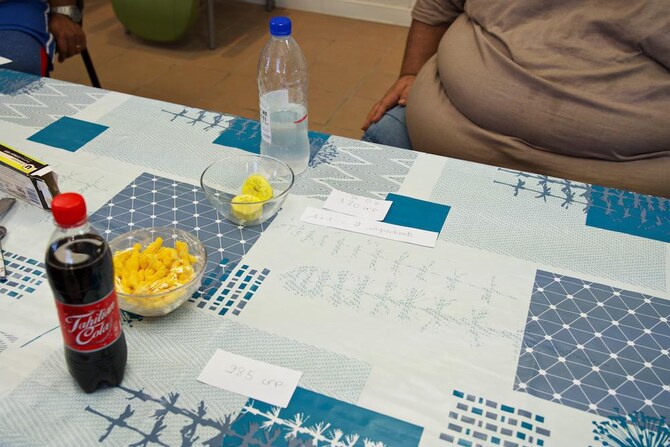
Above, a nutrition workshop in French Polynesia. Without a serious change, the researchers estimate that 3.8 billion adults will be overweight or obese in 15 years – or around 60 percent of the global adult population in 2050. (AFP)
Short Url
Updated 04 March 2025
Follow

60% of adults will be overweight or obese by 2050: study

  • Number of overweight or obese people worldwide rose to 2.6 billion in 2021 from 929 million in 1990
  • More than half the world’s overweight or obese adults already live in just eight countries

PARIS: Nearly 60 percent of all adults and a third of all children in the world will be overweight or obese by 2050 unless governments take action, a large new study said Tuesday.
The research published in the Lancet medical journal used data from 204 countries to paint a grim picture of what it described as one of the great health challenges of the century.
“The unprecedented global epidemic of overweight and obesity is a profound tragedy and a monumental societal failure,” lead author Emmanuela Gakidou, from the US-based Institute for Health Metrics and Evaluation (IHME), said in a statement.
The number of overweight or obese people worldwide rose from 929 million in 1990 to 2.6 billion in 2021, the study found.
Without a serious change, the researchers estimate that 3.8 billion adults will be overweight or obese in 15 years – or around 60 percent of the global adult population in 2050.
The world’s health systems will come under crippling pressure, the researchers warned, with around a quarter of the world’s obese expected to be aged over 65 by that time.
They also predicted a 121-percent increase in obesity among children and adolescents around the world.
A third of all obese young people will be living in two regions – North Africa and the Middle East, and Latin America and the Caribbean – by 2050, the researchers warned.
But it is not too late to act, said study co-author Jessica Kerr from Murdoch Children’s Research Institute in Australia.
“Much stronger political commitment is needed to transform diets within sustainable global food systems,” she said.
That commitment was also needed for strategies “that improve people’s nutrition, physical activity and living environments, whether it’s too much processed food or not enough parks,” Kerr said.
More than half the world’s overweight or obese adults already live in just eight countries – China, India, the United States, Brazil, Russia, Mexico, Indonesia and Egypt, the study said.
While poor diet and sedentary lifestyles are clearly drivers of the obesity epidemic, “there remains doubt” about the underlying causes for this, said Thorkild Sorensen, a researcher at the University of Copenhagen not involved in the study.
For example, socially deprived groups have a “consistent and unexplained tendency” toward obesity, he said in a linked comment in The Lancet.
The research is based on figures from the Global Burden of Disease study from the IHME, which brings together thousands of researchers across the world and is funded by the Bill and Melinda Gates Foundation.


Burkinabe teen behind viral French ‘coup’ video has no regrets

Updated 20 December 2025
Follow

Burkinabe teen behind viral French ‘coup’ video has no regrets

  • “Coup d’etat in France,” declared the video, posted by the 17-year-old, showing what appeared to be journalists reporting on an ongoing takeover by an unidentified colonel
  • Posted on December 9 on TikTok, then shortly afterwards on Facebook, the post went viral, garnering more than 12 million views and tens of thousands of “likes”

PARIS: A Burkinabe teenager who used artificial intelligence to post fake news of a French coup on Facebook got more than he bargained for.
As well as millions of views and tens of thousands of “likes,” he also acquired a certain notoriety — and French President Emmanuel Macron, for one, was not amused.
And what he had planned as a money-making scheme only netted him seven euros, he said. But he has no regrets.
“Coup d’etat in France,” declared the video, posted by the 17-year-old, showing what appeared to be journalists reporting on an ongoing takeover by an unidentified colonel.
In one shot, the Eiffel Tower and the blue lights from a police car flashed in the background.
“Demonstrators have gathered to support the colonel who seems to have taken power yesterday,” said the reporters.
It was all fake, of course: the product of his online training in the use of artificial intelligence.
Posted on December 9 on TikTok, then shortly afterwards on Facebook, the post went viral, garnering more than 12 million views and tens of thousands of “likes.”
Last Tuesday, when Macron was asked about the video during a visit to Marseille, he spoke of his frustration at not having been able to force Facebook to take it down.
They had told him that it did not violate their rules, he said.

Money-making goal

In the end, it was the creator himself who deleted it, shortly after the French news media started contacting him.
Speaking to AFP, he explained that he had got into creating AI-generated videos last year after finding a training course on YouTube. But he only really started producing in October 2025.
He was taken aback by his sudden celebrity and that the French media was reporting on and even interviewing him.
He laughed about all the fuss in a video posted to his Facebook page.
But the teenager, who preferred to remain anonymous, was clear that his real aim had been to make money from advertising attached to his posts.
Not that he was living in poverty, he added.
“I eat, I can get to school, my parents take good care of me, thank God,” he told AFP.
But he wanted more to gain “financial independence,” he added.
He had seen “loads of pages that get millions of views” and had heard that TikTok paid money to producers, so he jumped into social media to see what he could do.
After a bit of trial and error, he latched on to AI-generated fake news because it generated more online traffic.
“I haven’t yet made a lot of money that way,” he admitted.
His Facebook page was not yet monetised, though he had made a little money from TikTok.
Normally, Africa is not a region that is eligible for monetization on the platform but he said he had found a way around that.
While his viral video on the fake coup in France may not have been a moneyspinner, he has used it to promote an offer of online training in AI-generated content on Facebook.
“There are people who have got in touch with me after this video, at least five people since last week,” he said.
For one hour’s coaching, he makes 7,000 CFA francs (10 euros).

No regrets 

France is frequently the target of disinformation, in particular from the Alliance of Sahel States (AES) — Mali, Niger and Burkina Faso.
Since a string of military coups there, all three countries have distanced themselves from France, the former colonial power, and moved instead toward Russia.
The Burkinabe junta in particular has become adept at AI-generated propaganda videos. They have included false clips of celebrities such as singer Beyonce or Pope Leo XIV singing the praises of Ibrahim Traore, the military government’s leader.
Burkina Faso also has a group of influential cyberactivists who promote the government’s propaganda online, known as the “Rapid-Intervention Communication Battalion.”
The teenager behind the fake French coup video told AFP he was not part of that group.
But while his main motivation was far from being political, he was happy to take a passing shot at France.
“I also created this video to scare people,” he said.
Some French media personalities and politicians do not present a fair view of what is going on in Africa’s Sahel region, instead broadcasting “fake news,” he said.
He cited recent reports that the Malian capital, Bamako, was on the point of falling to jihadist forces.
Informed sources agree that if the military government there was in difficulty recently from a jihadist blockage of supply routes, it has not so far been threatened to the point of losing power.
The French authorities “have no regrets about publishing false statements on the AES,” said the teenager.
“So I’m not going to regret publishing false things about them!“