ISLAMABAD: Pakistan and Uzbekistan have set a bilateral trade target of $1 billion, Pakistani state media reported on Sunday, citing the Uzbek envoy to Islamabad.
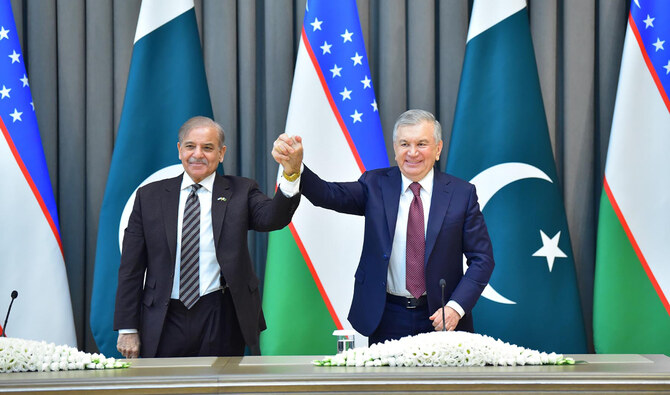
The development came nearly a week after Prime Minister Shehbaz Sharif’s visit to Uzbekistan as part of Pakistan’s economic diplomacy push to enhance trade and investment with landlocked Central Asian states.
Pakistan is seeking to leverage its strategic position as a key trade and transit hub to connect Central Asia with global markets and since last year, there has been a flurry of high-level visits, investment discussions and other economic engagements between Islamabad and Central Asian republics.
Both countries have lately been working toward optimizing cargo flows, establishing green corridors at border customs points, and digitalization of customs clearance processes to facilitate smoother trade operations.
“Pakistan and Uzbekistan are committed to achieve the target of bilateral trade volume worth one billion dollar,” Uzbek Ambassador to Pakistan Alisher Tukhtaev was quoted as saying by the Radio Pakistan broadcaster.
“Specific measures were being taken to expand the export and import structure of food, textile, and electrical products.”
The development comes as Pakistan treads a long path to economic recovery under a $7 billion International Monetary Fund (IMF) program Islamabad secured in Sept. last year.
Uzbekistan is the largest consumer market and the second-biggest economy in Central Asia. It is central to Pakistan’s regional connectivity plans and was the first Central Asian nation with which Pakistani officials signed a bilateral Transit Trade Agreement (UPTTA) and a Preferential Trade Agreement (PTA) covering 17 items.
Ambassador Tukhtaev said both countries were developing and diversifying cargo transportation routes for fast and convenient movement of goods, in cooperation with large transport and logistics companies, according to the report.
“Uzbekistan is interested in increasing the volume of agricultural exports to Pakistan, especially in the supply of fruits and vegetables, grain products, and textile products,” he said.
“At the same time, Pakistan’s potential in the pharmaceutical, textile, construction materials and information technology sectors is also of great importance for the Uzbek market.”
Pakistan and Uzbekistan have forged strong economic ties in recent years and a landmark moment in their relationship was the signing of the Joint Declaration on the Establishment of a Strategic Partnership during the visit of a high-level Pakistani delegation to Uzbekistan on July 15-16, 2021. This was followed by President Shavkat Mirziyoyev’s visit to Pakistan on March 3-4, 2022, which resulted in the signing of another Joint Declaration on Further Steps to Enhance the Strategic Partnership and multiple agreements covering trade, investment, and economic cooperation.
In February 2023, Pakistan and Uzbekistan signed a $1 billion trade deal to enhance bilateral commerce, facilitating the exchange of goods and services.
Last month, Ambassador Tukhtaev also announced plans to launch direct flights between Uzbekistan and Pakistan’s southern port city of Karachi.


![]()

Pakistan, Uzbekistan set $1 billion bilateral trade target, Uzbek envoy says
Short Url
https://arab.news/wmfqj
Pakistan, Uzbekistan set $1 billion bilateral trade target, Uzbek envoy says
- Uzbekistan is interested in increasing the volume of agricultural exports, including fruit, vegetables and grain products, to Pakistan
- Pakistan’s potential in pharmaceutical, textile, construction materials and IT sectors is also of great value to Uzbek market, envoy says
Latest updates


Recommended


© 2026 SAUDI RESEARCH & PUBLISHING COMPANY, All Rights Reserved And subject to Terms of Use Agreement.