

Pakistan saw 175 percent rise in civilian deaths from militant attacks in February— report

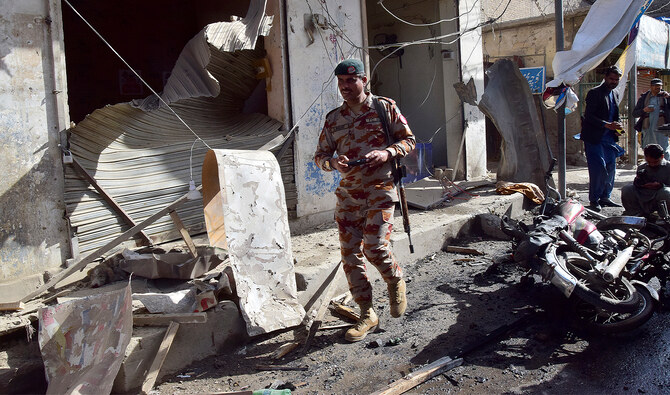
A security official checks the site of a bomb blast in Quetta, Pakistan, on Feb. 28, 2025. (AP)
Short Url
Updated 02 March 2025
Follow

Pakistan saw 175 percent rise in civilian deaths from militant attacks in February— report

  • Pakistan suffered 79 militant attacks in February, with Balochistan reporting 32 attacks and 56 casualties
  • Militant fatalities dropped by 25 percent in February, with 208 killed in January compared to 156 in February

KARACHI: Pakistan saw a 175 percent increase in civilian casualties from militant attacks in February compared to January, an Islamabad-based think tank said on Sunday, with the country’s southwestern Balochistan province suffering the most number of attacks last month. 

According to a report by Islamabad-based think tank Pakistan Institute for Conflict and Security Studies (PICSS), the country witnessed 79 militant attacks in February. This resulted in the deaths of 55 civilians and 47 security personnel, while 81 security forces personnel and 45 civilians sustained injuries. 

The report also said that security forces intensified their counter-militancy operations last month, eliminating 156 militants, injuring 20, and arresting 66.

“February 2025 marked the first month since August 2024 in which civilian fatalities surpassed those of security forces,” the report said. “Civilian deaths rose by 175 percent compared to January 2025, when 20 civilians were killed, while security forces’ casualties declined by 18 percent, down from 57 in January.”

The report said militant fatalities also dropped by 25 percent in February, with 208 killed in January compared to 156 in February. It said Balochistan remained the most volatile province, recording 32 militant attacks that claimed 56 lives, including 35 civilians, 10 security personnel and 11 militants. The attacks also left 44 people injured, including 32 security forces personnel and 12 civilians.

“In erstwhile FATA [Federally Administered Tribal Areas], 21 militant attacks were reported, leading to the deaths of 22 security personnel and eight civilians,” the think tank said. 

It added that 26 security forces personnel and 11 civilians were injured while security forces killed at least 98 militants, injured 15, and arrested 50 suspected militants in FATA. 

Meanwhile, mainland Khyber Pakhtunkhwa recorded 23 militant attacks, resulting in 14 security forces personnel and 12 civilian deaths in February. Twenty-two civilians and an equal number of security personnel were injured during the month while security forces killed 47 militants in KP during February, the report added. 

Sindh witnessed three minor militant attacks, resulting in the death of one security official and injury to another.

“No militant attack was reported in Punjab, but security forces arrested 16 suspected militants from various locations,” the report said. “No incidents of militant violence were reported from Gilgit-Baltistan, Azad Kashmir, or Islamabad.” 

Pakistan has suffered a rise in militant attacks in its western provinces bordering Afghanistan, KP and Balochistan, since a fragile truce with the Pakistani Taliban and the state fell apart. 

In its bid to impose its strict brand of Islam across the country, the TTP has carried out suicide attacks against Pakistani security agencies and killed civilians as well. 

In the southwestern Balochistan province, separatist ethnic Baloch militants have waged an insurgency for decades against the state whom it accuses of exploiting the mineral-and-gas rich province while depriving its locals of a share in the resources. Pakistan’s state rejects these allegations. 


Pakistan FM discusses developments in Asia, Middle East with Bangladeshi, Malaysian counterparts

Updated 6 sec ago
Follow

Pakistan FM discusses developments in Asia, Middle East with Bangladeshi, Malaysian counterparts

  • Ishaq Dar speaks to foreign ministers of both countries amid tensions in Yemen, strained ties between Delhi, Dhaka
  • Dar reaffirms commitment to enhance cooperation with Bangladesh, Malaysia in telephone call with both counterparts 

ISLAMABAD: Pakistan’s Foreign Minister Ishaq Dar discussed evolving developments in the Asia and Middle East regions with his counterparts from Bangladesh and Malaysia, the foreign office said on Sunday, reaffirming Islamabad’s resolve to enhance cooperation with both states. 

Tensions escalated in Yemen this week after a Saudi-led coalition carried out a “limited” airstrike targeting weapons shipments from the UAE to the port city of Mukalla in southern Yemen. 

The coalition forces spokesperson said the weapons were meant to support the Southern Transitional Council (STC) forces, backed by the UAE, in Yemen’s Hadramaut and Al-Mahra “with the aim of fueling the conflict.”

Pakistan has expressed solidarity with Saudi Arabia and called on regional powers to resolve tensions with dialogue and diplomacy. 

“DPM/FM Senator Mohammad Ishaq Dar held a telephone conversation with FM of Malaysia, Mohamad bin Hajji Hasan,” Pakistan’s foreign office said in a statement. 

“They also exchanged views on recent regional developments, including the evolving situation in Asia and the Middle East.”

In a separate statement, the foreign office said Dar held a telephonic conversation with Bangladesh’s Foreign Adviser Touhid Hossain. 

The two leaders also discussed developments in the Middle East and Asia, agreeing to remain in close contact. 

“The two leaders reviewed Pakistan–Bangladesh relations and reaffirmed their commitment to enhancing cooperation across various sectors,” the statement said. 

The developments also take place in light of Bangladesh’s rising political tensions with Pakistan’s arch-rival India. 

Tensions between the two countries have surged in recent weeks after a 25-year-old Hindu man was lynched and burned publicly in Bangladesh following allegations of blasphemy. India’s foreign ministry last month condemned what it called “unremitting hostility against minorities” in Bangladesh.

A few days later, Hindutva activists tried to storm the Bangladesh High Commission in New Delhi, rallying against the neighboring nation for what they said was Dhaka’s failure to protect its Hindu minorities.

Ties between Dhaka and New Delhi have remained strained ever since the ouster of former Bangladeshi PM Sheikh Hasina in 2024, when she fled to India after her ouster in violent protests in the country. 

India has so far not accepted Bangladesh’s request to extradite Hasina, further stoking tensions between the countries.