

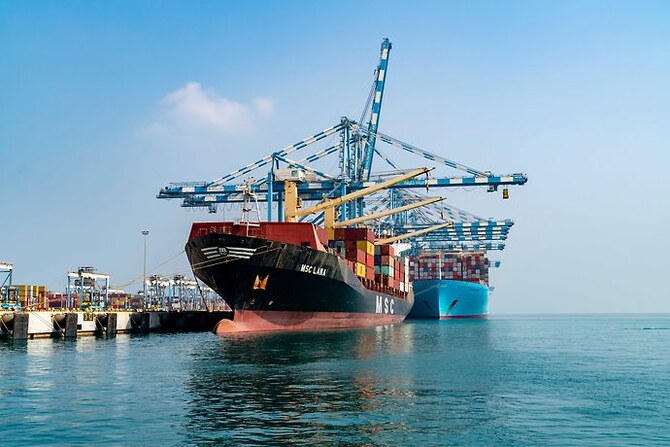
Abu Dhabi Customs sees record 72% pre-arrival clearance rate in 2024

The figure represents a sharp rise from 47 percent in 2023, reflecting a 53 percent annual growth rate, according to the UAE’s state news agency WAM. File
Short Url
Updated 02 March 2025
Follow

Abu Dhabi Customs sees record 72% pre-arrival clearance rate in 2024

RIYADH: Abu Dhabi Customs recorded a 72 percent pre-arrival clearance rate in 2024, marking a significant increase as the emirate accelerates digital transformation and streamlines trade operations. 

The figure represents a sharp rise from 47 percent in 2023, reflecting a 53 percent annual growth rate, according to the UAE’s state news agency WAM.

The surge underscores efforts to enhance digital customs processes, integrate advanced technologies, and optimize clearance systems. 

Pre-arrival clearance for outbound shipments accounted for 85 percent of total exit declarations in 2024, up from 67 percent a year earlier, while inbound shipments made up 60 percent of entry declarations, compared with 31 percent in 2023. Abu Dhabi Customs has also automated the issuance of entry and exit customs certificates to expedite processing. 

Pre-arrival customs clearance, available through smart platforms like the Abu Dhabi Government Services Platform, or TAMM, and the Advanced Trade and Logistics Platform, or ATLP, enables importers, exporters, and their representatives to complete customs procedures before goods reach customs centers. This process includes submitting declarations, paying duties, meeting regulatory requirements, if applicable, and finalizing procedures in advance, streamlining operations and improving efficiency. 

Freight clearance and shipping companies have benefited from electronic integration with regulatory entities and service-level agreements with key stakeholders, reducing transaction times.  

In August, Abu Dhabi Customs reported that the average time for customs clearance transactions in the first half of 2024 was 13.86 minutes, down from 15.47 minutes in the same period of 2023. 

In December, the General Administration of Abu Dhabi Customs launched its 2024–2028 Strategic Plan, focused on facilitating secure and legitimate trade through advanced innovations and digital technologies. 

The plan is built on six pillars, including enhancing customer experience to position Abu Dhabi as a preferred trade hub, increasing revenue collection, and driving economic growth and competitiveness.  

It also emphasizes fostering a culture of excellence through innovation and sustainability, developing professional talent for the future of customs, and leveraging technology to achieve digital leadership. 

In November, Abu Dhabi Customs signed an agreement with Brazil’s Tax Authority to launch the pilot phase of the Trusted Digital Trade Corridor project. 

The initiative aims to enhance trade, simplify customs procedures, reduce transaction times, strengthen data security, and improve cross-border trade efficiency through advanced technology and digital transformation. 


European gas prices soar almost 50% as Iran conflict halts Qatar LNG output

Updated 02 March 2026
Follow

European gas prices soar almost 50% as Iran conflict halts Qatar LNG output

  • Analysts warn prolonged disruption could push prices higher
  • Some shipments of oil, LNG through Strait of Hormuz suspended
  • Benchmark Asian LNG price up almost 39 percent

LONDON: ​Benchmark Dutch and British wholesale gas prices soared by almost 50 percent on Monday, after major liquefied natural gas exporter Qatar Energy said it had halted production due to attacks in the Middle East.

Qatar, soon to cement its role as the world’s second largest LNG exporter after the US, plays a major role in balancing both Asian and European markets’ demand of LNG.

Most tanker owners, oil majors and ‌trading houses ‌have suspended crude oil, fuel and liquefied natural ​gas shipments ‌via ⁠the ​Strait of ⁠Hormuz, trade sources said, after Tehran warned ships against moving through the waterway.

Europe has increased imports of LNG over the past few years as it seeks to phase out Russian gas following Russia’s invasion of Ukraine.

Around 20 percent of the world’s LNG transits through the Strait of Hormuz and a prolonged suspension or full closure would increase global competition for other ⁠sources of the gas, driving up prices internationally.

“Disruptions to ‌LNG flows would reignite competition between ‌Asia and Europe for available cargoes,” said ​Massimo Di Odoardo, vice president, gas ‌and LNG research at Wood Mackenzie.

The Dutch front-month contract at the ‌TTF hub, seen as a benchmark price for Europe, was up €14.56 at €46.52 per megawatt hour, or around $15.92/mmBtu, by 12:55 p.m. GMT, ICE data showed.

Prices were already some 25 percent higher earlier in the day but extended gains ‌after QatarEnergy’s production halt.

Benchmark Asian LNG prices jumped almost 39 percent on Monday morning with the S&P Global ⁠Energy Japan-Korea-Marker, widely used ⁠as an Asian LNG benchmark, at $15.068 per million British thermal units, Platts data showed.

“If LNG/gas markets start to price in an extended period of losses to Qatari LNG supply, TTF could potentially spike to 80-100 euros/MWh ($28-35/mmBtu),” Warren Patterson, head of commodities strategy at ING, said. The British April contract was up 40.83 pence at 119.40 pence per therm, ICE data showed.

Europe is also relying on LNG imports to help fill its gas storage sites which have been depleted over the winter and are currently around 30 percent full, the latest data from Gas Infrastructure ​Europe showed. In the European carbon ​market, the benchmark contract was down €1.10 at €69.17 a tonne