CAPE CANAVERAL: A private lunar lander carrying a drill, vacuum and other experiments for NASA touched down on the moon Sunday, the latest in a string of companies looking to kickstart business on Earth’s celestial neighbor ahead of astronaut missions.
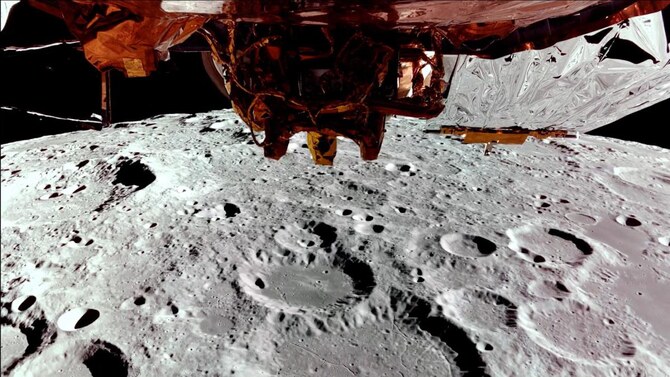
Firefly Aerospace’s Blue Ghost lander descended from lunar orbit on autopilot, aiming for the slopes of an ancient volcanic dome in an impact basin on the moon’s northeastern edge of the near side.
Confirmation of touchdown came from the company’s Mission Control outside Austin, Texas, following the action some 225,000 miles (360,000 kilometers) away.
“We’re on the moon,” Mission Control reported, adding the lander was “stable.”
A smooth, upright landing makes Firefly — a startup founded a decade ago — the first private outfit to put a spacecraft on the moon without crashing or falling over. Even countries have faltered, with only five claiming success: Russia, the US, China, India and Japan.
Two other companies’ landers are hot on Blue Ghost’s heels, with the next one expected to join it on the moon later this week.
Launched in mid-January from Florida, the 6-foot-6 (2 meters) tall lander carried 10 experiments to the moon for NASA. The space agency paid $101 million for the delivery, plus $44 million for the science and tech on board. It’s the third mission under NASA’s commercial lunar delivery program, intended to ignite a lunar economy of competing private businesses while scouting around before astronauts show up later this decade.
The demos should get two weeks of run time, before lunar daytime ends and the lander shuts down.
It carried a vacuum to suck up moon dirt for analysis and a drill to measure temperature as deep as 10 feet (3 meters) below the surface. Also on board: a device for eliminating abrasive lunar dust — a scourge for NASA’s long-ago Apollo moonwalkers, who got it caked all over their spacesuits and equipment.
On its way to the moon, Blue Ghost beamed back exquisite pictures of the home planet. The lander continued to stun once in orbit around the moon, with detailed shots of the moon’s gray pockmarked surface. At the same time, an on-board receiver tracked and acquired signals from the US GPS and European Galileo constellations, an encouraging step forward in navigation for future explorers.
The landing set the stage for a fresh crush of visitors angling for a piece of lunar business.
Another lander — a tall and skinny 15-footer (4 meters tall) built and operated by Houston-based Intuitive Machines — is due to land on the moon Thursday. It’s aiming for the bottom of the moon, just 100 miles (160 kilometers) from the south pole. That’s closer to the pole than the company got last year with its first lander, which broke a leg and tipped over.
Despite the tumble, Intuitive Machines’ lander put the US back on the moon for the first time since NASA astronauts closed out the Apollo program in 1972.
A third lander from the Japanese company ispace is still three months from landing. It shared a rocket ride with Blue Ghost from Cape Canaveral on Jan. 15, taking a longer, windier route. Like Intuitive Machines, ispace is also attempting to land on the moon for the second time. Its first lander crashed in 2023.
The moon is littered with wreckage not only from ispace, but dozens of other failed attempts over the decades.
NASA wants to keep up a pace of two private lunar landers a year, realizing some missions will fail, said the space agency’s top science officer Nicky Fox.
Unlike NASA’s successful Apollo moon landings that had billions of dollars behind them and ace astronauts at the helm, private companies operate on a limited budget with robotic craft that must land on their own, said Firefly CEO Jason Kim.
“Every time we go up, we’re learning from each other,” Kim said.

Private lunar lander Blue Ghost touches down on the moon with a special delivery for NASA
https://arab.news/yavb3
Private lunar lander Blue Ghost touches down on the moon with a special delivery for NASA
- A private lunar lander has touched down on the moon, delivering a drill and other experiments for NASA
- The flurry comes as NASA strives to ignite a lunar economy and send astronauts back
Burkinabe teen behind viral French ‘coup’ video has no regrets
- “Coup d’etat in France,” declared the video, posted by the 17-year-old, showing what appeared to be journalists reporting on an ongoing takeover by an unidentified colonel
- Posted on December 9 on TikTok, then shortly afterwards on Facebook, the post went viral, garnering more than 12 million views and tens of thousands of “likes”
PARIS: A Burkinabe teenager who used artificial intelligence to post fake news of a French coup on Facebook got more than he bargained for.
As well as millions of views and tens of thousands of “likes,” he also acquired a certain notoriety — and French President Emmanuel Macron, for one, was not amused.
And what he had planned as a money-making scheme only netted him seven euros, he said. But he has no regrets.
“Coup d’etat in France,” declared the video, posted by the 17-year-old, showing what appeared to be journalists reporting on an ongoing takeover by an unidentified colonel.
In one shot, the Eiffel Tower and the blue lights from a police car flashed in the background.
“Demonstrators have gathered to support the colonel who seems to have taken power yesterday,” said the reporters.
It was all fake, of course: the product of his online training in the use of artificial intelligence.
Posted on December 9 on TikTok, then shortly afterwards on Facebook, the post went viral, garnering more than 12 million views and tens of thousands of “likes.”
Last Tuesday, when Macron was asked about the video during a visit to Marseille, he spoke of his frustration at not having been able to force Facebook to take it down.
They had told him that it did not violate their rules, he said.
Money-making goal
In the end, it was the creator himself who deleted it, shortly after the French news media started contacting him.
Speaking to AFP, he explained that he had got into creating AI-generated videos last year after finding a training course on YouTube. But he only really started producing in October 2025.
He was taken aback by his sudden celebrity and that the French media was reporting on and even interviewing him.
He laughed about all the fuss in a video posted to his Facebook page.
But the teenager, who preferred to remain anonymous, was clear that his real aim had been to make money from advertising attached to his posts.
Not that he was living in poverty, he added.
“I eat, I can get to school, my parents take good care of me, thank God,” he told AFP.
But he wanted more to gain “financial independence,” he added.
He had seen “loads of pages that get millions of views” and had heard that TikTok paid money to producers, so he jumped into social media to see what he could do.
After a bit of trial and error, he latched on to AI-generated fake news because it generated more online traffic.
“I haven’t yet made a lot of money that way,” he admitted.
His Facebook page was not yet monetised, though he had made a little money from TikTok.
Normally, Africa is not a region that is eligible for monetization on the platform but he said he had found a way around that.
While his viral video on the fake coup in France may not have been a moneyspinner, he has used it to promote an offer of online training in AI-generated content on Facebook.
“There are people who have got in touch with me after this video, at least five people since last week,” he said.
For one hour’s coaching, he makes 7,000 CFA francs (10 euros).
No regrets
France is frequently the target of disinformation, in particular from the Alliance of Sahel States (AES) — Mali, Niger and Burkina Faso.
Since a string of military coups there, all three countries have distanced themselves from France, the former colonial power, and moved instead toward Russia.
The Burkinabe junta in particular has become adept at AI-generated propaganda videos. They have included false clips of celebrities such as singer Beyonce or Pope Leo XIV singing the praises of Ibrahim Traore, the military government’s leader.
Burkina Faso also has a group of influential cyberactivists who promote the government’s propaganda online, known as the “Rapid-Intervention Communication Battalion.”
The teenager behind the fake French coup video told AFP he was not part of that group.
But while his main motivation was far from being political, he was happy to take a passing shot at France.
“I also created this video to scare people,” he said.
Some French media personalities and politicians do not present a fair view of what is going on in Africa’s Sahel region, instead broadcasting “fake news,” he said.
He cited recent reports that the Malian capital, Bamako, was on the point of falling to jihadist forces.
Informed sources agree that if the military government there was in difficulty recently from a jihadist blockage of supply routes, it has not so far been threatened to the point of losing power.
The French authorities “have no regrets about publishing false statements on the AES,” said the teenager.
“So I’m not going to regret publishing false things about them!“


