CAPE CANAVERAL: A private lunar lander carrying a drill, vacuum and other experiments for NASA touched down on the moon Sunday, the latest in a string of companies looking to kickstart business on Earth’s celestial neighbor ahead of astronaut missions.
Firefly Aerospace’s Blue Ghost lander descended from lunar orbit on autopilot, aiming for the slopes of an ancient volcanic dome in an impact basin on the moon’s northeastern edge of the near side.
Confirmation of touchdown came from the company’s Mission Control outside Austin, Texas, following the action some 225,000 miles (360,000 kilometers) away.
“We’re on the moon,” Mission Control reported, adding the lander was “stable.”
A smooth, upright landing makes Firefly — a startup founded a decade ago — the first private outfit to put a spacecraft on the moon without crashing or falling over. Even countries have faltered, with only five claiming success: Russia, the US, China, India and Japan.
Two other companies’ landers are hot on Blue Ghost’s heels, with the next one expected to join it on the moon later this week.
Launched in mid-January from Florida, the 6-foot-6 (2 meters) tall lander carried 10 experiments to the moon for NASA. The space agency paid $101 million for the delivery, plus $44 million for the science and tech on board. It’s the third mission under NASA’s commercial lunar delivery program, intended to ignite a lunar economy of competing private businesses while scouting around before astronauts show up later this decade.
The demos should get two weeks of run time, before lunar daytime ends and the lander shuts down.
It carried a vacuum to suck up moon dirt for analysis and a drill to measure temperature as deep as 10 feet (3 meters) below the surface. Also on board: a device for eliminating abrasive lunar dust — a scourge for NASA’s long-ago Apollo moonwalkers, who got it caked all over their spacesuits and equipment.
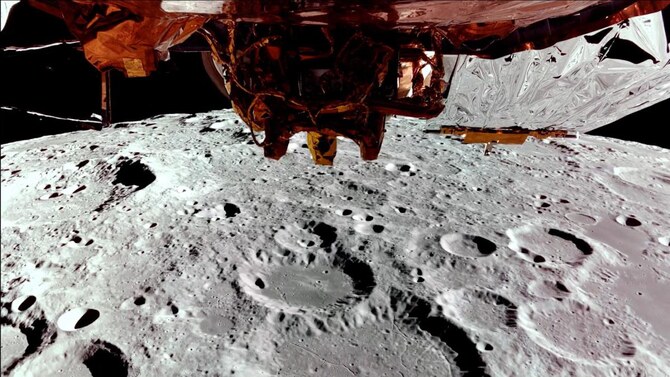
On its way to the moon, Blue Ghost beamed back exquisite pictures of the home planet. The lander continued to stun once in orbit around the moon, with detailed shots of the moon’s gray pockmarked surface. At the same time, an on-board receiver tracked and acquired signals from the US GPS and European Galileo constellations, an encouraging step forward in navigation for future explorers.
The landing set the stage for a fresh crush of visitors angling for a piece of lunar business.
Another lander — a tall and skinny 15-footer (4 meters tall) built and operated by Houston-based Intuitive Machines — is due to land on the moon Thursday. It’s aiming for the bottom of the moon, just 100 miles (160 kilometers) from the south pole. That’s closer to the pole than the company got last year with its first lander, which broke a leg and tipped over.
Despite the tumble, Intuitive Machines’ lander put the US back on the moon for the first time since NASA astronauts closed out the Apollo program in 1972.
A third lander from the Japanese company ispace is still three months from landing. It shared a rocket ride with Blue Ghost from Cape Canaveral on Jan. 15, taking a longer, windier route. Like Intuitive Machines, ispace is also attempting to land on the moon for the second time. Its first lander crashed in 2023.
The moon is littered with wreckage not only from ispace, but dozens of other failed attempts over the decades.
NASA wants to keep up a pace of two private lunar landers a year, realizing some missions will fail, said the space agency’s top science officer Nicky Fox.
Unlike NASA’s successful Apollo moon landings that had billions of dollars behind them and ace astronauts at the helm, private companies operate on a limited budget with robotic craft that must land on their own, said Firefly CEO Jason Kim.
“Every time we go up, we’re learning from each other,” Kim said.

Private lunar lander Blue Ghost touches down on the moon with a special delivery for NASA
https://arab.news/yavb3
Private lunar lander Blue Ghost touches down on the moon with a special delivery for NASA
- A private lunar lander has touched down on the moon, delivering a drill and other experiments for NASA
- The flurry comes as NASA strives to ignite a lunar economy and send astronauts back
Italian cooking and its rituals get UN designation as world heritage
- UNESCO added the rituals surrounding Italian food preparation and consumption to its list of the world’s traditional practices and expressions
ROME: Italian food is known and loved around the world for its fresh ingredients and palate-pleasing tastes, but on Wednesday, the UN’s cultural agency gave foodies another reason to celebrate their pizza, pasta and tiramisu by listing Italian cooking as part of the world’s “intangible” cultural heritage.
UNESCO added the rituals surrounding Italian food preparation and consumption to its list of the world’s traditional practices and expressions. It’s a designation celebrated alongside the more well-known UNESCO list of world heritage sites, on which Italy is well represented with locations like the Rome’s Colosseum and the ancient city of Pompeii.
The citation didn’t mention specific dishes, recipes or regional specialties, but highlighted the cultural importance Italians place on the rituals of cooking and eating: the Sunday family lunch, the tradition of grandmothers teaching grandchildren how to fold tortellini dough just so, even the act of coming together to share a meal.
“Cooking is a gesture of love, a way in which we tell something about ourselves to others and how we take care of others,” said Pier Luigi Petrillo, a member of the Italian UNESCO campaign and professor of comparative law at Rome’s La Sapienza University.
“This tradition of being at the table, of stopping for a while at lunch, a bit longer at dinner, and even longer for big occasions, it’s not very common around the world,” he said.
Premier Giorgia Meloni celebrated the designation, which she said honored Italians and their national identity.
“Because for us Italians, cuisine is not just food or a collection of recipes. It is much more: it is culture, tradition, work, wealth,” she said in a statement.
It’s by no means the first time a country’s cuisine has been recognized as a cultural expression: In 2010, UNESCO listed the “gastrnomic meal of the French” as part of the world’s intangible heritage, highlighting the French custom of celebrating important moments with food.
Other national cuisines and cultural practices surrounding them have also been added in recent years: the “cider culture” of Spain’s Asturian region, the Ceebu Jen culinary tradition of Senegal, the traditional way of making cheese in Minas Gerais, Brazil.
UNESCO meets every year to consider adding new cultural practices or expressions onto its lists of so-called “intangible heritage.” There are three types: One is a representative list, another is a list of practices that are in “urgent” need of safeguarding and the third is a list of good safeguarding practices.
This year, the committee meeting in New Delhi considered 53 nominations for the representative list, which already had 788 items. Other nominees included the Swiss yodelling, the handloom weaving technique used to make Bangladesh’s Tangail sarees, and Chile’s family circuses.
In its submission, Italy emphasized the “sustainability and biocultural diversity” of its food. Its campaign noted how Italy’s simple cuisine valued seasonality, fresh produce and limiting waste, while its variety highlighted its regional culinary differences and influences from migrants and others.
“For me, Italian cuisine is the best, top of the range. Number one. Nothing comes close,” said Francesco Lenzi, a pasta maker at Rome’s Osteria da Fortunata restaurant, near the Piazza Navona. “There are people who say ‘No, spaghetti comes from China.’ Okay, fine, but here we have turned noodles into a global phenomenon. Today, wherever you go in the world, everyone knows the word spaghetti. Everyone knows pizza.”
Lenzi credited his passion to his grandmother, the “queen of this big house by the sea” in Camogli, a small village on the Ligurian coast where he grew up. “I remember that on Sundays she would make ravioli with a rolling pin.”
“This stayed with me for many years,” he said in the restaurant’s kitchen.
Mirella Pozzoli, a tourist visiting Rome’s Pantheon from the Lombardy region in northern Italy, said the mere act of dining together was special to Italians:
“Sitting at the table with family or friends is something that we Italians cherish and care about deeply. It’s a tradition of conviviality that you won’t find anywhere else in the world.”
Italy already has 13 other cultural items on the UNESCO intangible list, including Sicilian puppet theater, Cremona’s violin craftsmanship and the practice moving of livestock along seasonal migratory routes known as transhumance.
Italy appeared in two previous food-related listings: a 2013 citation for the “Mediterranean diet” that included Italy and half a dozen other countries, and the 2017 recognition of Naples’ pizza makers.
Petrillo, the Italian campaign member, said after 2017, the number of accredited schools to train Neapolitan pizza makers increased by more than 400 percent.
“After the UNESCO recognition, there were significant economic effects, both on tourism and and the sales of products and on education and training,” he said.


