Three cops injured in grenade attack in Pakistan’s Karachi day after deadly bombing in northwest

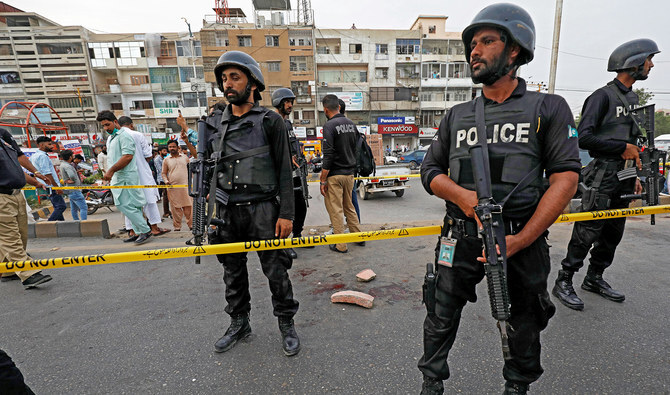
Police officers stand guard at the cordoned site of a grenade attack, in Karachi, Pakistan, on August 5, 2020. (REUTERS/File)
Short Url
Updated 01 March 2025
Follow

Three cops injured in grenade attack in Pakistan’s Karachi day after deadly bombing in northwest

  • No group has so far claimed responsibility for the attack on the police station in Karachi’s Saddar
  • Pakistan, battling twin insurgencies, has witnessed a surge in militant violence in recent months

KARACHI: Three policemen were injured in a grenade attack on a police station in Pakistan’s commercial capital of Karachi, police said on Saturday, a day after a deadly bombing in the country’s northwest killed six people.
Karachi, which is home to over 15 million people, has a history of attacks on police by organized gangs involved in drug trafficking and land grabbing as well as by militant groups.
Mehzor Ali, a senior superintendent of police (SSP), said unidentified men lobbed a hand grenade incident the Preedy police station in Karachi’s Saddar business district at 12:16am on Saturday.
“No group has claimed responsibility for the attack,” he told reporters in Karachi. “Bomb disposal squad has been summoned and the incident is being investigated.”
The development came a day after a deadly bombing killed a top cleric among six people at a mosque in Pakistan’s northwestern Khyber Pakhtunkhwa (KP) province, according to officials.
The blast occurred during Friday prayers at Darul Uloom Haqqania, one of Pakistan’s largest and most influential religious seminaries.
Separately on Friday, nine people, including a paramilitary troop, were injured in a roadside blast in Quetta in the southwestern Balochistan province, police said.
No group has claimed responsibility for Friday’s attacks either, but Pakistan has been battling twin insurgencies — one mounted by religiously motivated groups like the Tehreek-e-Taliban Pakistan (TTP) in the country’s northwest and the other by ethnic Baloch separatists in Balochistan.


Pakistan launches final nationwide polio drive of 2025 to vaccinate 45 million children

Updated 4 sec ago
Follow

Pakistan launches final nationwide polio drive of 2025 to vaccinate 45 million children

  • Campaign comes as Pakistan records 30 polio cases this year, one of only two countries where virus is endemic
  • Health minister urges parents to welcome vaccinators as insecurity, misinformation hinder eradication efforts

ISLAMABAD: Pakistan on Thursday launched its final polio vaccination campaign of the year, with Health Minister Mustafa Kamal administering drops to children under five as part of a nationwide effort to reach 45 million children, the country’s polio program said.

The Dec. 15–21 drive is part of Pakistan’s decades-long struggle to eliminate wild poliovirus. Pakistan and neighboring Afghanistan are the only two countries where the virus remains endemic, keeping global eradication efforts at risk.

Pakistan has reported 30 polio cases so far this year. The incurable and highly infectious virus can cause lifelong paralysis and can only be prevented through repeated oral vaccinations and routine immunization, health officials say.

“I want to take this opportunity to speak directly to parents and caregivers. When our polio vaccinator knocks at your door, I urge you to welcome them in and ensure that every child under five in your house receives two drops of this essential vaccine,” the polio program quoted Health Minister Kamal as saying.

“I also urge you to advocate for vaccination in your families and communities and create a welcoming environment for our vaccinators.”

The new campaign comes days after Pakistan conducted a nationwide measles, rubella and polio vaccination drive from Nov. 17–29, which targeted 22.9 million children across 89 high-risk districts.

Pakistan recorded 74 polio cases in 2024, a steep rise from six in 2023 and just one in 2021, underscoring the volatility of eradication efforts in a country where misinformation, vaccine hesitancy and political instability have repeatedly disrupted progress.

Violence has also hampered the program. Polio teams and their security escorts have been attacked frequently by militants and religious hard-liners in parts of northwestern Khyber Pakhtunkhwa and southwestern Balochistan. Officials say continued security threats, coupled with natural disasters such as recent flooding, pose major obstacles to reaching every child.

Pakistan has drastically reduced polio prevalence since the 1990s, when annual cases exceeded 20,000. By 2018, the number had fallen to eight. But health authorities warn that without consistent access to children, particularly in high-risk, underserved region, eradication will remain out of reach.