

Alleged Chinese spies gave Philippine city and police cash and motorbikes

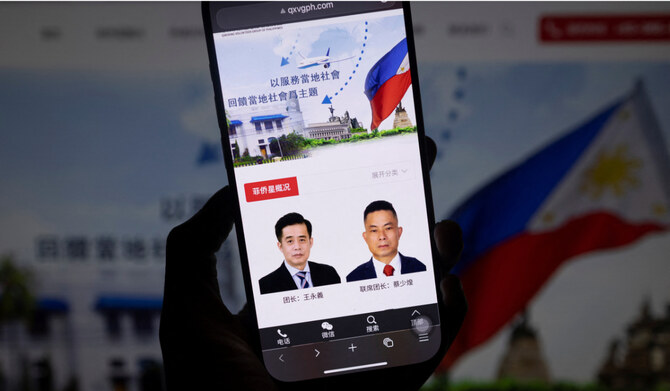
The website of the Qiaoxing Volunteer Group, a Chinese community organization in the Philippines, features photos of Wang Yongyi, left, and Cai Shaohuang, in this illustration picture taken February 27, 2025. (REUTERS)
Short Url
Updated 28 February 2025
Follow

Alleged Chinese spies gave Philippine city and police cash and motorbikes

  • Wang, Wu and Cai made the donations to the city of Tarlac and to the police forces via the Chinese-backed groups in 2022 and continued to host officials at events through 2024. Reuters could not establish the reason for the donations

BANGKOK/MANILA: Four Chinese nationals accused by the Philippines of espionage led Chinese Communist Party-affiliated groups that made donations of cash to a Philippine city and vehicles to two police forces, according to photos, videos and online posts seen by Reuters.
Wang Yongyi, Wu Junren, Cai Shaohuang, and Chen Haitao were among five Chinese men detained by Philippine investigators in late January for allegedly gathering images and maps of Philippine naval forces near the South China Sea.
The five men had flown drones to spy on the Philippines’ navy, said the National Bureau of Investigation, adding that it had found photos and maps of sensitive sites and vessels on their phones. A senior NBI official told Reuters that the men had been charged with espionage, which carries a prison term of up to 20 years.

HIGHLIGHTS

• Three alleged spies met frequently with China’s defense attache.

• China denies espionage, claims Philipines using smear tactics.

Reuters could not identify a lawyer for the men or establish how they intend to plead. They have not spoken publicly about their arrests and questions directed to them via the Chinese Embassy in Manila went unanswered.
The four men were leaders of civic groups overseen by the Chinese Communist Party’s foreign influence network, according to Reuters’ review of articles and multimedia posted by the two groups and in Philippine media.
China’s Foreign Ministry, in a statement to Reuters, said China required its citizens to abide by local laws and that the civic groups “spontaneously formed and self-managed by the relevant Chinese citizens ... have no affiliation with the Chinese government.”
Wang, Wu and Cai made the donations to the city of Tarlac and to the police forces via the Chinese-backed groups in 2022 and continued to host officials at events through 2024. Reuters could not establish the reason for the donations.
Tarlac is home to major military bases, including one used by the Philippines and the US for live-fire exercises during annual military drills. Photos of bases in the area were not among the sites that NBI said were found on the men’s devices.
All five detained men also met China’s military attache in Manila, Senior Col. Li Jianzhong, at least once in the weeks before their arrest, Reuters found. Images and videos additionally show Wang, Wu, and Cai meeting the attache at least three times in 2024, including in May, when he opened the civic groups’ office in Manila.
Details of the donations made by the men, their interaction with Li, and their association with the CCP have not previously been reported.
The ties revealed by Reuters go beyond public statements made by Philippine investigators, who have said the men disguised themselves as “harmless” members of a legitimate organization. The NBI said the men were apprehended after “hot-pursuit” operations. It did not specify who the men were suspected of working for. But Beijing has denied the accusations of espionage, which state media has branded the “smear tactics” of a nation whose Chinese policy “is slipping into an impulsive and irrational abyss.”
China’s Ministry of Foreign Affairs and its Manila embassy did not respond to requests for comment.
The office of the mayor of Manila, whose police force took motorbikes from the men, said in response to Reuters’ questions that the “deed of donation and motorcycles... were found to be in order.”
The mayor of Tarlac city and the two police forces did not respond to requests for comment.
The Philippines does not have a specific foreign interference law, but is currently drafting one amid rising tensions with China. Government agencies are permitted to receive donations but contributions from foreign authorities must be approved by the president, according to guidelines. The practice of donations has been criticized by academics and the Transparency International non-profit, which has noted that Philippine leaders have sometimes used such donations to solicit bribes.


China’s top diplomat to visit Somalia on Africa tour

Updated 6 sec ago
Follow

China’s top diplomat to visit Somalia on Africa tour

  • Stop in Mogadishu provides diplomatic boost after Israel became the first country to formally recognize breakaway Somaliland
  • Tour focusses on Beijing's strategic trade ​access across eastern and southern Africa
BEIJING: China’s top diplomat began his annual New Year tour of Africa on Wednesday, focusing on strategic trade ​access across eastern and southern Africa as Beijing seeks to secure key shipping routes and resource supply lines.
Foreign Minister Wang Yi will travel to Ethiopia, Africa’s fastest-growing large economy; Somalia, a Horn of Africa state offering access to key global shipping lanes; Tanzania, a logistics hub linking minerals-rich central Africa to the Indian Ocean; and Lesotho, a small southern African economy squeezed by US trade measures. His trip this year runs until January 12.
Beijing aims to highlight countries it views as model partners of President Xi Jinping’s flagship “Belt and Road” infrastructure program and to expand export markets, particularly in young, increasingly ‌affluent economies such ‌as Ethiopia, where the IMF forecasts growth of 7.2 percent this year.
China, ‌the ⁠world’s ​largest bilateral ‌lender, faces growing competition from the European Union to finance African infrastructure, as countries hit by pandemic-era debt strains now seek investment over loans.
“The real litmus test for 2026 isn’t just the arrival of Chinese investment, but the ‘Africanization’ of that investment. As Wang Yi visits hubs like Ethiopia and Tanzania, the conversation must move beyond just building roads to building factories,” said Judith Mwai, policy analyst at Development Reimagined, an Africa-focussed consultancy.
“For African leaders, this tour is an opportunity to demand that China’s ‘small yet beautiful’ projects specifically target our industrial gaps, ⁠turning African raw materials into finished products on African soil, rather than just facilitating their exit,” she added.
On his start-of-year trip in 2025, ‌Wang visited Namibia, the Republic of Congo, Chad and Nigeria.
His visit ‍to Somalia will be the first by a Chinese foreign minister since the 1980s and is ‍expected to provide Mogadishu with a diplomatic boost after Israel became the first country to formally recognize the breakaway Republic of Somaliland, a northern region that declared itself independent in 1991.
Beijing, which reiterated its support for Somalia after the Israeli announcement in December, is keen to reinforce its influence around the Gulf of Aden, the entrance ​to the Red Sea and a vital corridor for Chinese trade transiting the Suez Canal to Europe.
Further south, Tanzania is central to Beijing’s plan to secure access to Africa’s ⁠vast copper deposits. Chinese firms are refurbishing the Tazara Railway that runs through the country into Zambia. Li Qiang made a landmark trip to Zambia in November, the first visit by a Chinese premier in 28 years.
The railway is widely seen as a counterweight to the US and European Union-backed Lobito Corridor, which connects Zambia to Atlantic ports via Angola and the Democratic Republic of the Congo.
By visiting the southern African kingdom of Lesotho, Wang aims to highlight Beijing’s push to position itself as a champion of free trade. Last year, China offered tariff-free market access to its $19 trillion economy for the world’s poorest nations, fulfilling a pledge by Chinese President Xi Jinping at the 2024 China-Africa Cooperation summit in Beijing.
Lesotho, one of the world’s poorest nations with a gross domestic product of just over $2 billion, ‌was among the countries hardest hit by US President Donald Trump’s sweeping tariffs last year, facing duties of up to 50 percent on its exports to the United States.
