At least 47 feared trapped after glacier burst in Indian Himalayas — media reports

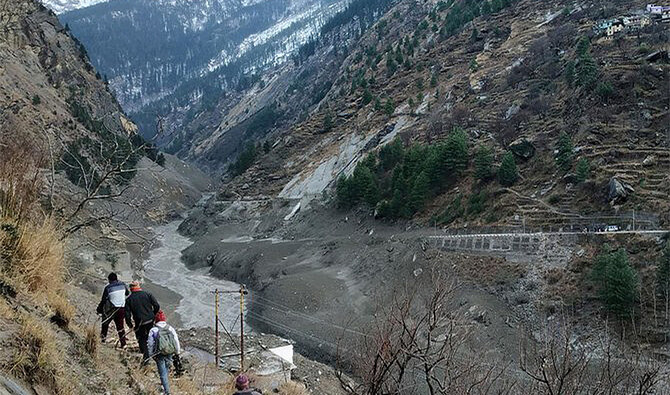
People walk past a destroyed dam after a Himalayan glacier broke and crashed into the dam at Raini Chak Lata village in Chamoli district, northern state of Uttarakhand, India, February 7, 2021. (Reuters/File)
Short Url
Updated 28 February 2025
Follow

At least 47 feared trapped after glacier burst in Indian Himalayas — media reports

  • Incident took place near highway in Uttarakhand state’s Chamoli region, less than 5km from popular Hindu temple of Badrinath
  • At least 57 workers engaged in road construction in border area, which adjoins Tibet, were trapped, senior police officer says

NEW DELHI: At least 47 people were feared to be trapped following a glacier burst in the Indian Himalayan state of Uttarakhand, local media reported on Friday.
The incident took place near a highway in the state’s Chamoli region, less than five kilometers (3 miles) from the popular Hindu temple of Badrinath, which is visited by hundreds of thousands of devotees each year.
At least 57 workers engaged in road construction in the border area, which adjoins Tibet, were trapped, senior police officer Nilesh Anand Bharne told news agency ANI, in which Reuters has a minority stake.
“Out of these, 10 workers have been rescued and sent to the army camp near Mana (village) in critical condition,” he said.
Rescue workers were finding it difficult to reach the spot where the 47 were trapped due to heavy snowfall, ANI reported another senior official as saying.


Czech Republic ‘certainly not’ on path to higher defense spending, says Babis

Updated 2 sec ago
Follow

Czech Republic ‘certainly not’ on path to higher defense spending, says Babis

Asked in an online interview on Thursday on news server Denik.cz if the government was on a path to higher spending, Babis said: “Certainly not“
“Our ⁠priority is the health of our citizens, so that they live long lives”

PRAGUE: The Czech Republic is “certainly not” setting a path to reach higher defense spending despite rising NATO targets, Prime Minister Andrej Babis said on Thursday, marking a clear departure from the previous government’s policy.
Babis’ government, led by his populist ANO party, took power in December and is pushing a re-worked 2026 budget plan through parliament. It has faced some criticism over lower defense spending, however.
Babis said before last year’s election ⁠that a NATO ⁠agreement to gradually raise defense spending to 5 percent of gross domestic product was unrealistic.
Asked in an online interview on Thursday on news server Denik.cz if the government was on a path to higher spending, Babis said: “Certainly not.”
“Our ⁠priority is the health of our citizens, so that they live long lives,” he said.
Babis won last year’s election with promises to concentrate more on people’s standard of living by boosting wages, cutting some taxes and adding new benefits.
The new government’s 2026 budget proposal cuts spending on defense to 2.1 percent of GDP versus the previous center-right cabinet’s plan for 2.35 percent — ⁠a ⁠plan Defense Minister Jaromir Zuna said on Wednesday would not hurt army modernization projects.
The previous administration — a staunch supporter of Kyiv in the Ukraine-Russia war — had sought for defense spending to gradually rise to 3 percent of GDP by 2030.
The new government has continued a Czech-led initiative sourcing large-calibre ammunition for Ukraine and financed by donations from countries like Germany. But it has stopped providing budget funds itself to the program.