Czech Republic ‘certainly not’ on path to higher defense spending, says Babis

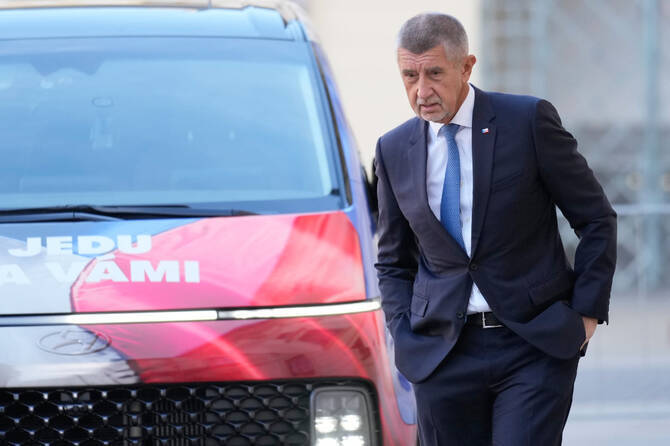
The Czech Republic is “certainly not” setting a path to reach higher defense spending despite rising NATO targets, Prime Minister Andrej Babis said on Thursday, (AP/File)
Short Url
Updated 26 February 2026
Follow

Czech Republic ‘certainly not’ on path to higher defense spending, says Babis

  • Asked in an online interview on Thursday on news server Denik.cz if the government was on a path to higher spending, Babis said: “Certainly not“
  • “Our ⁠priority is the health of our citizens, so that they live long lives”

PRAGUE: The Czech Republic is “certainly not” setting a path to reach higher defense spending despite rising NATO targets, Prime Minister Andrej Babis said on Thursday, marking a clear departure from the previous government’s policy.
Babis’ government, led by his populist ANO party, took power in December and is pushing a re-worked 2026 budget plan through parliament. It has faced some criticism over lower defense spending, however.
Babis said before last year’s election ⁠that a NATO ⁠agreement to gradually raise defense spending to 5 percent of gross domestic product was unrealistic.
Asked in an online interview on Thursday on news server Denik.cz if the government was on a path to higher spending, Babis said: “Certainly not.”
“Our ⁠priority is the health of our citizens, so that they live long lives,” he said.
Babis won last year’s election with promises to concentrate more on people’s standard of living by boosting wages, cutting some taxes and adding new benefits.
The new government’s 2026 budget proposal cuts spending on defense to 2.1 percent of GDP versus the previous center-right cabinet’s plan for 2.35 percent — ⁠a ⁠plan Defense Minister Jaromir Zuna said on Wednesday would not hurt army modernization projects.
The previous administration — a staunch supporter of Kyiv in the Ukraine-Russia war — had sought for defense spending to gradually rise to 3 percent of GDP by 2030.
The new government has continued a Czech-led initiative sourcing large-calibre ammunition for Ukraine and financed by donations from countries like Germany. But it has stopped providing budget funds itself to the program.


Spain cites Israeli ‘insults’ in decision to withdraw ambassador

Updated 5 sec ago
Follow

Spain cites Israeli ‘insults’ in decision to withdraw ambassador

  • With the ambassador’s removal, Spain’s diplomatic representation will now be handled by its charge d’affaires
  • “It’s become clear that Spain’s goodwill in maintaining cordial relations hasn’t been reciprocated,” Albares said

MADRID: Spain on Thursday explained its decision to permanently withdraw its ambassador to Israel, citing repeated “insults and slanders” by the country.
Veteran diplomat Ana Maria Salomon Perez was officially relieved of her duties on Tuesday at the proposal of Spanish Foreign Minister Jose Manuel Albares.
She was recalled from Tel Aviv in September after Spanish Prime Minister Pedro Sanchez unveiled measures designed to “stop the genocide in Gaza, pursue its perpetrators and support the Palestinian population.”
With the ambassador’s removal, Spain’s diplomatic representation will now be handled by its charge d’affaires, a lower-ranking official whose status is meant to reflect the downgraded relations.
Israel withdrew its ambassador to Madrid in 2024 after Spain recognized Palestinian statehood and has since also been represented by a charge d’affaires.
“It’s become clear that Spain’s goodwill in maintaining cordial relations hasn’t been reciprocated — not diplomatically — through an increase in Israel’s representation in Spain, nor by restraining insults and slanders aimed at the Spanish people,” Albares said.
“As a result, keeping an ambassador who had been called back for consultations for six months no longer made sense,” he added during an interview with Spanish public television.
Spain’s decision to definitively retire the ambassador follows years of tense exchanges between the two governments.
Sanchez, one of the most vocal critics of Israel’s war on Gaza, has also opposed the US-Israeli military strikes on Iran that began on February 28.
Israeli Foreign Minister Gideon Sarr has accused the Spanish government of “standing with tyrants” by opposing the US-Israeli attacks on Iran.
He also accused Spain of being “complicit in inciting genocide against Jews and war crimes” after it recognized a Palestinian state.
Spain only established diplomatic ties with Israel in 1986 following the death of dictator General Francisco Franco in 1975.
Under Franco, Spain avoided recognizing Israel and maintained closer diplomatic ties with Arab states.