

Review: ‘Zero Day’ — Robert De Niro brings his star power to the small screen
Review: ‘Zero Day’ — Robert De Niro brings his star power to the small screen/node/2591918/lifestyle
Review: ‘Zero Day’ — Robert De Niro brings his star power to the small screen
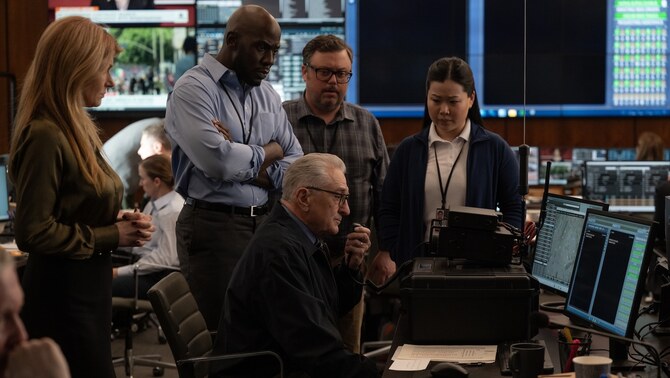
(L to R) Connie Britton as Valerie Whitesell, McKinley Belcher III as Carl Otieno, Robert De Niro as George Mullen, Jay Klaitz as Tim Pennington, and Eden Lee as Agent Angela Kim in 'Zero Day.' (Supplied)
Review: ‘Zero Day’ — Robert De Niro brings his star power to the small screen
Iconic actor is as good as he’s ever been in taut political thriller
Updated 28 February 2025
Matt Ross
LONDON: Despite his lauded career, Robert De Niro, arguably our greatest living actor, has, for the most part, steered clear of TV roles. So the news that he was to not only appear in, but also executive produce, new Netflix thriller “Zero Day” was noteworthy. And what’s even better? This taut, tense, six-part political thriller is every bit as captivating as you’d hope — a relief, given that De Niro’s more recent output has featured more than a few… let’s call them duds.
De Niro is perfectly cast as George Mullen, a universally respected former US President who confounded the political world by not seeking a second term, choosing instead to focus on his family after a personal tragedy. When the US is targeted by a nationwide cyberattack, which freezes all electronic devices and kills thousands of people, sitting President Mitchell (Angela Bassett) asks him to head up a new division tasked with finding and punishing the people behind the attack.
On paper, Mullen is the obvious choice — he’s a former prosecutor and hails from a time when politicians could still command bipartisan respect. But he’s also a man out of step — caught out by the speed of the modern media landscape, still struggling with his own grief, and suffering from a range of hallucinations.
That De Niro manages to convince with all of the above within the first episode is testament not only to the strength of his performance, but also to the skill of creators Eric Newman, Noah Oppenheim, and journalist Michael Schmidt. Though costars Jesse Plemons, Lizzy Caplan, Matthew Modine and others are all superb, none comes close to De Niro. George is simultaneously frighteningly fierce and alarmingly frail, possessed with a sense of naïve optimism that makes him either a fool or the smartest person in the room.
“Zero Day” is not perfect – there’s a lull around episode three, and some budget-chewing grandstanding before the finale. But the last two episodes are as tense and thrilling as any show from the last couple of years.
Akio Fujimoto discusses RSIFF Golden Yusr winner ‘Lost Land’
The Japanese filmmaker on his groundbreaking Rohingya-language feature
Updated 19 December 2025
Shyama Krishna Kumar
JEDDAH: Some stories demand to be told. Not just as narratives, but as acts of witness.
Japanese filmmaker Akio Fujimoto’s “Lost Land” is one such story. Billed as the first feature film in the Rohingya language, the movie took home the top prize — the Golden Yusr — at this year’s Red Sea International Film Festival.
“Lost Land” — which premiered in the Horizons section at this year’s Venice Film Festival, where it won the special jury prize — follows two young Rohingya siblings, Somira and Shafi, fleeing persecution in Myanmar as they undertake a perilous journey d to join their uncle in Malaysia.
Shomira Rias Uddin (R) and Muhammad Shofik Rias Uddin in 'Lost Land.' (Supplied)
Presenting the Golden Yusr to Fujimoto, RSIFF jury head, the US filmmaker Sean Baker, said the film “confronts the plight of displaced children with unflinching empathy and poetic urgency.”
Fujimoto’s journey to this film is a profound narrative of personal reckoning. Having worked in Myanmar for more than a decade, he recognized the unspoken tensions surrounding discussions about refugee experiences but never spoke out himself due to fear of persecution. The 2021 military coup in Myanmar, he said, forced him to confront a lingering sense of guilt about his previous silence on the subject.
“Looking back on my decade of work, I realized I had been avoiding topics I wanted to focus on as a filmmaker,” Fujimoto said in an interview with Arab News at RSIFF.
That self-reflection became the catalyst for “Lost Land,” transforming personal hesitation into a powerful act of cinematic storytelling.
Eschewing traditional casting methods, Fujimoto discovered his lead actors through serendipity during community fieldwork. Shomira Rias Uddin and Muhammad Shofik Rias Uddin, real-life siblings who play the film’s young leads, were found walking near interview locations, compelling the filmmaker to reshape the entire script around their natural chemistry. While the original script was written with two teenage brothers in mind, the discovery of the Rias Uddin siblings led Fujimoto to alter the script significantly.
Communication between the cast and crew became an intricate dance of translation and cultural bridge-building. With Fujimoto speaking primarily Japanese and some Burmese, the team relied on Sujauddin Karimuddin, a Rohingya translator who did far more than linguistic conversion. “He wasn’t just translating words but conveying messages, creating trust, and establishing a collaborative atmosphere,” said Watanabe, Fujimoto’s translator.
One of the most remarkable aspects of “Lost Land” is its linguistic significance. Beyond being a narrative, the film serves as a critical instrument of cultural preservation. Karimuddin, who is also a producer on the film, approached his role like a linguistic curator. “As a Rohingya myself, I had the privilege of choosing words carefully, trying to instill poetry, capturing linguistic nuances that are slowly disappearing. So, the film is very important when it comes to the preservation of a people’s language. It was a privilege for me to contribute to it,” he said.
As they were making the first fiction film focused on Rohingya experiences, the team felt an immense responsibility. “Lost Land” aims to humanize a community often reduced to statistics, giving voice and complexity to individual experiences.
Shomira Rias Uddin and Muhammad Shofik Rias Uddin (R) in 'Lost Land.' (Supplied)
“In our film, we had around 200 people — including extras — who were all part of the Rohingya community. I felt in order to show their feelings and their voice; it was really important to bring in the Rohingya people and tell the story together with them,” said Fujimoto.
For Fujimoto, whose previous films include “Passage of Life” (2017) and “Along the Sea” (2020), the film represents more than an artistic achievement. It’s a form of personal and collective redemption. “I can now clearly talk about these people without hesitation,” he said.
The filmmaker’s future ambitions involve expanding on this project. He sees “Lost Land” as a crucial first step, and hopes to support Rohingya filmmakers in telling their own stories directly.
“The next phase is bringing narratives from the Rohingya perspective, directed by Rohingya filmmakers,” he said.