Pakistan reports two new polio cases amid deepening virus crisis

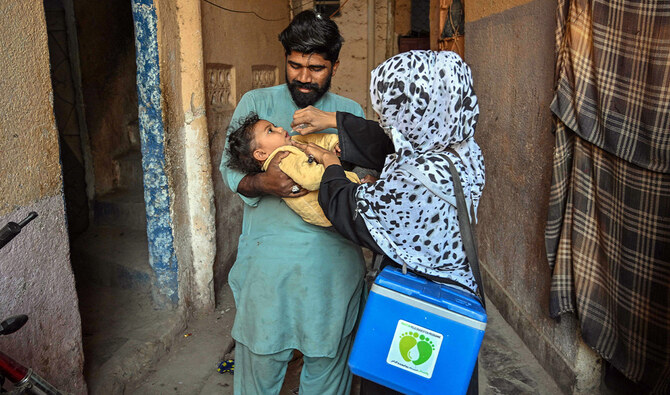
A health worker (R) administers polio drops to a child on the first day of a nationwide polio vaccination campaign, in Karachi on February 3, 2025. (AFP/File)
Short Url
Updated 28 February 2025
Follow

Pakistan reports two new polio cases amid deepening virus crisis

  • The South Asian country has witnessed an intense resurgence of the virus in recent months
  • Pakistan, Afghanistan are the last two countries in the world where polio remains an endemic

ISLAMABAD: Health authorities have confirmed two new cases of wild poliovirus type 1 (WPV1) in Pakistan, the country’s polio program said on Thursday.
Polio is a paralyzing disease that has no cure. Multiple doses of the oral polio vaccine and completion of the routine vaccination schedule for all children under the age of 5 is essential to provide children high immunity against the disease.
The South Asian country has been witnessing an intense resurgence of the virus and reported a total of 74 cases last year, raising several questions about the gains made in recent years in the fight against the viral disease.
Health authorities have confirmed one new case of the virus in the Kambar district of the southern Sindh province and another in the Mandi Bahauddin district of the Punjab province, according to the country’s polio program.
“This is the third polio case from Sindh and the first from Punjab this year, bringing the total number of cases in the country to five,” the polio program said in a statement.
Pakistan and Afghanistan are the last two countries in the world where polio remains an endemic.
Immunization campaigns have succeeded in most countries and have come close in Pakistan, but persistent problems remain. In the early 1990s, Pakistan reported around 20,000 cases annually but in 2018 the number dropped to eight cases. Six cases were reported in 2023 and only one in 2021.
Pakistan’s polio program began in 1994 but efforts to eradicate the virus have since been undermined by vaccine misinformation and opposition from some religious hard-liners who say immunization is a foreign ploy to sterilize Muslim children or a cover for Western spies. Militant groups also frequently attack and kill members of polio vaccine teams.
Pakistan this month concluded its first nationwide anti-polio campaign of 2025, with 99 percent of the targets achieved, according to the polio program. The campaign, conducted on Feb. 3-9, vaccinated more than 45 million children.
“[An] fIPV-OPV (fractional dose inactivated poliovirus vaccine-oral polio vaccine) campaign is underway in Karachi and Quetta Division to vaccinate nearly 1 million children with the injectable and oral polio vaccines for an added immunity boost,” the polio program said.
“Moreover, a targeted vaccination activity in 104 union councils bordering Afghanistan or having Afghan refugee camps/populations is also in progress (February 24-28) to vaccinate over 0.66 million children, to reduce the risk of cross-border and internal poliovirus transmission.”
“The Polio Programme urges all parents to get their children vaccinated against polio at every opportunity to keep them protected from this devastating disease,” it added.
This week, the World Health Organization said Saudi Arabia had reaffirmed its $500 million pledge to eradicate polio from Pakistan and Afghanistan under the Global Polio Eradication Initiative (GPEI).
The GPEI hopes to declare an end to the wild virus and the vaccine-derived variant by 2027 and 2029, respectively, compared with a previous deadline of 2026 for both forms.


India’s Bollywood bets big on ‘event cinema’

Updated 25 January 2026
Follow

India’s Bollywood bets big on ‘event cinema’

  • Films centered on geopolitical conflict, internal enemies, masculinity now dominate mainstream Hindi cinema
  • Critics argue Bollywood is using cinema’s unrivalled mass reach to shape the public sentiment in India 

MUMBAI: India’s Bollywood is moving decisively toward a cinema of scale and confrontation — where patriotism, spectacle, and ideological clarity increasingly trump nuance and narrative risk, industry insiders say.

The shift has fueled what experts describe as “event cinema,” as studios rely on big-budget spectacles and top-tier stars to lure audiences — especially smartphone-loving Gen Z viewers — back into theaters.

That strategy appears to be working. Akshaye Rathi, a prominent film exhibitor, predicted a 45-50 percent rise in net Hindi box-office collections and a 25 percent increase in young theater-goers this year.

“The year looks poised for historic numbers,” Rathi told AFP.

The industry’s financial model was shaken during the Covid-19 pandemic, which coincided with the rapid rise of streaming platforms and a shift to home viewing.

But its 2026 upcoming slate, packed with patriotic war dramas, spy thrillers, mythological epics and nationalist narratives — reflects not just a commercial recalibration, analysts say, but a broader change in creative priorities.

‘PROPAGANDA’

Critics argue Bollywood is increasingly producing polarizing films aligned with the ideology of Prime Minister Narendra Modi’s Hindu-nationalist government, using cinema’s unrivalled mass reach to shape public sentiment.

“These days film themes also depend upon who is ruling at the center — Hindu wave, propaganda... all these are big factors that filmmakers cash in on,” said movie business analyst Atul Mohan, editor of film trade magazine Complete Cinema. “But only one or two films work, not all 10 or 15.”

He cited the success of 2022 blockbuster “The Kashmir Files,” depicting in harrowing detail how several hundred thousand Hindus fled Muslim militants in Indian-administered Kashmir in 1989-90.

And he compared that with the 2025 film “The Bengal Files,” on alleged political violence in eastern India, which he described as a commercial “disaster.”

Films centered on geopolitical conflict, internal enemies, and heroic masculinity now dominate mainstream Hindi cinema, reflecting both the political mood and the economics of theatrical survival.

Last year’s gory action thriller “Dhurandhar,” meaning “formidable,” leaned heavily on hyper-nationalist tropes of Indian agents confronting Pakistan-linked foes, and became one of 2025’s highest-grossing films — following a real-life four-day border clash with Pakistan.

Its sequel, “Dhurandhar 2,” again starring Ranveer Singh, is set for release in March.

‘GRATUITIOUS VIOLENCE’

Veteran Delhi-based film critic Arnab Banerjee said political messaging now outweighs craftsmanship.

“It is not the quality of the film that matters today, it is propaganda films that are working,” said Banerjee.

“The mood of the nation is such that people are lapping up these subjects. Pakistan-bashing and references to enemy countries are being accepted without questioning.”

Banerjee also criticized what he called an excess of “gratuitous violence,” arguing that “it is social media hype that is deciding the film’s fate.”

He pointed to “Ikkis,” a film on the 1971 India-Pakistan war released in January, which struggled commercially despite positive reviews.

“It is a well-made film, but it didn’t work,” he said. “Perhaps because Pakistan is not shown as the enemy.”

Director Ahmed Khan, however, said quality still ultimately determines success, citing his upcoming action-comedy “Welcome to the Jungle,” starring Akshay Kumar.

“Whatever the genre — action, drama, comedy or horror — it depends on how well you’ve made it,” Khan said.

He pointed to the 2025 successes of the contrasting romantic drama “Saiyaara” as well as high-octane “Dhurandhar.”

“Both, poles apart in genre, did great business,” he said. “People’s mood can change any time.”