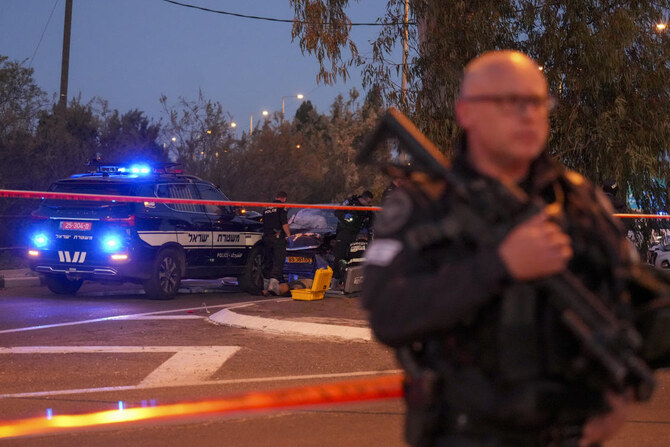
JERUSALEM: Israeli police said a Palestinian man rammed a car into a bus stop in the north of the country on Thursday, wounding 13 civilians in an incident they were treating as a “terror” attack.
“At 16:17 today, Israel Police’s emergency dispatch received reports of a ramming attack at Karkur Junction, where a vehicle struck multiple civilians waiting at a bus stop,” police said in a statement.
Israel’s first responders, Magen David Adom, said a team treated injured people at the site of the incident, including a 17-year old girl who was in critical condition.
Police said 13 people, including a police officer, were wounded, and that two of them were in “serious” condition.
The suspect was a “53-year-old Palestinian from the Jenin area, (who) was residing in Israel unlawfully with his family,” the police statement said.
“The circumstances of his presence in Israel are under investigation,” the police said, adding that “preliminary findings indicate that he deliberately targeted civilians waiting at a bus stop.”
Israel’s military launched earlier this year a major offensive in the north of the occupied West Bank, deploying tanks into the area for the first time in 20 years.
Dubbed “Iron Wall” by the Israeli military, the operation came days after a ceasefire took effect in Gaza.
The raids have spanned multiple refugee camps near the cities of Jenin, Tulkarem and Tubas.
Military operations are commonplace in Jenin’s refugee camp, a bastion of Palestinian militancy.


Israel car ramming attack wounds 13 people at bus stop
https://arab.news/rq2eu
Israel car ramming attack wounds 13 people at bus stop

- 13 people including a police officer were wounded
- Israel’s first responders treated injured people at the site of the incident


The art of war: fears for masterpieces on loan to Louvre Abu Dhabi
- UAE paid more than €1 billion to borrow priceless works, but experts in France want them back
PARIS: The Middle East war has raised fears for the safety of priceless masterpieces on loan from France to the Louvre Abu Dhabi, the museum’s only foreign branch.
The Abu Dhabi museum, which opened in 2017, has so far escaped damage from nearly 1,800 Iranian drone and missile strikes launched since the conflict erupted on Feb. 28.
However, concerns are mounting in France. “The works must be removed,” said Didier Selles, who helped broker the original agreement between France and the UAE.
French journal La Tribune de l’Art echoed that alarm. “The Louvre’s works in Abu Dhabi must be secured!” it said.
France’s culture ministry said French authorities were “in close and regular contact with the authorities of the UAE to ensure the protection of the works loaned by France.”
Under the agreement with the UAE, France agreed to provide expertise, lend works of art and organize exhibitions, in return for €1 billion, including €400 million for licensing the use of the Louvre name. The deal was extended in 2021 to 2047 for an additional €165 million.
Works on loan include paintings by Rembrandt and Chardin, Classical statues of Isis, Roman sarcophagi and Islamic masterpieces: such as the Pyxis of Al-Mughira.
A Louvre Abu Dhabi source said the museum was designed to protect collections from both security threats and natural disasters.