

France threatens to review longstanding accords with Algeria

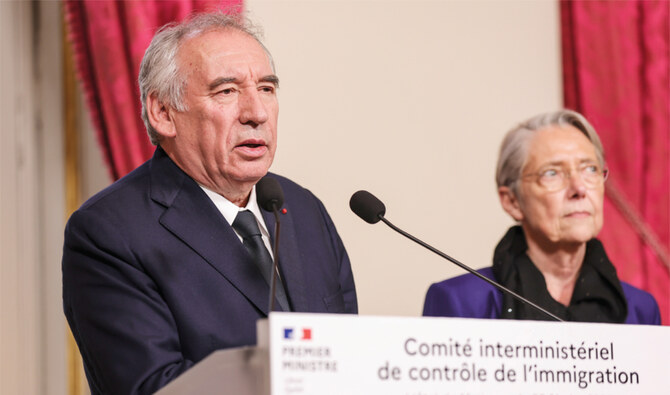
French Prime Minister Francois Bayrou, left, speaks in Paris. (AP)
Short Url
Updated 27 February 2025
Follow

France threatens to review longstanding accords with Algeria

  • The threat to cancel the agreement with Algeria on free movement came after a deadly knife attack in which the main suspect is a man of Algerian origin

PARIS: French Prime Minister Francois Bayrou threatened  to cancel a longstanding agreement with Algeria on free movement after a deadly knife attack in which the main suspect is a man of Algerian origin.

The row is just the latest in a series of disputes that has heightened tension between France and its former colony.

Bayrou spoke following a Cabinet meeting held days after Saturday’s knife attack in Mulhouse in which one person was killed and several others wounded.

Prosecutors say the 37-year-old suspect is an Algerian-born man who was on a terrorism watchlist and subject to deportation orders.

Interior Minister Bruno Retailleau has said that France had repeatedly attempted to expel him, but Algeria refused to accept him.

Bayrou said Wednesday: “The victims we saw in Mulhouse this weekend are the direct victims of the refusal to apply these agreements” between the two countries.

The suspect had been presented to the Algerian authorities 14 times and on each occasion they had refused to take him back, he added.

Under the 1968 accords between the two countries, Algerians enjoy favorable treatment on immigration matters in France.

But Algeria has in recent months refused on several occasions to accept its citizens when France has expelled them.

Bayrou said France would ask Algiers to examine how the relevant agreements between the two countries were being applied, giving them a month to six weeks to comply.

If there was no response, then canceling the existing agreements would “be the only possible outcome,” he added — even though “this is not the one we want.”

On Tuesday, French Foreign Minister Jean-Noel Barrot announced travel restrictions on Algerian dignitaries.

On Wednesday, Barrot said those measures, involving several hundred people, had been in place for several weeks.

Algiers has denounced the new measures as a “provocation.”

This new dispute is just the latest in a series between two countries feeding the tension between Paris and Algiers.


Iran war unsettles India’s packaged water makers as bottles, caps get pricey

Updated 55 min 10 sec ago
Follow

Iran war unsettles India’s packaged water makers as bottles, caps get pricey

  • Higher polymer ‌prices hurt bottled water industry
  • Industry worth $5 billion has big multinational players like Pepsi, Coca-Cola

NEW ​DELHI: The Iran war is rattling India’s $5 billion packaged water market just ahead of the sweltering summer season.
One of the world’s fastest growing bottled water markets is seeing some manufacturers hike prices for distributors, as supply disruptions linked to the war fuel higher costs in everything from plastic bottles to caps, labels and cardboard boxes.
Though retail prices are yet to feel the heat and bigger companies are absorbing the pain, about 2,000 smaller bottled water makers have increased rates for their resellers by around 1 rupee per ‌bottle, a ‌5 percent hike, which will rise by a further 10 percent in ​coming ‌days, ⁠according ​to the ⁠Federation of All India Packaged Drinking Water Manufacturers’ Association.
Consumers usually pay less than 20 rupees, or around 20 US cents, for a one-liter bottle.
“There is chaos and within the next 4-5 days, this will start impacting customer prices,” said Apurva Doshi, the federation’s secretary general.
Rising oil prices have increased the cost of polymer, which is made from crude oil and is a key material for the industry’s plastic bottles. The cost of material used in making ⁠plastic bottles has risen by 50 percent to 170 rupees per kilogram, ‌while the price of the caps has more than ‌doubled to 0.45 rupees apiece. Even corrugated boxes, labels and ​adhesive tape are costing much more, ‌industry letters showed.
Clean water is a privilege in the country of 1.4 billion people where ‌researchers say 70 percent of the groundwater is contaminated, leaving people reliant on bottled water. Companies including Bisleri, Coca-Cola’s Kinley, Pepsi’s Aquafina, billionaire Mukesh Ambani’s Reliance and Tata all compete for a share of the $5 billion market. The companies did not respond to Reuters request for comment.
PREMIUM WATER FACES HEAT ‌TOO
Within the broad bottled water market, natural mineral water is a $400 million business in India and a new, fast-growing wellness product for ⁠India’s wealthy.
The premium ⁠water segment accounted for 8 percent of the bottled water market last year in India, compared to just 1 percent in 2021, Euromonitor says.
Aava, which sells mineral water sourced from the foothills of the Aravalli mountains, has increased prices of its water bottles by 18 percent for resellers, Shiroy Mehta, CEO of the company, told Reuters.
“Most manufacturers are absorbing 40-50 percent of the cost to ensure that they don’t lose clients. It’s a poor situation for the beverage industry ahead of the summer season,” he said.
The mass market, however, is dominated by companies that produce “drinking water” to be sold in 1-liter bottles to customers. Clear Premium Water, a brand of India’s Energy Beverages, said in a notice to its distributors there ​had been an “unprecedented and continuous surge” in ​prices of key raw materials used in packaging and production.
“It is no longer possible for us to absorb the escalating costs while maintaining existing product prices,” the notice said.