

Indonesian hospital in northern Gaza resumes inpatient services

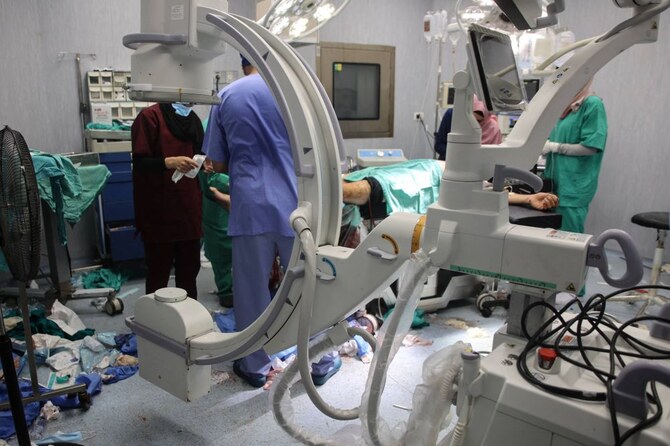
Doctors at the Indonesian Hospital in Beit Lahia in the northern Gaza Strip perform surgery on a victim of Israeli bombardment, on July 9, 2024. (AFP)
Short Url
Updated 27 February 2025
Follow

Indonesian hospital in northern Gaza resumes inpatient services

  • Hospital administration is working to reach 50 percent capacity by July 
  • Facility will be main referral hospital in north Gaza, parts of Gaza city 

JAKARTA: The Indonesia Hospital in northern Gaza has resumed inpatient services, the Jakarta-based NGO that funded it said on Thursday, as the facility races to resume full operations after repairs to the building and equipment that were destroyed by Israeli forces.

The health facility in Beit Lahiya, funded by the Indonesian NGO Medical Emergency Rescue Committee, was one of the first sites hit when Israel began its assault on Gaza in October 2023.

As relentless Israeli attacks pushed the enclave’s healthcare system to the brink of collapse, the Indonesia Hospital stood as one of the last functioning health facilities in the north.

Since the ceasefire began on Jan. 19, the hospital has been gradually resuming essential services, with inpatient treatment being the latest. 

“The Indonesia Hospital is resuming its operations to handle sick patients,” Sarbini Abdul Murad, chairman of MER-C’s board of trustees in Jakarta, told Arab News. 

“We hope to renovate and rebuild every part of the facility that was destroyed, as well as fully supply the hospital to meet all of the patients’ needs.”

Israeli forces targeted and heavily damaged most of the medical facilities in the Gaza Strip. 

The Indonesia Hospital was treating about 1,000 people at one point during Israel’s war on Gaza, which has killed more than 48,300 people and injured over 111,000.

Since last month, it has resumed services for emergencies, surgeries, radiology, laboratory, outpatient and inpatient treatments, and is now operating at 30 percent of full capacity

“Six months from the beginning of the ceasefire, we are aiming to reactivate essential services to reach at least 50 percent of full capacity,” Dr. Hadiki Habib, chairman of MER-C’s executive committee, told Arab News. 

The Indonesia Hospital will be the main referral hospital in northern Gaza and some parts of Gaza City, after the former main referral hospital, Al-Shifa, was destroyed by Israeli siege and attacks. 

“There is a great need for essential services,” Habib said. “Over a year of displacement and limited access (to healthcare), many Palestinians with chronic illnesses need quality treatments.” 


France to vaccinate cattle for lumpy skin disease as farmers protest against cull

Updated 6 sec ago
Follow

France to vaccinate cattle for lumpy skin disease as farmers protest against cull

PARIS: France will vaccinate 1 million head of cattle in the coming weeks against lumpy skin disease, Agriculture Minister Annie Genevard said on Saturday, as protesting farmers blocked roads in opposition to the government’s large-scale culling policy.
The announcement comes after several outbreaks of the highly contagious disease prompted authorities to order the culling of entire herds, sparking demonstrations by farmers who consider the measure excessive.
Lumpy skin disease is a virus spread by insects that affects cattle and buffalo, causing blisters and reducing milk production. While not harmful to humans, it often results in trade restrictions and severe economic losses.
“We will vaccinate nearly one million animals in the coming weeks and protect farmers. I want to reiterate that the state will stand by affected farmers, their losses will be compensated as well as their operating losses,” Genevard told local radio network ICI.
France says that total culling of infected herds, alongside vaccination and movement restrictions, is necessary to contain the disease and allow cattle exports. If the disease continues to spread in livestock farms, it could kill “at the very least, 1.5 million cattle,” Genevard told Le Parisien daily in a previous interview.
A portion of the A64 motorway south of Toulouse remained blocked since Friday afternoon, with about 400 farmers and some 60 tractors still in place on Saturday morning, according to local media.
The government, backed by the main FNSEA farming union, maintains that total culling of infected herds is necessary to prevent the disease from spreading and triggering export bans that would devastate the sector.
But the Coordination Rurale, a rival union, opposes the systematic culling approach, calling instead for targeted measures and quarantine protocols.
“Vaccination will be mandatory because vaccination is protection against the disease,” Genevard said, adding that complete culling remains necessary in some cases because the disease can be asymptomatic and undetectable.
France detected 110 outbreaks across nine departments and culled about 3,000 animals, according to the agriculture ministry. It has paid nearly six million euros to farmers since the first outbreak on June 29.