

Pakistan, Uzbekistan call for Muslim unity, two-state solution in Middle East

Palestinians sheltering in tents set up near the rubble of buildings, amid a ceasefire between Israel and Hamas, in Gaza City on February 26, 2025. (REUTERS)
Short Url
Updated 26 February 2025
Follow

Pakistan, Uzbekistan call for Muslim unity, two-state solution in Middle East

  • PM Shehbaz Sharif discusses Gaza situation with Uzbek President Shavkat Mirziyoyev at Tashkent 
  • Pakistan advocates for Palestinian state based on pre-1967 borders with Al-Quds Al-Sharif as capital

ISLAMABAD: Pakistan’s Prime Minister Shehbaz Sharif and Uzbek President Shavkat Mirziyoyev on Wednesday reiterated their support for a two-state solution in the Middle East, calling for Muslim countries to unite in the face of complex challenges worldwide. 
Prominent Muslim countries around the world, including Pakistan, have been advocating for an independent state of Palestine based on “internationally agreed parameters” and the pre-1967 borders with Al-Quds Al-Sharif as its capital.
Sharif, who arrived on an official visit to Uzbekistan to promote trade and investment on Tuesday, said he and Mirziyoyev reviewed the Middle East situation, where an uneasy truce currently holds after Israel’s 15-month war on Gaza. 
“Finally, I would like to mention that Pakistan stands by the people of Gaza, we believe in a two-state concept, an independent state of Palestine and their rights enshrined in UN Security Council resolutions,” Sharif said. 
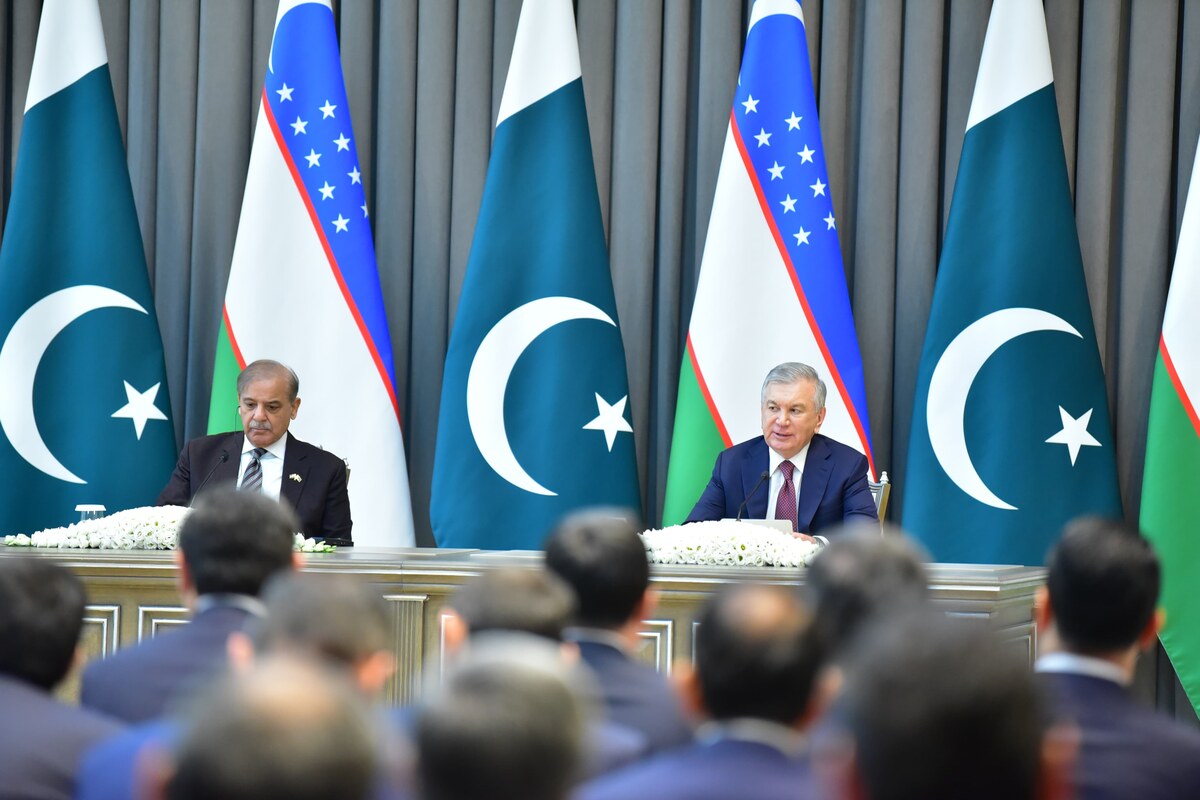


Uzbekistan President Shavkat Mirziyoyev speaks during a joint press stakeout with Pakistan Prime Minister Shehbaz Sharif in Tashkent on February 26, 2025. (Photo courtesy: X/@PakPMO)

He said both leaders agreed on the need for greater Muslim unity to navigate the challenges of the complex world. 
“I also told you that in this complex world we need to unite the Muslim world and we talked about Gaza during the negotiations,” Mirziyoyev said.
“There should be a two-state concept whether anyone would like it or not.”
Israel killed over 48,000 Palestinians in Gaza through its relentless military campaigns that began since Oct. 7, 2023 after a surprising Hamas attack. 
Both sides agreed to an uneasy truce in January this year which has led to the cessation of hostilities and exchange of hostages. 
Fears of the truce collapsing were renewed last week after Israel delayed the release of some 600 Palestinian prisoners on Saturday to protest what it says is the cruel treatment of hostages during their release by Hamas.
The Palestinian group has released hostages, and the bodies of four dead hostages, in large public ceremonies during which the Israelis were paraded and forced to wave to large crowds.
Hamas has said the delay is a “serious violation” of their ceasefire and that talks on a second phase of the truce are not possible until the Palestinians are freed.


Pakistan accuses India of manipulating Chenab flows, seeks clarification under Indus Waters Treaty

Updated 1 min 25 sec ago
Follow

Pakistan accuses India of manipulating Chenab flows, seeks clarification under Indus Waters Treaty

  • Foreign office spokesperson says sudden variations in river flows threaten agriculture, food security and livelihoods downstream
  • He also condemns a niqab-removal incident in India, calling it part of a broader pattern of religious intolerance and Islamophobia

ISLAMABAD: Pakistan said on Thursday it had observed abrupt variations in the flow of the River Chenab during the ongoing month, accusing India of manipulating river flows at a critical point in the agricultural cycle and saying it had written to New Delhi seeking clarification.

Local media reported quoted Pakistani officials as saying India released about 58,000 cusecs of water at Head Marala on Dec. 7–8 before sharply reducing flows to roughly 870–1,000 cusecs through Dec. 17, far below the 10-year historical average of 4,000–10,000 cusecs for this period.

Pakistan’s Foreign Office spokesman Tahir Andrabi told a weekly media briefing in Islamabad India had failed to share prior information or operational data on the Chenab flows, a practice he said New Delhi had previously followed under the 1960 Indus Waters Treaty. New Delhi said earlier this year it had put the treaty “in abeyance” following a gun attack in Indian-administered Kashmir that it blamed on Pakistan, a charge Islamabad denied, calling instead for an impartial and transparent international investigation.

Pakistan also described India’s unilateral suspension of the treaty as a violation of international law and an “act of war.”

“Pakistan would like to reiterate that the Indus Waters Treaty is a binding international agreement, which has been an instrument of peace and security and stability in the region,” Andrabi said. “Its breach or violation, on one hand, threatens the inviolability of international treaties in compliance with international law, and on the other hand, it poses serious threats to regional peace, principles of good neighborliness, and norms governing interstate relations.”

Andrabi said Pakistan viewed the sudden variations in the Chenab’s flow with “extreme concern and seriousness,” saying the country’s Indus Waters Commissioner had written to his Indian counterpart seeking clarification in line with procedures outlined in the treaty.

“Any manipulation of river flow by India, especially at a critical time of our agricultural cycle, directly threatens the lives and livelihoods, as well as food and economic security of our citizens,” he continued. “We call upon India to respond to the queries raised by Pakistan.”

He said Pakistan had fulfilled its obligations under the Indus Waters Treaty and urged the international community to take note of India’s “continued disregard” of a bilateral treaty and to counsel New Delhi to act responsibly under international law.

Andrabi maintained Pakistan remained committed to peaceful resolution of disputes with India but would not compromise on its water rights.

In the same briefing, he also condemned an incident in which the chief minister of the Indian state of Bihar was seen in a video forcibly removing the niqab of a Muslim woman during a public interaction, followed by remarks by a minister in Uttar Pradesh who mocked the episode, saying it reflected a broader pattern of religious intolerance and Islamophobia and warranted strong condemnation.