

Hamas hands over bodies of four hostages, Israel frees Palestinian prisoners

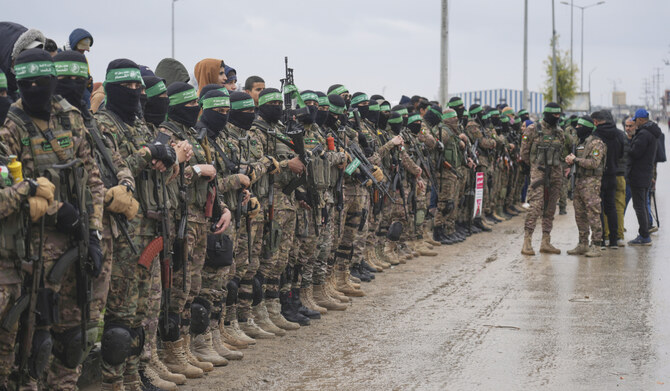
Hamas fighters stand in formation ahead Israeli hostages release in Nuseirat, Gaza Strip, Saturday, Feb. 22, 2025. (AP)
Short Url
Updated 27 February 2025
Follow

Hamas hands over bodies of four hostages, Israel frees Palestinian prisoners

  • First phase of ceasefire set to end this week
  • Fate of 59 remaining hostages and second phase of ceasefire unclear

JERUSALEM/TEL AVIV/GAZA: Hamas handed over the bodies of four Israeli hostages while it waited for hundreds of Palestinian prisoners to be released by Israel in return, in an overnight exchange marking the final swap as part of a fragile truce in Gaza.
The ceasefire came into effect on January 19 and has largely held, despite numerous setbacks. But its first phase is due to end this week and the fate of its next phase, which aims to end the war, remains unclear.
Hamas said on Thursday that it was ready to start talks on the second phase, and that the only way remaining hostages would be freed is through commitment to the ceasefire.
After days of impasse, Egyptian mediators on Wednesday secured the handover of the bodies of the final four hostages in the deal’s first phase, for 620 Palestinians either detained by Israeli forces in Gaza or jailed in Israel.
Israel had refused to release prisoners on Saturday after Hamas handed over six hostages in a staged ceremony.
Hamas had been displaying living hostages and coffins carrying hostage remains on stage in front of a crowd in Gaza before handing them over, to sharp criticism including from the United Nations.
The final handover did not include such a ceremony.
Israel received coffins carrying the remains of the four hostages, Prime Minister Benjamin Netanyahu’s office said in the early hours of Thursday.
Hamas had previously identified the bodies as those of Tsachi Idan, Itzhak Elgarat, Ohad Yahalomi and Shlomo Mantzur, all of whom were abducted during the October 7, 2023 attack from their kibbutz homes near Gaza.
The bodies were undergoing initial identification in Israeli territory and official notice would be given to the hostages’ families once the process is complete, Netanyahu’s office said in a statement.
The handover agreement had also been held up previously after Hamas handed over the remains of an unidentified Palestinian woman instead of Shiri Bibas, before delivering the correct body the next day. The unidentified woman’s body was sent back to a Gaza hospital on Thursday, medics said.
A full forensic examination to determine cause of death for the final four bodies returned to Israel will come later, according to the Israeli health ministry.
Around 30 hostages have been killed in Gaza, according to Israeli authorities. Some were slain by their captors and some were killed in Israel’s offenses.

Freed Palestinian detainees
The Palestinian detainees released include 445 men and 24 women and minors arrested in Gaza, as well as 151 prisoners serving life sentences for deadly attacks on Israelis, according to a Hamas source.
A bus carrying a handful of the released Palestinian prisoners left Israel’s Ofer prison in the occupied West Bank and arrived in the Palestinian city of Ramallah shortly after, live footage showed.
The group got off the bus to cheers from hundreds congregated outside, with some of the released men — clad in green jackets and keffiyehs — hoisted aloft by the crowd.
Released prisoner Bilal Yassin, 42, told Reuters he had been in Israeli detention for 20 years. The West Bank native said he had faced oppression and poor conditions the entire time.
“Our sacrifices and imprisonment were not in vain,” Yassin said. “We had confidence in the (Palestinian) resistance.”
Nearly 100 more Palestinian prisoners were handed over to Egypt, where they will stay until another country accepts them, according to a Hamas source and Egyptian media.
Ambulances later arrived at the European Hospital in Khan Younis, in southern Gaza, early on Thursday transporting freed Palestinians, who are set to undergo medical examination.
In total, 580 prisoners and detainees will be freed in Gaza, according to Hamas. Buses escorted by the Red Cross are expected to arrive in coming hours.
The first phase of the ceasefire included the exchange of 33 Israeli hostages in total for around 2,000 Palestinian prisoners and detainees, and the withdrawal of Israeli troops from some positions in Gaza as well as an influx of aid.
But with the 42-day truce due to expire on Saturday, it remains unclear whether an extension that could see more of the 59 remaining hostages go free will happen or whether negotiations can begin on a second stage of the deal.


Israel fires mortar into Gaza residential area, wounding at least 10

Updated 12 sec ago
Follow

Israel fires mortar into Gaza residential area, wounding at least 10

  • The attack is the latest Israeli attack since the Oct. 10 ceasefire took effect
  • Palestinian health officials have reported over 370 deaths from Israeli fire since the truce
JERUSALEM: Israeli troops fired a mortar shell over the ceasefire line into a Palestinian residential area in the Gaza Strip, in the latest incident to rock the tenuous ceasefire with Hamas. Health officials said at least 10 people were wounded, and the army said it was investigating.
The military said the mortar was fired during an operation in the area of the “Yellow Line,” which was drawn in the ceasefire agreement and divides the Israeli-held majority of Gaza from the rest of the territory.
The military did not say what troops were doing or whether they had crossed the line. It said the mortar had veered from its intended target, which it did not specify.
Fadel Naeem, director of Al-Ahli Hospital, said the hospital received 10 people wounded in the strike on central Gaza City, some critically.
It was not the first time since the ceasefire took effect on Oct. 10 that Israeli fire has caused Palestinian casualties outside the Yellow Line. Palestinian health officials have reported over 370 deaths from Israeli fire since the truce.
Israel has said it has opened fire in response to Hamas violations, and says most of those killed have been Hamas militants. But an Israeli military official, speaking on condition of anonymity in line with military protocol, said the army is aware of a number of incidents where civilians were killed, including young children and a family traveling in a van.
Palestinians say civilians have been killed in some cases because the line is poorly marked. Israeli troops have been laying down yellow blocks to delineate it, but in some areas the blocks have not yet been placed.
Ceasefire’s next phase
The Israel-Hamas ceasefire is struggling to reach its next phase, with both sides accusing each other of violations. The first phase involved the exchange of hostages for Palestinian prisoners. The second is supposed to involve the deployment of an international stabilization force, a technocratic governing body for Gaza, the disarmament of Hamas and further Israeli troop withdrawals from the territory.
The remains of one hostage, Ran Gvili, are still in Gaza, and the militants appear to be struggling to find it. Israel is demanding the return of Gvili’s remains before moving to the second phase.
Hamas is calling for more international pressure on Israel to open key border crossings, cease deadly strikes and allow more aid into the strip. Recently released Israeli military figures suggest it hasn’t met the ceasefire stipulation of allowing 600 trucks of aid into Gaza a day, though Israel disputes that finding.
Humanitarian groups say the lack of aid has had harsh effects on most of Gaza’s residents. Food remains scarce as the territory struggles to bounce back from famine, which affected parts of Gaza during the war.
The toll of war
The vast majority of Gaza’s 2 million people have been displaced. Most live in vast tent camps or among the shells of damaged buildings.
The initial Hamas-led Oct. 7, 2023, attack on southern Israel killed around 1,200 people and took 251 hostages. Almost all hostages or their remains have been returned in ceasefires or other deals.
Israel’s two-year campaign in Gaza has killed more than 70,660 Palestinians, roughly half of them women and children, according to the territory’s Health Ministry, which does not distinguish between militants and civilians in its count. The ministry, which operates under the Hamas-run government, is staffed by medical professionals and maintains detailed records viewed as generally reliable by the international community.