How the UNFPA is working with Saudi Arabia’s KSrelief to protect women in Gaza

Andrew Paul Saberton, deputy executive director of the United Nations Population Fund (UNFPA) is pictured on the sidelines of the 4th Riyadh International Humanitarian Forum on Tuesday. (AN Photo by Jafar Al-Saleh)
Short Url
Updated 25 February 2025
Follow

How the UNFPA is working with Saudi Arabia’s KSrelief to protect women in Gaza

  • “This is the first KSrelief (Forum) I have been to over the four and it’s been an excellent experience to see how the work of KSrelief has grown the engagement and how it’s actually bringing partners together,” he told Arab News

RIYADH: The UN Population Fund is working with Saudi Arabia’s KSrelief to provide reproductive, maternal and protective services to women and girls in countries facing humanitarian crises in the region, such as Palestine, Yemen and Somalia.

“Whenever we are in a humanitarian situation, women and girls are always actually the first to suffer and they suffer the most in so many ways,” Andrew Paul Saberton, deputy executive director of the fund, told Arab News on the sidelines of the 4th Riyadh International Humanitarian Forum on Tuesday.

The UNFPA’s projects with the King Salman Humanitarian Aid and Relief Center are providing maternal and reproductive services as well as protection for women and young girls subjected to gender-based and sexual violence.

The UNFPA’s mandate is to provide these services in both humanitarian crises and more than 150 developing countries around the world.
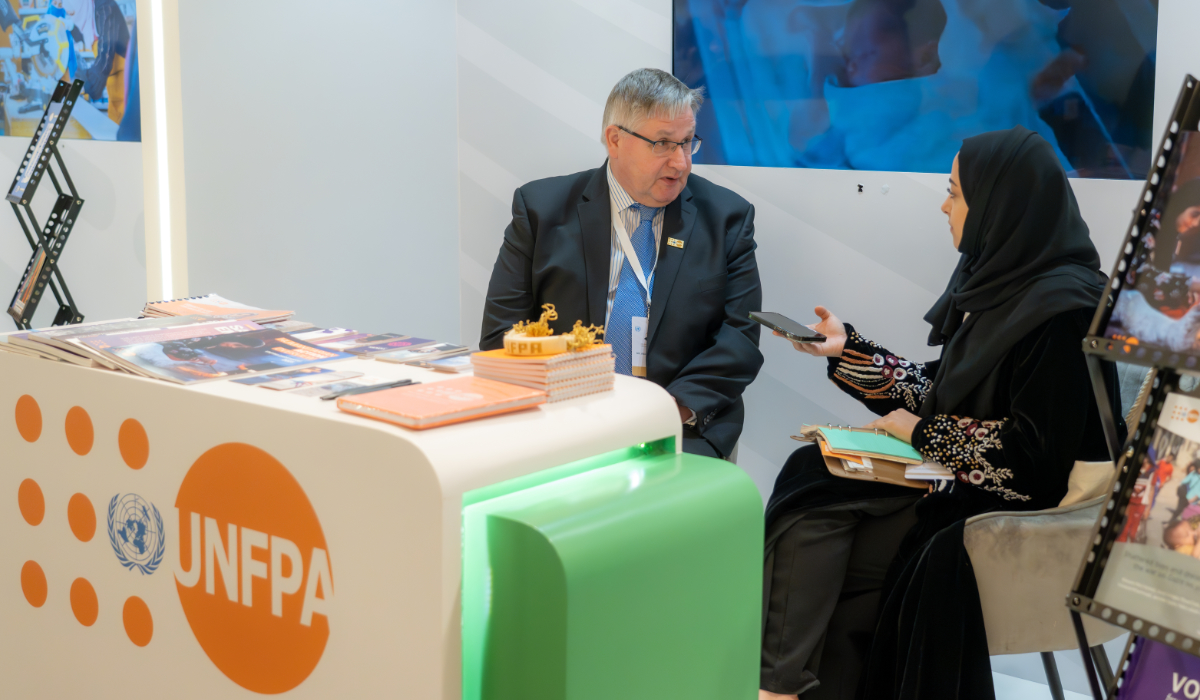


Saberton noted that displacement, people on the move, economic conditions, and cramped living conditions contributed to violence against women and girls. (AN photo by Jafar Al-Saleh)

Regionally, the UNFPA has numerous programs in place, including “delivering safe births in Gaza where there are mobile teams, and providing reproductive health services for 50,000 pregnant women in Gaza.”

When asked if the 50,000 figure from Gaza is on an annual or monthly basis, Saberton said that “at any moment in time there are 50,000 pregnant women in Gaza and the number is between 4,000-5,000 childbirths a month.

“In Yemen we are providing protection services, making sure there are protection services as well as maternal health services.

“In Sudan, we are working with displaced populations and providing maternal health services,” he said.

Saberton added that services are provided both in the form of health clinics and mobile teams, “to make sure that we make childbirth as safe as possible.”

The mobile clinics are providing health services to women and girls in humanitarian situations that are displaced and may not have access to physical health facilities if any are even available.

“Nobody should die in childbirth anywhere in the world,” Saberton said.

“Within any crisis, I am afraid the situation always gets worse for women and girls. For example, with maternal health and reproductive health. If you look at the world figures there are about 800 maternal deaths every day … 60 percent of maternal deaths occur in countries subject to fragile contexts or humanitarian contexts so the risk goes up,” he said.

“This is the reality of the situation.”

“It’s important to realize the humanitarian situation seems to be getting worse every day around the world.”

“Nearly half the countries that we work in — and we work in 150 countries and territories — nearly half, or 60 plus, are in a some form of humanitarian context and often those humanitarian crises are multifaceted; it could be conflict, climate change-related or economic instability.”

The causes of displacement, people on the move, the economic situation and cramped living conditions are some of the issues Saberton highlighted that increase violence against women and girls in humanitarian crises.

Saberton said that this is one of the reasons why the UNFPA has protection services on the ground.

“We are providing both safety and also providing well-being, and social support, but also medical facilities for any harm to women and girls.”

UNFPA is providing 1,600 human safe spaces where women have psychological support provided to them, and can access any health resources and facilities they might need.

Saberton was one of the forum’s speakers, and he said the event was “an excellent opportunity to talk, meet, and share ideas and knowledge with other humanitarian actors.

“This is the first KSrelief (Forum) I have been to over the four and it’s been an excellent experience to see how the work of KSrelief has grown the engagement and how it’s actually bringing partners together,” he told Arab News.

“Our partnership with KSrelief has grown over the years and has been a very important partner to us in the regional countries and we hope that will continue going forward.”


Saudi-EU relations: Huge progress achieved

Updated 8 sec ago
Follow

Saudi-EU relations: Huge progress achieved

  • European Parliament endorsed a roadmap to deepen EU-Saudi relations, backing negotiations toward a full strategic partnership
  • Lawmakers cited Saudi Arabia’s expanding diplomatic role, new opportunities for political and economic engagement under Vision 2030

RIYADH: The European Parliament on Tuesday endorsed a roadmap to boost EU-Saudi relations into a full-fledged strategic partnership, marking what Saudi Ambassador to the EU Haifa Al-Jedea described as “an important milestone” in the evolution of bilateral ties.

Parliamentarians overwhelmingly supported deepening collaboration with Saudi Arabia on the political, economic, and social levels in light of escalating tensions in the Middle East, acknowledging the Kingdom’s growing geopolitical role as a diplomatic actor who made significant contributions to regional and global stability.

The report recognizes the Kingdom’s expanding diplomatic footprint in the context of the wars in Gaza, Ukraine, and Yemen, as well as maritime security in the Red Sea.

It highlights Saudi Arabia’s hosting of peace talks, ceasefire negotiations, and its leading role in reviving the two-state solution for the longstanding Palestine-Israel conflict and inclusive peace processes across the region — including in Syria, Sudan, and Lebanon.

The report outlined enhanced cooperation across a wide spectrum — from energy security and economic diversification to human rights dialogue, regional diplomacy, and cross-cultural exchanges.

It comes at a time when the Kingdom is undergoing sweeping reforms under Vision 2030 and expanding its global role in regional diplomacy, infrastructure development, and green energy transitions.

Members of the European Parliament noted that Saudi Arabia’s reforms opened new opportunities for collaboration in areas of shared interest including economic diversification, innovation, climate action, education, and regional stability.

“The Kingdom is engaged in a broad process of transformation that is unprecedented in its scope,” Al-Jadea told Arab News.

“By unlocking new horizons for cooperation between Saudi Arabia and the EU, we can co-create solutions that advance growth, stability, and opportunity — not just for our peoples but for the wider global arena.”

The report, adopted by 417 votes in favor, backs the start of negotiations for a strategic partnership agreement with Saudi Arabia, describing it as a “pivotal opportunity” to align foreign policy, energy security, and regional stability under a common framework.

In line with the report, the EU has appointed for the first time a dedicated rapporteur for EU-Saudi relations.

“This reflects not only Saudi Arabia’s growing strategic importance — including as a leading member of the Gulf Cooperation Council — but also the Parliament’s intention to play a more proactive role in shaping this evolving partnership,” the report read.

The new rapporteur, Hana Jalloul Muro, vice-chair for the European Parliament’s Committee on Foreign Affairs, said in a statement that the report comes “at a pivotal moment, recognizing Saudi Arabia’s geopolitical role in Ukraine, Gaza and Syria.”

She reiterated support of this “engagement and progress” as EU-GCC strategic ties advance.

The report also underscored Saudi Arabia’s importance as both a traditional energy partner and a future green energy leader. It highlighted major potential for cooperation in renewables, green hydrogen, and critical raw materials.

The Kingdom’s pledge to produce four million tonnes of clean hydrogen annually by 2030 and achieve net-zero emissions by 2060 was commended as a cornerstone of future joint ventures.

Saudi Arabia is now among the top 10 global energy storage markets, with the EU aiming to leverage its advanced clean tech capabilities for joint sustainability projects.

The parliament also acknowledged Saudi Arabia’s strides in entrepreneurship and economic reform, inviting deeper cooperation on sustainable energy, critical raw materials, information technology, and entrepreneurship — areas where European investors and tech players are expected to play a growing role.

The report stressed that economic cooperation was “the cornerstone” of the Saudi-EU ties.

“Together, Saudi Arabia and Europe can reimagine how renewable energy and connectivity power sustainable growth, strengthen resilience, and link our regions in ways that benefit the global economy,” Al-Jedea told Arab News.

“Impactful growth can be achieved if we move forward together, with confidence, mutual respect, and a shared belief in a brighter future.”

While urging continued progress on reform, the European Parliament acknowledged Saudi Arabia’s “meaningful social transformation,” citing rising female workforce participation (now at 36 percent), the abolition of male guardianship restrictions, and the launch of curriculum reforms to promote tolerance.

It welcomed the EU-Saudi Human Rights Dialogue as a platform for mutual engagement, calling for more concrete outcomes — such as time-bound reforms and independent oversight.

It also urged faster progress on visa liberalization, calling on the European Commission to explore a Schengen visa waiver for Saudi citizens.

It recommended boosting academic and cultural exchange through Erasmus Mundus, Horizon Europe, and youth mobility programs.

Saudi Arabia’s growing contribution to tourism, investment and innovation in EU states — as well as the increasing number of Saudi nationals in senior diplomatic, academic, and entrepreneurial roles — were also emphasized as key trends shaping the future of bilateral ties.

Through the report, parliamentarians supported stronger foreign and security policy cooperation with the Kingdom to advance regional and global stability.

They called for greater efforts and collaboration with Saudi Arabia on counterterrorism and anti-radicalization efforts, as well as closer political and intelligence cooperation.

“Ultimately, the message is clear: the EU and Saudi Arabia share a strong mutual interest in working together,” the report read.

“With mutual respect, open dialogue, and a pragmatic, forward-looking approach, this partnership can contribute meaningfully to addressing the complex challenges of today’s interconnected world.”