

IFC, other lenders urge Pakistan to rethink move to renegotiate power contracts

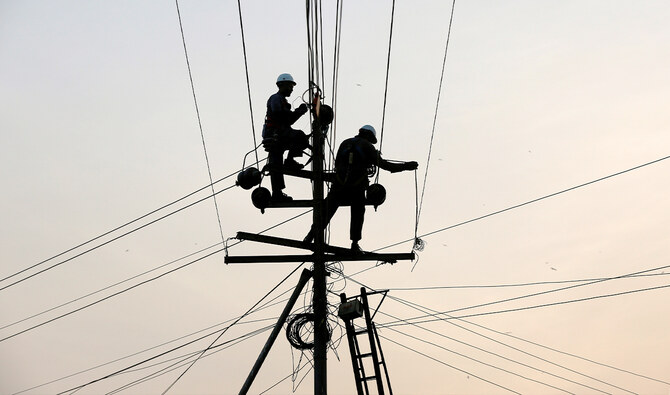
Technicians are silhouetted as they fix cables on a power transmission line in Karachi, Pakistan, on January 9, 2017. (REUTERS/File)
Short Url
Updated 25 February 2025
Follow

IFC, other lenders urge Pakistan to rethink move to renegotiate power contracts

  • Development finance institutions say contracts with independent power producers cannot be revised without lender approval
  • Pakistan is working to revise agreements with 14 IPPs to lower electricity tariffs and save approximately $5 billion to national exchequer

KARACHI: The International Finance Corp. and other global financial institutions have urged the Pakistan government to rethink its move to renegotiate power purchase agreements (PPAs) with wind and solar energy producers, saying contracts with independent power producers (IPPs) cannot be amended without prior lender approval, according to a letter seen by Arab News on Tuesday. 

Last month, the Pakistani cabinet approved revisions to agreements with 14 IPPs to lower electricity tariffs for households and businesses and save approximately Rs1.4 trillion ($5 billion) for the national exchequer. 

About a decade ago, Pakistan approved dozens of private projects by IPPs, financed mostly by foreign lenders, to tackle chronic shortages. But the deals, featuring incentives such as high guaranteed returns and commitments to pay even for unused power, resulted in excess capacity after a sustained economic crisis reduced consumption. Short of funds, the government had built those fixed costs and capacity payments into consumer bills, sparking protests by domestic users, industry bodies and political parties. 

The need to revisit the deals was an issue in talks for a critical staff-level pact with the International Monetary Fund (IMF) for a $7-billion bailout approved last year. 

In a letter signed by eight development finance institutions (DFIs) and addressed to the Pakistani ministries of finance and energy, the lenders have raised concern about the “non-consultative” nature of the contract renegotiation process and warned that it could undermine investor confidence.

“We... wish to emphasize that under the terms of their financing and investment agreements, the IPPs we have financed are not permitted to agree to changes to any major project document, including the PPA, without prior written approval from the lenders,” the letter, dated Feb. 18 and signed by agencies such as the World Bank’s International Finance Corporation (IFC), the Islamic Development Bank (IDB) and the Asian Development Bank (ADB), said. 

The letter acknowledged the challenges faced by Pakistan’s power sector and commended certain government measures aimed at addressing long-term structural issues.

However, it cautioned that “renegotiating PPAs in a non-consultative manner will be detrimental to the long-term development of the sector,” potentially eroding investor confidence and deterring essential future private investment.

The DFIs said they had collectively invested $2.7 billion in Pakistan over the past 25 years to support the development of the country’s power sector and create a conducive environment for private sector investment. 

“We hope the Government will reconsider its approach to PPA renegotiations and work to find alternative ways of solving the energy sector’s structural challenges,” the letter concluded. 

The letter comes after a visit to Pakistan by IFC Chief Makhtar Diop during which he said the organization aimed to invest $2 billion in the country annually over the next decade to support private sector growth.

Last October, Pakistan’s energy ministry said it had ended power purchase contracts with five private companies, including one with the country’s largest utility, Hub Power Company Ltd, that should have been in place until 2027, to cut costs.


Pakistan joins 22 Muslim states, OIC to condemn Israeli FM’s visit to Somaliland

Updated 08 January 2026
Follow

Pakistan joins 22 Muslim states, OIC to condemn Israeli FM’s visit to Somaliland

  • Israeli Foreign Minister Gideon Saar visited breakaway African region of Somaliland on January 6
  • Muslim states urge Israel to withdraw Somaliland recognition, respect Somalia’s sovereignty

ISLAMABAD: A joint statement by Pakistan, 22 other Muslim states and the Organization of Islamic Cooperation (OIC) on Thursday condemned Israeli Foreign Minister Gideon Saar’s recent visit to Somaliland as a violation of the African nation’s territorial integrity and sovereignty.

Saar’s visit to Somaliland capital Hargeisa on Jan. 6 followed Israel’s move last month to recognize Somaliland, a breakaway region from Somalia, as an independent country. The move drew a sharp reaction from Muslim states, including Pakistan, who said it was in contravention of the UN Charter and international norms. 

Several international news outlets months earlier reported that Israel had contacted Somaliland over the potential resettlement of Palestinians forcibly removed from Gaza. Muslim countries fear Israel’s recognition of the breakaway region could be part of its plan to forcibly relocate Palestinians from Gaza to the region. 

“The said visit constitutes a clear violation of the sovereignty and territorial integrity of the Federal Republic of Somalia, and undermines established international norms and the United Nations Charter,” the joint statement shared by Pakistan’s foreign office, read. 

The joint statement was issued on behalf of 23 Muslim states, including Saudi Arabia, Bangladesh, Pakistan, Egypt, Iraq, Iran, Palestine, Jordan, Kuwait, Türkiye, Oman and others. 

It reaffirmed support for Somalia’s territorial integrity and sovereignty, pointing out that respect for international law and non-interference in the internal affairs of sovereign states was necessary for regional stability. 

“Encouraging secessionist agendas are unacceptable and risk exacerbating tensions in an already fragile region,” the statement said. 

The joint statement urged Israel to revoke its recognition of the breakaway region. 

“Israel should fully respect Somalia’s sovereignty, national unity and territorial integrity and honor its obligations in compliance with international law, and demand immediate revocation of the recognition issued by Israel,” the statement read.

Somaliland broke away from Somalia unilaterally in 1991 as a civil war raged in the country. Somaliland has its own constitution, parliament and currency, a move that has infuriated Somalia over the years as it insists the region is part of its territory.