

New York City announces it will close migrant center in Pakistan-owned Roosevelt Hotel

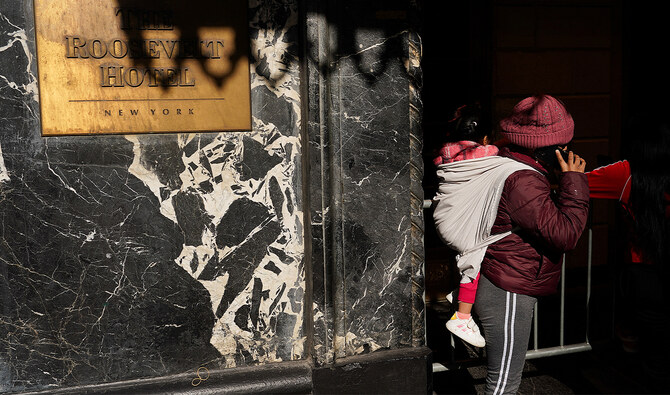
A migrant carrying a child speaks on the phone outside of The Roosevelt Hotel after New York City Mayor Eric Adams announced the forthcoming closure of the Asylum Seeker Arrival Center and Humanitarian Emergency Response and Relief Center located at The Roosevelt Hotel, in midtown Manhattan in New York City, US, on February 24, 2025. (REUTERS/File)
Short Url
Updated 25 February 2025
Follow

New York City announces it will close migrant center in Pakistan-owned Roosevelt Hotel

  • NYC struck $220 million deal in 2023 to convert hotel, owned by Pakistan’s national carrier PIA, into migrant shelter
  • Roosevelt is one of over 50 shelters that New York has closed or announced it will shutter as migrant arrivals decrease

ISLAMABAD: New York City Mayor Eric Adams this week announced his government would close “in the coming months” a migrant processing center and shelter for asylum seekers housed since 2023 in the Pakistan-owned Roosevelt Hotel, citing the easing of the US migrant crisis.

The Roosevelt Hotel, owned by Pakistan International Airlines (PIA), closed to guests in December 2020 after the coronavirus pandemic shuttered the tourism industry worldwide. The site is one of more than 50 shelters that New York has closed or announced it will shutter as the number of new migrant arrivals has decreased due to strict immigration policies by the previous and new American administrations. Since taking power, US President Donald Trump has ended access to CBP One, a popular scheduling app for asylum seekers, and also stepped up enforcement at the US-Mexico border.

According to the New York City government’s projections, its efforts to reduce care for migrants will save more than $5 billion over the next three fiscal years.

“The Roosevelt Hotel, which has served as both our asylum arrival center and a humanitarian emergency response and relief center for nearly two years, will be closing in the coming months,” Adams said in a video message.

“While we are not done caring for those who came into our care, today marks another milestone in demonstrating the immense progress we have achieved in turning the corner on the unprecedented international humanitarian effort.”

The Roosevelt hotel is located in a prime midtown Manhattan location, steps from Grand Central Terminal and some of the highest-priced office buildings on Park Avenue. As per a report in The New York Times, NYC struck a $220 million, three-year deal with PIA to convert the hotel into a shelter in 2023. The city agreed to pay a nightly rate of $202 per room in the hotel, which has more than 1,000 rooms. The hotel has since served as an arrival center for migrants where they could get access to vaccines, food and other resources. 

A report published in Bloomberg said the number of migrants arriving to New York had fallen to 350 a week, down from a peak of about 4,000. It said the Roosevelt Hotel, which had taken in over 173,000 migrants since it opened as a shelter, had “struggled to keep up with the influx” of migrants.

Adams’ announcement comes after Vivek Ramaswamy, now a member of Trump’s cabinet, criticized New York’s deal with PIA in December 2024.

“A taxpayer-funded hotel for illegal migrants is owned by the Pakistani government which means NYC taxpayers are effectively paying a foreign government to house illegals in our own country,” Ramaswamy wrote on social media platform X. 


Pakistan says economy stabilizing as it looks to 2026 growth

Updated 4 sec ago
Follow

Pakistan says economy stabilizing as it looks to 2026 growth

  • Inflation averages 5 percent, remittances hit $16.1 billion as government cites signs of recovery
  • IT exports, industry and development spending highlighted as focus shifts to next year’s targets

ISLAMABAD: Pakistan’s economy has shown signs of stabilization in the first half of the current fiscal year, Planning Minister Ahsan Iqbal said on Thursday, as the government looks ahead to sustaining growth momentum into 2026 after several years of economic volatility.

Briefing the media on economic performance through November, Iqbal said key indicators including inflation, industrial output, exports, remittances and fiscal revenues had improved, creating what he described as a more stable base for forward planning.

Pakistan has spent much of the past two years navigating high inflation, external financing pressures and fiscal tightening under an IMF-backed reform program. While growth remains modest, officials say recent data suggests the economy has moved out of crisis mode and into a consolidation phase.

“During July to November of fiscal year 2025–26, stability has returned to Pakistan’s economy,” Iqbal said, adding that average inflation during the period stood at around 5 percent, compared with 7.9% last year, easing pressure on households and businesses.

Large-scale manufacturing posted growth of 4.1 percent, which Iqbal described as “clear evidence of recovery in industrial activity.”

The planning minister said government revenues also improved, with Federal Board of Revenue collections reaching Rs4,733 billion ($16.9 billion) during July–November, reflecting a 10.2% increase.

External inflows remained resilient, with workers’ remittances rising 9.3% to $16.1 billion, while IT services exports increased 19% to $1.8 billion over the same period, he said.

On the public investment side, Iqbal said Rs196 billion ($700 million) were released under the development budget during the quarter, of which Rs92 billion ($329 million) had already been spent. He added that cost rationalization in development projects between July and October saved Rs3.3 billion ($11.8 million) billion in public funds.

In November, the planning minister said, the Central Development Working Party approved 10 development projects, while six major schemes were referred to the Executive Committee of the National Economic Council.

Iqbal said the approved projects were expected to create 994 immediate jobs, with nearly 24,859 direct and 40,873 indirect employment opportunities projected overall.

Looking ahead, he said all future development schemes would be required to comply with green building codes to ensure environmental protection and sustainable growth.

He also highlighted skills and innovation initiatives, saying that under the “Uraan Pakistan” program, partnerships with Oxford and Cambridge universities were being pursued to promote research, technology and innovation.

Under an IT industry revival plan, he said more than 20,000 young people were being trained in advanced technologies, with over 14,000 new jobs expected to be created.

The government has said maintaining macroeconomic stability while gradually lifting growth remains its central challenge as Pakistan moves into 2026, with officials emphasising disciplined spending, export growth and job creation as key priorities.