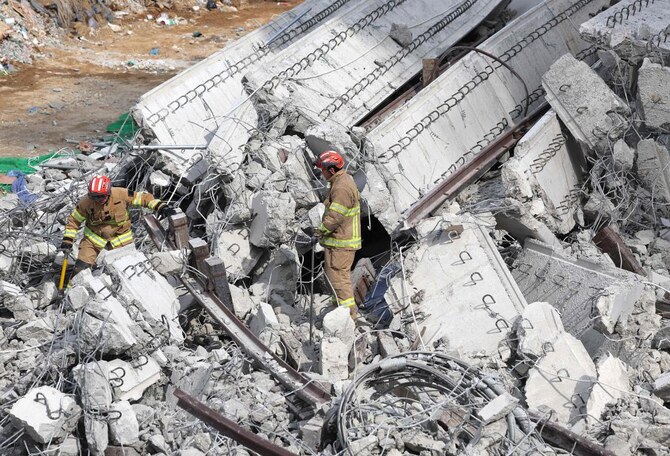
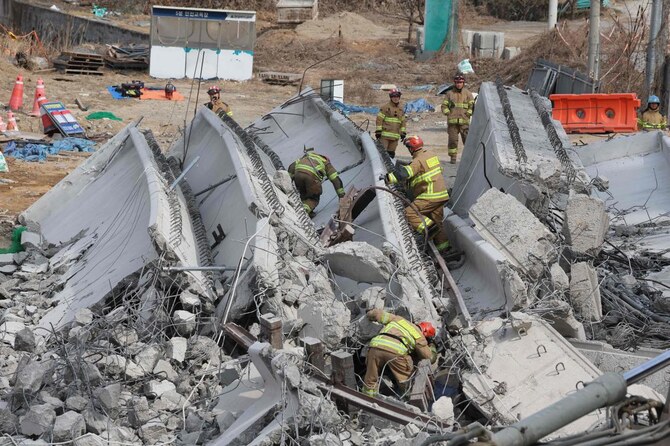
SEOUL: Elevated parts of a highway under construction collapsed in South Korea on Tuesday, killing four workers and injuring six others, officials said.
Ten people were working on the site in the city of Cheonan, about 90 kilometers south of Seoul. They fell when it collapsed and were trapped in the rubble, the National Fire Agency said.
One was found dead in the rubble. Eight injured workers were sent to hospitals before two of them were declared dead there later, according to fire agency officials.
The fire agency said in a statement that five remained in serious condition. It said that rescue workers were trying to find the missing worker.
The cause of the collapse wasn’t immediately known.
Acting President Choi Sang-mok urged authorities to mobilize all available personnel and equipment to salvage the workers.

Four killed as elevated part of South Korea highway being built collapses
Short Url
https://arab.news/p5vx4
Four killed as elevated part of South Korea highway being built collapses
- Ten people were working on the site in the city of Cheonan, about 90 kilometers south of Seoul
- Eight injured workers were sent to hospitals before two of them were declared dead there later
Sri Lanka arrests former intelligence chief over 2019 Easter bombings
- Retired Maj. Gen. Suresh Sallay was taken into custody at dawn in a suburb of the capital
- Sallay accused of involvement in the coordinated suicide bombings, a charge he has denied
COLOMBO: Sri Lanka’s criminal investigators arrested the country’s former intelligence chief on Wednesday in connection with the 2019 Easter Sunday bombings that killed 279 people, police said.
Retired Maj. Gen. Suresh Sallay was taken into custody at dawn in a suburb of the capital, police said.
“He was arrested for conspiracy and aiding and abetting the Easter Sunday attacks,” an investigating officer said.
Sallay, who was promoted to State Intelligence Service (SIS) chief in 2019 after Gotabaya Rajapaksa became president, had been accused of involvement in the coordinated suicide bombings, a charge he has denied.
British broadcaster Channel 4 reported in 2023 that Sallay was linked to the Islamist bombers and had met them prior to the attack.
A whistleblower told the network that he had permitted the attack to proceed with the intention of influencing that year’s presidential election in favor of Rajapaksa.
Two days after the bombings, Rajapaksa declared his candidacy and went on to win the November vote in a landslide after promising to stamp out Islamist extremism.
Sallay was promoted to head the SIS, Sri Lanka’s main intelligence agency, following Rajapaksa’s victory, but was dismissed after Anura Kumara Dissanayake won the presidency in 2024, promising prosecutions of those behind the attack.
In the aftermath, officials blamed a local militant group for the suicide bombings on three churches and three hotels, but Sallay was also accused of orchestrating the attack.
Other investigations faulted the authorities for failing to act on warnings from an Indian intelligence agency that an attack was imminent.
More than 500 people were wounded in the bombings, which also killed 45 foreigners and crippled the island nation’s lucrative tourism industry.
The Supreme Court fined then-President Maithripala Sirisena and four senior officials more than $1.03 million in a civil case for their failure to prevent the attacks.
The UN has asked Sri Lanka to publish parts of previous inquiries into the bombings that were withheld from the public.
Retired Maj. Gen. Suresh Sallay was taken into custody at dawn in a suburb of the capital, police said.
“He was arrested for conspiracy and aiding and abetting the Easter Sunday attacks,” an investigating officer said.
Sallay, who was promoted to State Intelligence Service (SIS) chief in 2019 after Gotabaya Rajapaksa became president, had been accused of involvement in the coordinated suicide bombings, a charge he has denied.
British broadcaster Channel 4 reported in 2023 that Sallay was linked to the Islamist bombers and had met them prior to the attack.
A whistleblower told the network that he had permitted the attack to proceed with the intention of influencing that year’s presidential election in favor of Rajapaksa.
Two days after the bombings, Rajapaksa declared his candidacy and went on to win the November vote in a landslide after promising to stamp out Islamist extremism.
Sallay was promoted to head the SIS, Sri Lanka’s main intelligence agency, following Rajapaksa’s victory, but was dismissed after Anura Kumara Dissanayake won the presidency in 2024, promising prosecutions of those behind the attack.
In the aftermath, officials blamed a local militant group for the suicide bombings on three churches and three hotels, but Sallay was also accused of orchestrating the attack.
Other investigations faulted the authorities for failing to act on warnings from an Indian intelligence agency that an attack was imminent.
More than 500 people were wounded in the bombings, which also killed 45 foreigners and crippled the island nation’s lucrative tourism industry.
The Supreme Court fined then-President Maithripala Sirisena and four senior officials more than $1.03 million in a civil case for their failure to prevent the attacks.
The UN has asked Sri Lanka to publish parts of previous inquiries into the bombings that were withheld from the public.
© 2026 SAUDI RESEARCH & PUBLISHING COMPANY, All Rights Reserved And subject to Terms of Use Agreement.