Ship that caused deadly Baltimore bridge collapse has been refloated and is moving back to port

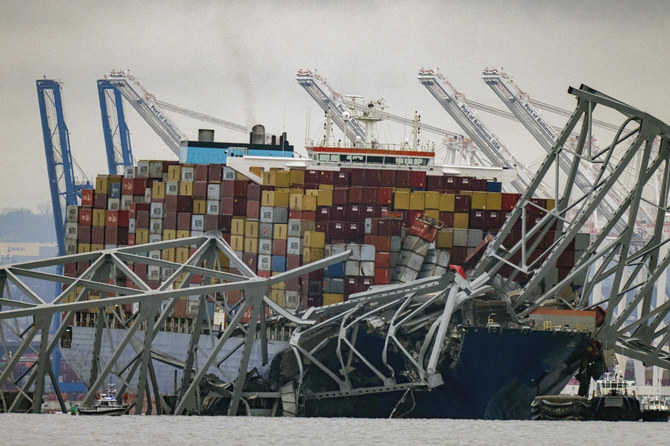
The ship appeared to start moving shortly after 6 a.m. as crews started to maneuver it out of the wreckage. (AP)
Short Url
Updated 20 May 2024
Follow

Ship that caused deadly Baltimore bridge collapse has been refloated and is moving back to port

  • The disaster killed six construction workers and snarled traffic into Baltimore Harbor
  • Several tugboats are escorting the Dali on its 2.5-mile path to the marine terminal

BALTIMORE: The container ship that caused the deadly collapse of Baltimore’s Francis Scott Key Bridge was refloated Monday and has begun slowly moving back to port.
The Dali has remained at the collapse site since it lost power and crashed into one of the bridge’s supporting columns on March 26, killing six construction workers and snarling traffic into Baltimore Harbor.
The ship appeared to start moving shortly after 6 a.m. as crews started to maneuver it out of the wreckage. It started and stopped a few times before slowly backing away from the collapse site.
Officials said it would move at about 1 mph on the roughly 2.5-mile (4-kilometer) trip, a fraction of the speed it was traveling when it lost power and crashed into the bridge. Pieces of the bridge’s steel trusses protruded from its bow, which remained covered in concrete from the collapsed roadway.
Officials have said they plan to unload the ship’s containers and complete some short-term repairs while it’s docked in Baltimore.
Monday morning’s high tide had been expected to bring the best conditions for crews to refloat and start moving the ship, according to a statement from the Key Bridge Response Unified Command.
Several tugboats were escorting the Dali on its path to the marine terminal. The work is expected to last at least 21 hours.
Crews conducted a controlled demolition on May 13 to break down the largest remaining span of the collapsed bridge.
The Dali experienced four electrical blackouts within about 10 hours before leaving the Port of Baltimore for Sri Lanka and hitting the bridge, according to a preliminary report issued by the National Transportation Safety Board.


China says Philippines distorted facts about incident near disputed atoll

Updated 2 sec ago
Follow

China says Philippines distorted facts about incident near disputed atoll

BEIJING: China’s defense ministry accused the Philippines on Wednesday of distorting the facts about an incident involving the Chinese coast guard and Filipino fishermen near a South China Sea shoal, a charge Manila strongly rejected.
The Philippine coast guard said over the weekend that three Filipino fishermen were injured and two fishing vessels damaged when Chinese coast guard ships cut their anchor lines and fired water cannon near the Sabina Shoal on Friday, actions the Philippine defense secretary denounced as “dangerous” and “inhumane.”
The Chinese ministry defended its coast guard’s actions as “reasonable, lawful, professional and restrained,” and vowed to “take strong and effective measures” in response to “all acts of infringement and provocation,” according to a statement released on its social media account.
“The Philippine side amassed a large number of ships in an organized and premeditated manner to illegally intrude” into the atoll’s lagoon, the ministry said. “Philippine personnel even threatened Chinese coast guard on site with a knife,” it added.
Philippine defense ministry spokesperson Arsenio Andolong maintained that Manila has evidence to counter China’s assertions.
“The facts are not distorted. They are documented, timestamped, and corroborated by video recordings, vessel logs, and on-site reporting by the Philippine Coast Guard,” Andolong said in a statement.
“The Philippines is not hyping the issue, the facts speak for themselves. These are aggressive and excessive actions of an encroaching state,” he added.
Sabina Shoal, which China refers to as Xianbin Reef and the Philippines as the Escoda Shoal, lies in the Philippines’ exclusive economic zone 150 km (95 miles) west of Palawan province.
China claims almost the entire South China Sea, a waterway supporting more than $3 trillion of annual commerce. The areas Beijing claims cut into the exclusive economic zones of Brunei, Indonesia, Malaysia, the Philippines and Vietnam.
An international arbitral tribunal ruled in 2016 that Beijing’s sweeping claims had no basis under international law, a decision China rejects.