

‘Complete overhaul’: What went wrong for Pakistan in Champions Trophy

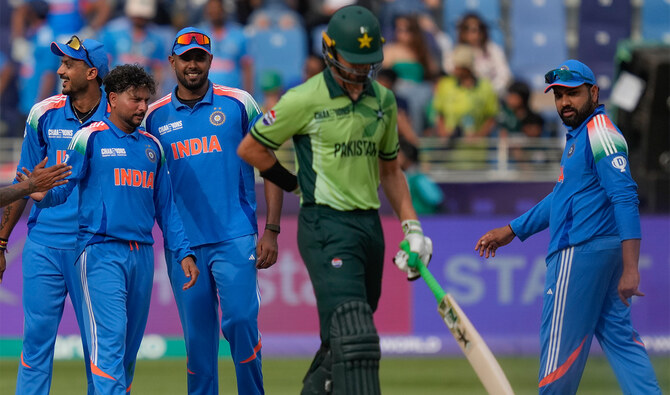
India's Kuldeep Yadav, second from left, celebrates with teammate the wicket of Pakistan's Shaheen Afridi, second from right, during the ICC Champions Trophy cricket match between India and Pakistan at Dubai International Cricket Stadium, United Arab Emirates, on Feb. 23, 2025. (AP)
Short Url
Updated 25 February 2025
Follow

‘Complete overhaul’: What went wrong for Pakistan in Champions Trophy

  • Pakistan was plagued with injuries to destructive openers Fakhar Zaman, Saim Ayub 
  • Cricket analysts say Pakistan played cautious and outdated cricket in tournament 

KARACHI: Title-holders and hosts Pakistan crashed out in the group phase of the Champions Trophy after losing to New Zealand and arch-rivals India.
They still have a match to play, against Bangladesh on Thursday, but their tournament is over — a disappointing end to their first hosting of a major international cricket event in three decades.
AFP Sport looks at where it all went wrong for Mohammad Rizwan’s men in the 50-over tournament:

- Uncertain build-up -
Rizwan was appointed white-ball skipper in October last year and led Pakistan to an impressive 2-1 ODI win over world champions Australia — their first series victory in 22 years in the country.
They also won in Zimbabwe and inflicted on South Africa their first home whitewash, with a 3-0 scoreline.
But fast-rising opener Saim Ayub injured his ankle during a subsequent Test in South Africa.
Pakistan delayed the announcement of their Champions Trophy squad until the deadline to wait on Ayub’s fitness but the left-hander failed to recover.
To add to the home team’s woes, fellow opener Fakhar Zaman was ruled out of the rest of the tournament after the first match — a 60-run defeat to New Zealand — with a muscle injury.
Pakistan’s much-vaunted pace attack of Shaheen Afridi, Naseem Shah and Haris Rauf — rested from the Test series to keep them fresh — looked rusty and failed to control the death overs.

- Poor squad selection -
Pakistan selectors resisted calls from former players and pundits to include a second spinner in the 15-man squad and instead chose only one in Abrar Ahmed.
They relied on part-time spinners Salman Agha and Khushdil Shah, who have managed just one wicket between them in two matches.
Pakistan also erred by not selecting a regular opener and took the risky step of promoting out-of-form Babar Azam to partner Zaman.
When Zaman was ruled out they brought in Imam-ul-Haq as a replacement. He made just 10 as Pakistan were crushed by title favorites India by six wickets.
In a surprise move they included in the squad all-rounders Khushdil and Faheem Ashraf on the basis of their performances in Bangladesh’s Twenty20 league.
Ashraf had not played an ODI for two years and Khushdil for three.
Former Pakistan captain and television pundit Rashid Latif called it a “political selection,” blaming outside influence

- Old-style cricket -
Former Pakistan captain and popular all-rounder Shahid Afridi accused Pakistan of playing outdated cricket.
“In 2025 Pakistan was playing the cricket style of the 1980s and 1990s while other teams had progressed well to adopt an aggressive and modern style,” he told AFP.
“The ailment of playing too many dot balls also hurt our game.”
Pakistan played 152 dot balls against India in scoring 241 in 49.4 overs, including a record 28 balls with no scores in the first six overs.
Their total of 260 in 47.2 overs in the defeat to New Zealand had 162 dot balls.
“The mindset of Pakistan players does not match with modern-day cricket,” said Afridi.
“We need a complete overhaul of the system so that we can produce players with an aggressive mindset.”


MESIF 2026 wraps up in Riyadh with spotlight on legacy, fans and sustainable sports growth

Updated 6 sec ago
Follow

MESIF 2026 wraps up in Riyadh with spotlight on legacy, fans and sustainable sports growth

  • A recurring theme in panel discussions was the importance of moving beyond siloed planning toward connected strategies
  • Abdullah Aldrees: I believe Saudi is a sleeping giant within the football ecosystem because of the high demand that exists

RIYADH: The sixth edition of the Middle East Sports Investment Forum concluded on Jan. 28 in Riyadh, reinforcing the need for long-term legacy planning, integrated infrastructure development and fan-centric strategies as the region’s sports ecosystem continues to mature.

Held over two days — Jan. 27-28 — at the ministry of investment headquarters and the Kingdom Arena, the forum brought together senior government officials, global sports executives, investors and technology leaders to assess how the Middle East — and Saudi Arabia in particular — can translate major event hosting and increased investment into sustainable impact.

A recurring theme in panel discussions was the importance of moving beyond siloed planning toward connected strategies that link infrastructure, finance, fan engagement and legacy from the earliest stages of project development.

Dr. Sakis Batsilas, deputy CEO of FIFA World Cup Qatar 2022, stressed that while international expertise has played a key role in the region’s rapid progress, long-term success depends on knowledge transfer and talent development.

“Yes, we do need experts and consultants and expatriates to help,” he said. “But the main, I would say, focus, is how we ensure that we transfer this knowledge and we build talent … to make sure we have the right talent.”

Drawing on his experience delivering major global events, Batsilas highlighted the need to embed legacy considerations during the bidding phase.

“Talking now from an operational point of view … I think everything starts with a bidding phase,” he said, adding that stronger legacy metrics would encourage greater long-term planning from host nations and rights holders alike.

Fan experience and commercialization also featured prominently, particularly as Saudi Arabia continues to expand its domestic leagues and host major international competitions. David Davies, chief experience officer of Catapult, said the Kingdom’s challenge lies in converting strong digital fandom into sustained in-stadium engagement.

“Saudi Arabia is … ranked consistently in the highest in the world” in terms of football fandom, Davies said. “However, attendance in-stadium is still developing.” He noted that younger, digitally native audiences require tailored engagement strategies. “The days of being able to ask them to come to you have gone,” he said.

From a government and delivery perspective, Abdullah Aldrees, chief of staff at the vice minister’s executive office at the ministry of sport, said MESIF highlighted the scale of opportunity ahead — and the importance of a joined-up approach.

“I believe Saudi is a sleeping giant within the football ecosystem because of the high demand that exists, the government support and the anchor IPs that we’re hosting,” Aldrees said. “So all of this can create a lot of opportunities for football to grow in Saudi.”

He said the Kingdom has entered a critical preparation phase as it gears up for a packed calendar of major events. “We are now living in the preparation phase. We’re preparing for all these IPs, we’re preparing for all these big events coming up,” Aldrees said. “So how do you make sure that you really reap the right benefit from them and have the right legacy?”

Pointing to upcoming milestones such as the AFC Asian Cup Saudi Arabia 2027 and the FIFA World Cup 2034, Aldrees emphasized the need to think beyond hosting.

“Yes, we’re hosting World Cup. We’re hosting Asia 2027, but how do you make sure that they have a long, lasting impact on the ecosystem?” he said.

Echoing a key message from the forum, Aldrees concluded: “The effective strategy is to be looking at these things together. We no longer can be looking at them as silos and test cycles.”

The transformation of Saudi football was also highlighted as a reflection of broader cultural and structural change. Juan Esteban Gomez, a football expert specializing in digitalization and artificial intelligence, said the shift has been tangible in recent years. “The people here are breathing football,” he said, describing the Saudi league as “one of the most enjoyable competitions in the world.”

As MESIF 2026 drew to a close, participants agreed that the next phase of sports investment in the Middle East will be defined by execution — ensuring that capital, policy and innovation align to deliver measurable legacy, deeper fan engagement and resilient ecosystems capable of sustaining growth well beyond headline events.