

EU must condemn Israeli atrocities at top-level meeting: Human Rights Watch

More than 100 civil society organizations, including HRW, urged the EU in a letter to center discussions with Saar on the potential suspension of the agreement. (FILE/AFP)
Short Url
Updated 24 February 2025
Follow

EU must condemn Israeli atrocities at top-level meeting: Human Rights Watch

  • ‘There can be no business as usual with a government responsible for crimes against humanity and acts of genocide’
  • ‘Unless the EU drastically changes course, it will provide a blank check for further abuses’

LONDON: EU officials must condemn Israeli atrocities and violations of international law at the EU-Israel Association Council meeting on Monday, Human Rights Watch has urged.

The meeting will be led by EU High Representative Kaja Kallas and Israeli Foreign Minister Gideon Saar.

Kallas will be joined by EU foreign ministers. Together, they should “signal an end to the bloc’s reluctance to acknowledge and address Israel’s war crimes, crimes against humanity — including apartheid — and acts of genocide,” HRW said.

Last February, Spain and Ireland requested a suspension to the EU-Israel Association Agreement due to Israel’s grave abuses of its human rights obligations. The request has yet to be answered by the EU.

The Association Council is the EU’s top-level bilateral meeting with Israel, held as part of the agreement.

The last meeting took place in October 2022 following a 10-year pause initiated by Israel over discontent with the EU’s condemnation of settlement-building in the Occupied Territories.

Claudio Francavilla, associate EU director at HRW, said: “There can be no business as usual with a government responsible for crimes against humanity, including apartheid, and acts of genocide, and whose sitting prime minister is wanted for atrocity crimes by the International Criminal Court.

“The only purpose of this Association Council meeting should be to call out those crimes and to announce long overdue measures in response.”

More than 100 civil society organizations, including HRW, urged the EU in a letter to center discussions with Saar on the potential suspension of the agreement.

Article 2 names human rights and democratic principles as “essential elements” which, if violated, can lead to the suspension of the treaty.

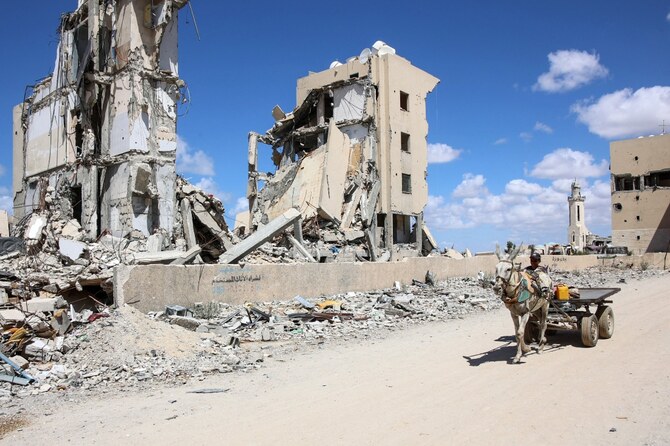
HRW has documented extensive abuses by Israel during the conflict in Gaza, including war crimes, ethnic cleansing, crimes against humanity and acts of genocide.  

The EU has yet to adopt any “concrete measure to press Israeli authorities” to halt these abuses, HRW warned. Any move by the bloc requires unanimous approval by its 27 members.

Several EU foreign ministers have criticized the International Criminal Court’s issuing of arrest warrants for Israeli Prime Minister Benjamin Netanyahu and former Defense Minister Yoav Gallant.

The EU approved two rounds of sanctions against Israeli settlers who had committed abuses in the West Bank, but fell short of punishing the authorities who have enabled them, HRW said.

EU states also continue to export weapons to Israel despite the risk of complicity in war crimes.

A smear campaign led by Israel also saw the EU and its member states pause, and in some cases fully end, support for the UN Relief and Works Agency, which provides vital services to Palestinian refugees.

Francavilla said: “Europe’s reluctance to condemn and address Israel’s atrocity crimes has fueled them and given rise to well-grounded accusations of EU double standards.

“Unless the EU drastically changes course, it will provide a blank check for further abuses and continue to undermine the EU’s stated commitment to human rights and the rules-based international order.”


Over 2,200 Daesh detainees transferred to Iraq from Syria: Iraqi official

Updated 08 February 2026
Follow

Over 2,200 Daesh detainees transferred to Iraq from Syria: Iraqi official

  • Iraq is still recovering from the severe abuses committed by the terrorists

BAGHDAD: Iraq has so far received 2,225 Daesh group detainees, whom the US military began transferring from Syria last month, an Iraqi official told AFP on Saturday.
They are among up to 7,000 Daesh detainees whose transfer from Syria to Iraq the US Central Command (CENTCOM) announced last month, in a move it said was aimed at “ensuring that the terrorists remain in secure detention facilities.”
Previously, they had been held in prisons and camps administered by the Kurdish-led Syrian Democratic Forces (SDF) in northeast Syria.
The announcement of the transfer plan last month came after US envoy to Syria Tom Barrack declared that the SDF’s role in confronting Daesh had come to an end.
Saad Maan, head of the security information cell attached to the Iraqi prime minister’s office, told AFP on Saturday that “Iraq has received 2,225 terrorists from the Syrian side by land and air, in coordination with the international coalition,” which Washington has led since 2014 to fight Daesh.
He said they are being held in “strict, regular detention centers.”
A Kurdish military source confirmed to AFP the “continued transfer of Daesh detainees from Syria to Iraq under the protection of the international coalition,” using another name for Daesh.
On Saturday, an AFP photographer near the Kurdish-majority city of Qamishli in northeastern Syria saw a US military convoy and 11 buses with tinted windows.

- Iraq calls for repatriation -

Daesh seized swathes of northern and western Iraq starting in 2014, until Iraqi forces, backed by the international coalition, managed to defeat it in 2017.
Iraq is still recovering from the severe abuses committed by the terrorists.
In recent years, Iraqi courts have issued death and life sentences against those convicted of terrorism offenses.
Thousands of Iraqis and foreign nationals convicted of membership in the group are incarcerated in Iraqi prisons.
On Monday, the Iraqi judiciary announced it had begun investigative procedures involving 1,387 detainees it received as part of the US military’s operation.
In a statement to the Iraqi News Agency on Saturday, Maan said “the established principle is to try all those involved in crimes against Iraqis and those belonging to the terrorist Daesh organization before the competent Iraqi courts.”
Among the detainees being transferred to Iraq are Syrians, Iraqis, Europeans and holders of other nationalities, according to Iraqi security sources.
Iraq is calling on the concerned countries to repatriate their citizens and ensure their prosecution.
Maan noted that “the process of handing over the terrorists to their countries will begin once the legal requirements are completed.”