Bangladeshi students, who ousted former PM Hasina, set to launch political party

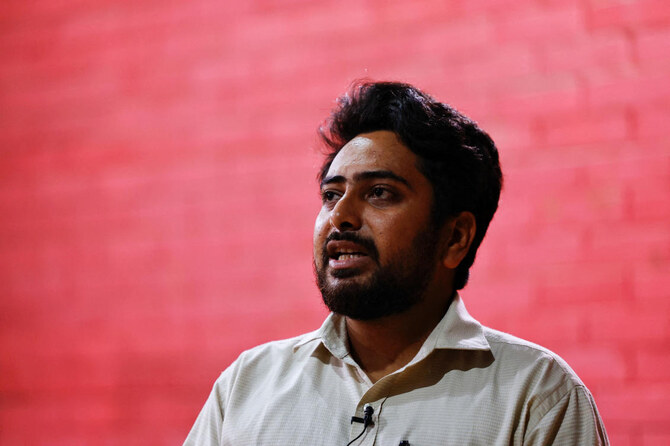
Nahid Islam, a student leader and adviser to the interim government, is expected to lead the party as convener. (Reuters)
Short Url
Updated 24 February 2025
Follow

Bangladeshi students, who ousted former PM Hasina, set to launch political party

  • The student group is finalizing plans to launch the new party during an event likely on Wednesday
  • Nahid Islam, a student leader and adviser to the interim government, is expected to lead the party as convener

DHAKA: Bangladeshi students, who were at the forefront of last year’s protests that ousted then Prime Minister Sheikh Hasina, are set to launch a political party this week, two sources with direct knowledge of the development said.
The Students Against Discrimination (SAD) group spearheaded the protests that began as a student-led movement against public sector job quotas but quickly morphed into a broader, nationwide uprising that forced Hasina to flee to India as the unrest peaked in early August.
The student group is finalizing plans to launch the new party during an event likely on Wednesday, said the sources who did not want to be named as they are not authorized to speak to the media.
Nahid Islam, a student leader and adviser to the interim government that took charge of Bangladesh after Hasina’s exit, is expected to lead the party as convener, the sources said.
Islam has been a key figure in advocating for student interests within the interim government, led by Nobel laureate Muhammad Yunus, which has been at the helm of Bangladesh since August 2024. He is expected to resign from his current role to focus on leading the new political party.
Islam did not immediately respond to a request for comment.
Yunus has said that elections could be held by the end of 2025, and many political analysts believe that a youth-led party could significantly reshape the country’s political landscape. Yunus has said he was not interested in running.
Yunus’ office did not immediately respond to a request for comment on the launch of the student-led political party.
The South Asian nation has been grappling with political unrest since Hasina left following weeks of protests during which more than 1,000 people were killed.
Officials from Hasina’s former government and security apparatus systematically committed serious human rights violations against the protesters during the uprising, the UN human rights commission said this month.
Hasina and her party deny any wrongdoing.


Cambodia says Thailand bombs casino hub on border

Updated 18 December 2025
Follow

Cambodia says Thailand bombs casino hub on border

  • The renewed fighting between the Southeast Asian neighbors this month has killed at least 21 people in Thailand and 17 in Cambodia, while displacing around 800,000

PHNOM PENH: Cambodia said Thailand’s military on Thursday bombed the casino town of Poipet, a major crossing between the two nations, as foreign powers pressured them to halt reignited border clashes.
Thai forces “dropped two bombs in the area of Poipet Municipality, Banteay Meanchey Province” at around 11:00 am (0400 GMT) Thursday, the Cambodian defense ministry said in a statement.
Thailand has not yet confirmed any strike on Poipet — a bustling casino hub popular with Thai gamblers.
The renewed fighting between the Southeast Asian neighbors this month has killed at least 21 people in Thailand and 17 in Cambodia, while displacing around 800,000, officials said.
The conflict stems from a territorial dispute over the colonial-era demarcation of their 800-kilometer (500-mile) border and a smattering of ancient temple ruins situated on the frontier.
Each side has blamed the other for instigating the fresh fighting and traded accusations of attacks on civilians.
Thailand said Tuesday that between 5,000 and 6,000 Thai nationals remained stranded in Poipet after Cambodia closed its land border crossings with its neighbor.
Cambodia’s interior ministry said the border closures were a “necessary measure” to reduce risks to civilians amid the ongoing combat, adding that air travel remained an option for those seeking to leave.
At least four casinos in Cambodia have been damaged by Thai strikes, the interior ministry said this week.
- ‘Shuttle-diplomacy’ -
Five days of fighting between Cambodia and Thailand in July killed dozens of people before a truce was brokered by the United States, China and Malaysia, and then broken within months.
US President Donald Trump, who has repeatedly intervened in the long-standing conflict this year, claimed last week that the two countries had agreed to a new ceasefire.
But Bangkok denied any truce had been agreed, and fighting with artillery, tanks, drones and jets has continued daily since a border skirmish earlier this month sparked the latest round of conflict.
China said it was sending its special envoy for Asian affairs to Cambodia and Thailand on Thursday for a “shuttle-diplomacy trip” to help bridge the gaps and “rebuild peace.”
“Through its own way, China has been working actively for deescalation,” Beijing’s foreign ministry said in a statement late Wednesday.
Foreign ministers from ASEAN regional bloc nations are due to meet on Monday in Malaysia for emergency talks aimed at finding a diplomatic solution.
“Our duty is to present the facts but more important is to press upon them that it is imperative for them to secure peace,” Malaysian Prime Minister Anwar Ibrahim told journalists late Wednesday.
“We are appealing to them to immediately stop this frontline offensive and if possible, an immediate ceasefire,” Anwar said at his official residence in Putrajaya, adding that he was “cautiously optimistic” about the talks.
European Commission vice president Kaja Kallas said in a statement that she had spoken with the foreign ministers of Cambodia and Thailand on Wednesday, offering the European Union’s support for ceasefire monitoring with satellite imagery.
“The conflict between Thailand and Cambodia must not be allowed to spiral further. That’s why the ceasefire needs to be immediately restored,” Kallas said.