Pakistanis among 215 foreigners freed by Thai, Cambodian police in scam center raid

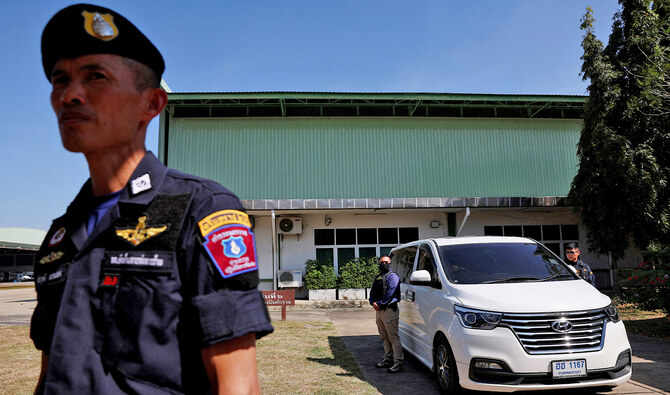
A vehicle carrying a suspect is escorted by police officers in Bangkok, Thailand, on January 11, 2025. (REUTERS/File)
Short Url
Updated 24 February 2025
Follow

Pakistanis among 215 foreigners freed by Thai, Cambodian police in scam center raid

  • Rescued foreigners included 109 Thais, 50 Pakistanis, 48 Indians, five Taiwanese and three Indonesians, Thai government said 
  • Hundreds of thousands trafficked by criminal gangs, forced to work in scam centers, illegal online operations across Southeast Asia

BANGKOK: Thai and Cambodian police raided a building in a border town and freed 215 foreigners, a senior Thai official said on Sunday, in an expansion of a regional crackdown against cyber scam centers.
Hundreds of thousands of people have been trafficked by criminal gangs and forced to work in scam centers and illegal online operations across Southeast Asia, according to the United Nations. A UN report in 2023 estimated that the fast-growing operations generate billions of dollars annually.
The Sunday raid targeted a three-story building in the Cambodian border town of Poipet in Banteay Meanchey province. The rescued foreigners included 109 Thais, 50 Pakistanis, 48 Indians, five Taiwanese and three Indonesians, Thai government spokesman Jirayu Houngsub said on Sunday.
“This is the largest number of Thais freed from a building suspected of cyber fraud for the two countries,” Jirayu said.
The raid was the result of a joint effort by Thailand and Cambodia to tackle scam centers, he said.
Scam centers have been operating for years. But they now face new scrutiny after the rescue of Chinese actor, Wang Xing, who was lured to Thailand with the promise of a job, and then abducted and taken to a scam center in Myanmar.
Southeast Asian countries have stepped up efforts to tackle scam centers with recent actions along the Thai-Myanmar border. Earlier this month, Thailand cut power, fuel and Internet supply to areas linked with scam centers.
China also repatriated 621 of its nationals rescued from scam centers in those areas over the past few days, the Thai army said on Saturday. 



ADB, Pakistan sign over $300 million agreements to undertake climate resilience initiatives

Updated 30 December 2025
Follow

ADB, Pakistan sign over $300 million agreements to undertake climate resilience initiatives

  • Pakistan ranks among nations most vulnerable to climate change and has seen erratic changes in weather patterns
  • The projects in Sindh and Punjab will restore nature-based coastal defenses and enhance agricultural productivity

ISLAMABAD: The Pakistani government and the Asian Development Bank (ADB) have signed more than $300 million agreements to undertake two major climate resilience initiatives, Pakistan’s Press Information Department (PID) said on Tuesday.

The projects include the Sindh Coastal Resilience Sector Project (SCRP), valued at Rs50.5 billion ($180.5 million), and the Punjab Climate-Resilient and Low-Carbon Agriculture Mechanization Project (PCRLCAMP), totaling Rs34.7 billion ($124 million).

Pakistan ranks among nations most vulnerable to climate change and has seen erratic changes in its weather patterns. In 2022, monsoon floods killed over 1,700 people, displaced another 33 million and caused over $30 billion losses, while another 1,037 people were killed in floods this year.

The South Asian country is ramping up climate resilience efforts, with support from the ADB and World Bank, and investing in climate-resilient infrastructure, particularly in vulnerable areas.

“Both sides expressed their commitment to effectively utilize the financing for successful and timely completion of the two initiatives,” the PID said in a statement.

The Sindh Coastal Resilience Project (SCRP) will promote integrated water resources and flood risk management, restore nature-based coastal defenses, and strengthen institutional and community capacity for strategic action planning, directly benefiting over 3.8 million people in Thatta, Sujawal, and Badin districts, according to ADB.

The Punjab project will enhance agricultural productivity and climate resilience across 30 districts, improving small farmers’ access to climate-smart machinery, introducing circular agriculture practices to reduce residue burning, establishing testing and training facilities, and empowering 15,000 women through skills development and livelihood diversification.

Earlier this month, the ADB also approved $381 million in financing for Pakistan’s Punjab province to modernize agriculture and strengthen education and health services, including concessional loans and grants for farm mechanization, Science, Technology, Engineering and Mathematics (STEM) education, and nursing sector reforms.