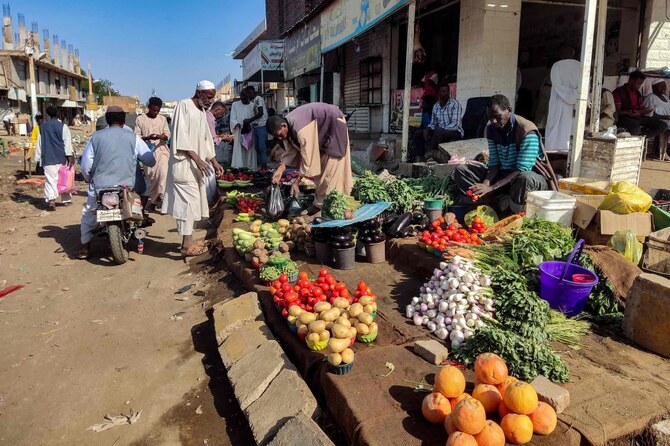
WAD MADANI, Sudan: In a bustling market in central Sudan, vegetable seller Ahmed Al-Obeid dusts off his wooden stall, carefully arranging fresh cucumbers and tomatoes in neat piles as customers cautiously return.
Just weeks ago, this market in the central Sudanese city of Wad Madani lay mostly deserted. Traders had shuttered their shops, gripped by fear of the paramilitaries who controlled the city.
Now, voices ring out again, bargaining over fresh produce as the city tentatively stirs back to life after the army reclaimed it from its rival Rapid Support Forces (RSF) last month.
“We are feeling safe again,” said Obeid.
“People are buying and selling like old times,” he told AFP, adjusting a pile of onions.
Since April 2023, Sudan has been engulfed in a war between the forces of army chief Abdel Fattah Al-Burhan and his former deputy Mohammed Hamdan Dagalo, who commands the RSF.
United Nations Secretary-General Antonio Guterres this month called it “an unprecedented humanitarian crisis” in Africa, and the United States has sanctioned both Burhan and Dagalo for abuses.
Wad Madani — the capital of pre-war breadbasket Al-Jazira state — became a battleground when RSF forces descended on the city in December 2023, forcing hundreds of thousands to flee the city and Al-Jazira.
But today, signs of recovery in the city are palpable, if restrained.
Buildings bear the scars of war. Blackened walls and piles of rubble are constant reminders of the destruction the city has endured.
Storefronts, restaurants and other businesses remain gutted by fire.
At a maternity ward in the city’s main hospital, expectant mothers wait with their families while nurses in white scrubs hurry through the corridors, attending to patients.
“Medicine is available. Life is finally back to normal. Things have completely changed, thank God,” Rehab Moussa, a patient receiving care, told AFP.
Yet, obstetrics and gynaecology specialist Khalid Mohammed said that although the hospital is slowly recovering, there are still serious shortages in staff, medicine and equipment.
“Our surgical supplies, including sutures, are nearly expired and we really need more anesthesia equipment,” Mohammed told AFP between surgeries.
When the RSF controlled Wad Madani, Mohammed was the only doctor on duty juggling multiple surgeries.
Even now, he dashes between operating rooms to manage the patient load.
Following the army’s recapture of Wad Madani in January, jubilant chants of “we’re going back” echoed in displacement centers across the country, including the de facto capital on the Red Sea, Port Sudan.
According to AFP journalists, dozens of buses carrying thousands of people have embarked from Port Sudan, Gedaref and Kassala — where around 1.5 million people in total have sought shelter — back home to Wad Madani.
Many of them had no idea what they would find, after the RSF had looted their way through the city, while others told AFP they knew their homes had been ransacked.
The city’s electricity has not yet been restored, water is unavailable most days and a communications blackout has only just been lifted, according to recent returnees.
However, near the market in Wad Madani, Mohammed Abdel Moneim, a tuk-tuk driver, is upbeat.
“The city is safe now. Everything is fine,” he said, weaving through the crowd in a search for passengers.
“But it is still missing one thing: the people. We need everyone to come back and rebuild the city,” he told AFP.
In addition to killing tens of thousands of people, the war in Sudan has created the world’s largest internal displacement crisis.
Across the country, more than 11.5 million people are internally displaced, including 2.7 million uprooted during previous wars in Sudan.
Most are suffering a rapidly worsening humanitarian situation as shortages of food, medicine and basic supplies plague even safe areas under army control.
Local monitors and the UN have also reported abuses following the city’s recapture, including targeting of minority communities and accusations of collaboration with the RSF.

Sudan’s heartland city limps back to life after army recapture
Short Url
https://arab.news/vv3ym
Sudan’s heartland city limps back to life after army recapture
- Just weeks ago, this market in the central Sudanese city of Wad Madani lay mostly deserted
- Traders had shuttered their shops, gripped by fear of the paramilitaries who controlled the city
Aid flow into Gaza falls short of ceasefire terms
- Israel says average of 459 trucks a day have entered Gaza, compared to the 600 promised under the ceasefire
- UN reports far fewer - just 113 trucks a day since Oct. 12
JERUSALEM: Aid deliveries into Gaza are falling far short of the amount called for under the US-brokered ceasefire, according to an Associated Press analysis of the Israeli military’s figures.
Under the October ceasefire deal between Israel and Hamas, Israel agreed to allow 600 trucks of aid into Gaza each day. But an average of only 459 trucks a day have entered Gaza between Oct. 12, when flow of the aid restarted, and Dec. 7, according to an AP analysis of figures by COGAT, the Israeli military body in charge of coordinating aid entry.
Aid has fallen short
COGAT said that roughly 18,000 trucks of food aid had entered Gaza between the ceasefire taking effect and Sunday. It said that figure amounted to 70 percent of all aid that had entered the territory since the truce.
That means COGAT estimates that a total of just over 25,700 trucks of aid have entered Gaza — well under the 33,600 trucks that should have entered by Sunday, under the terms of the ceasefire.
Throughout the conflict, the UN and aid groups have said the amount of aid entering Gaza is far lower than COGAT claims.
The UN says only 6,545 trucks have been offloaded at Gaza crossings between the ceasefire and Dec. 7, amounting to about 113 trucks a day. That’s according to its online database. The UN figures do not include aid trucks sent bilaterally by organizations not working through the UN network.
A Hamas document on Saturday provided to the AP put the amount of aid trucks that have entered at 7,333.
This week, United Nations Office for the Coordination of Humanitarian Affairs stressed a “dire” need for more aid to enter Gaza, saying Israeli restrictions on aid have bottlenecked recovery efforts.
Food remains scarce
Humanitarian groups say lack of aid has had harsh effects on many of Gaza’s 2 million residents, most of whom were forcibly displaced by war. Food remains scarce as the Palestinian territory struggles to bounce back from famine, which hit parts of Gaza during the war. Starving mothers in Gaza are giving birth to malnourished babies, some of whom have died in hospital, according to a recent report by UNICEF. As winter rains pick up, displaced families living in tents have been left exposed to the elements and without supplies to cope with floods and the biting cold.
“Needs far outpace the humanitarian community’s ability to respond, given persistent impediments,” the agency wrote in a report on Monday. “These obstacles include insecurity, customs clearance challenges, delays and denials of cargo at the crossings, and limited routes available for transporting humanitarian supplies within Gaza.”
Israel temporarily stopped all aid entry at least once in response to alleged Hamas violations of the truce. Israel said that Hamas has failed to return the bodies of the hostages in the time period established by the ceasefire, while Hamas has said it struggled to find the bodies due to the destruction left by Israel in the Palestinian territory.
Hamas has also accused Israel of violating the ceasefire terms because of the slow flow of aid, continued closure of the Rafah crossing and ongoing deadly strikes on Gaza.
Remains of final hostage
Meanwhile, Israel says it is demanding the return of the final hostage, Ran Gvili.
The Office of Prime Minister Benjamin Netanyahu told the AP on Wednesday that Gvili’s remains must be returned, a condition of the first phase of the ceasefire.
“Once phase one is completed, phase two will begin,” the office said in a statement.
Hamas militants and Red Cross crews continued to comb the ruins of Gaza City for the final body this week, while the militant group Islamic Jihad claimed it had handed over the last hostage body in its possession.
On Tuesday, Hamas called for more international pressure on Israel to open key border crossings, cease deadly strikes on the territory and allow more aid into the strip.
The accusations mark the latest road bump at what regional leaders have described as a critical time for the ceasefire agreement, as mediators seek to push the truce into its second, more complicated phase.
Under the October ceasefire deal between Israel and Hamas, Israel agreed to allow 600 trucks of aid into Gaza each day. But an average of only 459 trucks a day have entered Gaza between Oct. 12, when flow of the aid restarted, and Dec. 7, according to an AP analysis of figures by COGAT, the Israeli military body in charge of coordinating aid entry.
Aid has fallen short
COGAT said that roughly 18,000 trucks of food aid had entered Gaza between the ceasefire taking effect and Sunday. It said that figure amounted to 70 percent of all aid that had entered the territory since the truce.
That means COGAT estimates that a total of just over 25,700 trucks of aid have entered Gaza — well under the 33,600 trucks that should have entered by Sunday, under the terms of the ceasefire.
Throughout the conflict, the UN and aid groups have said the amount of aid entering Gaza is far lower than COGAT claims.
The UN says only 6,545 trucks have been offloaded at Gaza crossings between the ceasefire and Dec. 7, amounting to about 113 trucks a day. That’s according to its online database. The UN figures do not include aid trucks sent bilaterally by organizations not working through the UN network.
A Hamas document on Saturday provided to the AP put the amount of aid trucks that have entered at 7,333.
This week, United Nations Office for the Coordination of Humanitarian Affairs stressed a “dire” need for more aid to enter Gaza, saying Israeli restrictions on aid have bottlenecked recovery efforts.
Food remains scarce
Humanitarian groups say lack of aid has had harsh effects on many of Gaza’s 2 million residents, most of whom were forcibly displaced by war. Food remains scarce as the Palestinian territory struggles to bounce back from famine, which hit parts of Gaza during the war. Starving mothers in Gaza are giving birth to malnourished babies, some of whom have died in hospital, according to a recent report by UNICEF. As winter rains pick up, displaced families living in tents have been left exposed to the elements and without supplies to cope with floods and the biting cold.
“Needs far outpace the humanitarian community’s ability to respond, given persistent impediments,” the agency wrote in a report on Monday. “These obstacles include insecurity, customs clearance challenges, delays and denials of cargo at the crossings, and limited routes available for transporting humanitarian supplies within Gaza.”
Israel temporarily stopped all aid entry at least once in response to alleged Hamas violations of the truce. Israel said that Hamas has failed to return the bodies of the hostages in the time period established by the ceasefire, while Hamas has said it struggled to find the bodies due to the destruction left by Israel in the Palestinian territory.
Hamas has also accused Israel of violating the ceasefire terms because of the slow flow of aid, continued closure of the Rafah crossing and ongoing deadly strikes on Gaza.
Remains of final hostage
Meanwhile, Israel says it is demanding the return of the final hostage, Ran Gvili.
The Office of Prime Minister Benjamin Netanyahu told the AP on Wednesday that Gvili’s remains must be returned, a condition of the first phase of the ceasefire.
“Once phase one is completed, phase two will begin,” the office said in a statement.
Hamas militants and Red Cross crews continued to comb the ruins of Gaza City for the final body this week, while the militant group Islamic Jihad claimed it had handed over the last hostage body in its possession.
On Tuesday, Hamas called for more international pressure on Israel to open key border crossings, cease deadly strikes on the territory and allow more aid into the strip.
The accusations mark the latest road bump at what regional leaders have described as a critical time for the ceasefire agreement, as mediators seek to push the truce into its second, more complicated phase.
© 2025 SAUDI RESEARCH & PUBLISHING COMPANY, All Rights Reserved And subject to Terms of Use Agreement.


