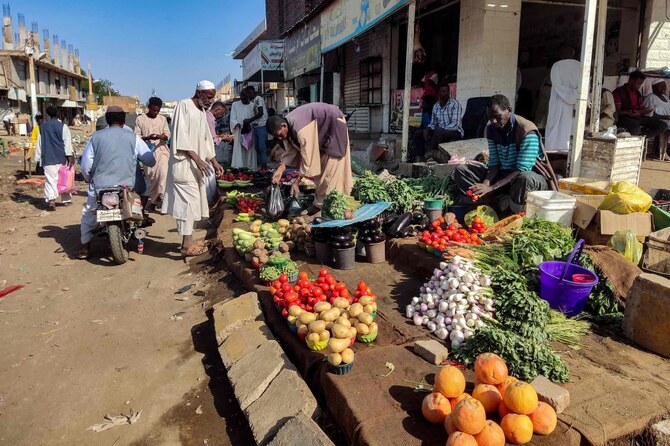
WAD MADANI, Sudan: In a bustling market in central Sudan, vegetable seller Ahmed Al-Obeid dusts off his wooden stall, carefully arranging fresh cucumbers and tomatoes in neat piles as customers cautiously return.
Just weeks ago, this market in the central Sudanese city of Wad Madani lay mostly deserted. Traders had shuttered their shops, gripped by fear of the paramilitaries who controlled the city.
Now, voices ring out again, bargaining over fresh produce as the city tentatively stirs back to life after the army reclaimed it from its rival Rapid Support Forces (RSF) last month.
“We are feeling safe again,” said Obeid.
“People are buying and selling like old times,” he told AFP, adjusting a pile of onions.
Since April 2023, Sudan has been engulfed in a war between the forces of army chief Abdel Fattah Al-Burhan and his former deputy Mohammed Hamdan Dagalo, who commands the RSF.
United Nations Secretary-General Antonio Guterres this month called it “an unprecedented humanitarian crisis” in Africa, and the United States has sanctioned both Burhan and Dagalo for abuses.
Wad Madani — the capital of pre-war breadbasket Al-Jazira state — became a battleground when RSF forces descended on the city in December 2023, forcing hundreds of thousands to flee the city and Al-Jazira.
But today, signs of recovery in the city are palpable, if restrained.
Buildings bear the scars of war. Blackened walls and piles of rubble are constant reminders of the destruction the city has endured.
Storefronts, restaurants and other businesses remain gutted by fire.
At a maternity ward in the city’s main hospital, expectant mothers wait with their families while nurses in white scrubs hurry through the corridors, attending to patients.
“Medicine is available. Life is finally back to normal. Things have completely changed, thank God,” Rehab Moussa, a patient receiving care, told AFP.
Yet, obstetrics and gynaecology specialist Khalid Mohammed said that although the hospital is slowly recovering, there are still serious shortages in staff, medicine and equipment.
“Our surgical supplies, including sutures, are nearly expired and we really need more anesthesia equipment,” Mohammed told AFP between surgeries.
When the RSF controlled Wad Madani, Mohammed was the only doctor on duty juggling multiple surgeries.
Even now, he dashes between operating rooms to manage the patient load.
Following the army’s recapture of Wad Madani in January, jubilant chants of “we’re going back” echoed in displacement centers across the country, including the de facto capital on the Red Sea, Port Sudan.
According to AFP journalists, dozens of buses carrying thousands of people have embarked from Port Sudan, Gedaref and Kassala — where around 1.5 million people in total have sought shelter — back home to Wad Madani.
Many of them had no idea what they would find, after the RSF had looted their way through the city, while others told AFP they knew their homes had been ransacked.
The city’s electricity has not yet been restored, water is unavailable most days and a communications blackout has only just been lifted, according to recent returnees.
However, near the market in Wad Madani, Mohammed Abdel Moneim, a tuk-tuk driver, is upbeat.
“The city is safe now. Everything is fine,” he said, weaving through the crowd in a search for passengers.
“But it is still missing one thing: the people. We need everyone to come back and rebuild the city,” he told AFP.
In addition to killing tens of thousands of people, the war in Sudan has created the world’s largest internal displacement crisis.
Across the country, more than 11.5 million people are internally displaced, including 2.7 million uprooted during previous wars in Sudan.
Most are suffering a rapidly worsening humanitarian situation as shortages of food, medicine and basic supplies plague even safe areas under army control.
Local monitors and the UN have also reported abuses following the city’s recapture, including targeting of minority communities and accusations of collaboration with the RSF.

Sudan’s heartland city limps back to life after army recapture
https://arab.news/vv3ym
Sudan’s heartland city limps back to life after army recapture
- Just weeks ago, this market in the central Sudanese city of Wad Madani lay mostly deserted
- Traders had shuttered their shops, gripped by fear of the paramilitaries who controlled the city
Israeli army takes journalists into a tunnel in a Gaza city it seized and largely flattened
- Israel and Hamas are on the cusp of finishing the first phase of the truce, which mandated the return of all hostages, living and dead, in exchange for Palestinians held by Israel
- Hamas has said communication with its remaining units in Rafah has been cut off for months and that it was not responsible for any incidents occurring in those areas
RAFAH, Gaza Strip: One by one, the soldiers squeezed through a narrow entrance to a tunnel in southern Gaza. Inside a dark hallway, some bowed their heads to avoid hitting the low ceiling, while watching their step as they walked over or around jagged concrete, crushed plastic bottles and tattered mattresses.
On Monday, Israel’s military took journalists into Rafah — the city at Gaza’s southernmost point that troops seized last year and largely flattened — as the 2-month-old Israel-Hamas ceasefire reaches a critical point. Israel has banned international journalists from entering Gaza since the war began more than two years ago, except for rare, brief visits supervised by the military, such as this one.
Soldiers escorted journalists inside a tunnel, which they said was one of Hamas’ most significant and complex underground routes, connecting cities in the embattled territory and used by top Hamas commanders. Israel said Hamas had kept the body of a hostage in the underground passage: Hadar Goldin, a 23-year-old soldier who was killed in Gaza more than a decade ago and whose remains had been held there.
Hamas returned Goldin’s body last month as part of a US-brokered ceasefire in the war triggered by the militants’ Oct. 7, 2023, attack on southern Israel in which 1,200 people were killed and hundreds taken hostage. Israel’s retaliatory offensive has killed more than 70,000 Palestinians, according to Gaza’s Health Ministry, which operates under the Hamas-run government. The ministry does not differentiate between civilians and combatants, but says roughly half the dead have been women and children.
Israel and Hamas are on the cusp of finishing the first phase of the truce, which mandated the return of all hostages, living and dead, in exchange for Palestinians held by Israel. The body of just one more hostage remains to be returned.
Mediators warn the second phase will be far more challenging since it includes thornier issues, such as disarming Hamas and Israel’s withdrawal from the strip. Israel currently controls more than half of Gaza.
Israeli Prime Minister Benjamin Netanyahu is set to travel to Washington this month to discuss those next steps with US President Donald Trump.
Piles of rubble line Rafah’s roads
Last year, Israel launched a major operation in Rafah, where many Palestinians had sought refuge from offensives elsewhere. Heavy fighting left much of the city in ruins and displaced nearly one million Palestinians. This year, when the military largely had control of the city, it systematically demolished most of the buildings that remained standing, according to satellite photos.
Troops also took control of and shut the vital Rafah crossing, Gaza’s only gateway to the outside world that was not controlled by Israel.
Israel said Rafah was Hamas’ last major stronghold and key to dismantling the group’s military capabilities, a major war aim.
On the drive around Rafah on Monday, towers of mangled concrete, wires and twisted metal lined the roads, with few buildings still standing and none unscathed. Remnants of people’s lives were scattered the ground: a foam mattress, towels and a book explaining the Qur’an.
Last week, Israel said it was ready to reopen the Rafah crossing but only for people to leave the strip. Egypt and many Palestinians fear that once people leave, they won’t be allowed to return. They say Israel is obligated to open the crossing in both directions.
Israel has said that entry into Gaza would not be permitted until Israel receives all hostages remaining in the strip.
Inside the tunnel
The tunnel that journalists were escorted through runs beneath what was once a densely populated residential neighborhood, under a United Nations compound and mosques. Today, Rafah is a ghost town. Underground, journalists picked their way around dangling cables and uneven concrete slabs covered in sand.
The army says the tunnel is more than 7 kilometers (4 miles) long and up to 25 meters (82 feet) deep and was used for storing weapons as well as long-term stays. It said top Hamas commanders were there during the war, including Mohammed Sinwar — who was believed to have run Hamas’ armed wing and was the younger brother of Yahya Sinwar, the Hamas leader who helped mastermind the Oct. 7 attack. Israel has said it has killed both of them.
“What we see right here is a perfect example of what Hamas did with all the money and the equipment that was brought into Gaza throughout the years,” said Lt. Col. Nadav Shoshani. “Hamas took it and built an incredible city underground for the purposes of terror and holding bodies of hostages.”
Israel has long accused Hamas of siphoning off money for military purposes. While Hamas says the Palestinians are an occupied people and have a right to resist, the group also has a civilian arm and ran a government that provided services such as health care, a police force and education.
The army hasn’t decided what to do with the tunnel. It could seal it with concrete, explode it or hold it for intelligence purposes among other options.
Since the ceasefire began, three soldiers have been killed in clashes with about 200 Hamas militants that Israeli and Egyptian officials say remain underground in Israeli-held territory.
Hamas has said communication with its remaining units in Rafah has been cut off for months and that it was not responsible for any incidents occurring in those areas.
Both Israel and Hamas have accused each other of repeated violations of the deal during the first phase. Israel has accused Hamas of dragging out the hostage returns, while Palestinian health officials say over 370 Palestinians have been killed in continued Israeli strikes since the ceasefire took effect.


