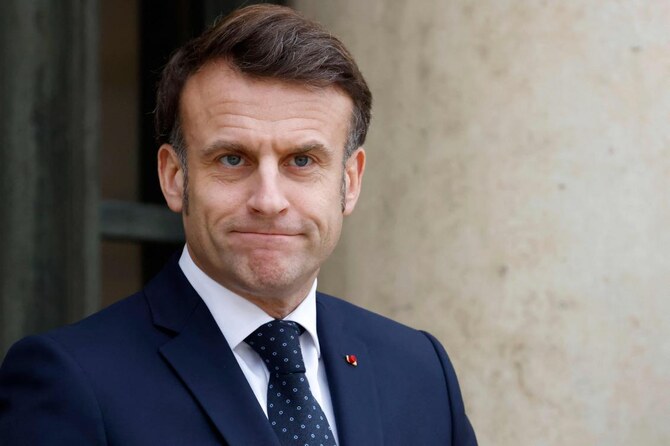
PARIS: French President Emmanuel Macron said that he intends to tell US counterpart Donald Trump that it’s in the joint interest of Americans and Europeans not to “be weak” in the face of Russian leader Vladimir Putin amid US-led negotiations to end the nearly three-year war in Ukraine.
Macron will travel to Washington to meet with Trump on Monday, the White House said.
In a one-hour question and answer session on social media Thursday, Macron said that he’ll tell Trump: “’You can’t be weak in the face of President Putin. It’s not you, it’s not your trademark, it’s not in your interest. How can you then be credible in the face of China if you’re weak in the face of Putin?’”
Trump’s recent statements that echo Putin’s narrative and plans to have direct negotiations with Moscow have left European allies and Ukrainian officials worried. But Macron suggested Trump’s strategy to create “uncertainty” in talks with Russia could actually make Western allies stronger in these talks.
Putin “doesn’t know what he (Trump) is going to do, he thinks (Trump) is capable of anything,” Macron said. “This uncertainty is good for us and for Ukraine.”
Macron said that he would seek to persuade Trump that US interests and Europeans’ interests are the same, telling him: “If you let Russia take over Ukraine, it would be unstoppable.”
That means any peace deal must be negotiated with Ukrainians and Europeans around the table, Macron said.
“We want peace. But we don’t want a ceasefire that means Ukraine surrendering, because that’s dangerous. And we know that would lead to Russia going further. We’ve already experienced it,” he said.
Macron also appeared ready to answer Trump’s call to boost defense spending. “Us, Europeans, we must increase our war effort,” he said.
Asked about whether he’s considering sending French troops to Ukraine, he said he wouldn’t send soldiers to fight in Ukraine but rather to be part of a security force meant to bring “guarantees” once a peace deal is achieved.
“We don’t rule out, within a framework planned with our allies, the possibility of having forces which, once peace has been negotiated, could contribute to guaranteeing Ukraine’s security,” he said.

Macron’s message to Trump: ‘You can’t be weak in the face of Putin’
Short Url
https://arab.news/bryet
Macron’s message to Trump: ‘You can’t be weak in the face of Putin’
- Macron will travel to Washington to meet with Trump on Monday, the White House said
- Putin “doesn’t know what he (Trump) is going to do, he thinks (Trump) is capable of anything,” Macron said
Russia’s war footing may remain after Ukraine war, Latvia spy chief warns
MUNICH: Russia will not end the militarization of its economy after fighting in Ukraine ends, the head of Latvia’s intelligence agency told AFP on the sidelines of the Munich Security Conference which ends Sunday.
“The potential aggressiveness of Russia when the Ukraine war stops will depend of many factors: How the war ends, if it’s frozen or not, and if the sanctions remain,” Egils Zviedris, director of the Latvian intelligence service SAB, told AFP.
Some observers believe that Russia has so thoroughly embraced a war economy and full military mobilization that it will be difficult for it to reverse course, and that this could push Moscow to launch further offensives against European territories.
Zviedris said that lifting current sanctions “would allow Russia to develop its military capacities” more quickly.
He acknowledged that Russia has drawn up military plans to potentially attack Latvia and its Baltic neighbors, but also said that “Russia does not pose a military threat to Latvia at the moment.”
“The fact that Russia has made plans to invade the Baltics, as they have plans for many things, does not mean Russia is going to attack,” Zviedris told AFP.
However, the country is subject to other types of threats from Moscow, particularly cyberattacks, according to the agency he leads.
The SAB recently wrote in its 2025 annual report that Russia poses the main cyber threat to Latvia, because of broader strategic goals as well as Latvia’s staunch support of Ukraine.
The threat has “considerably increased” since Moscow’s full-scale invasion of Ukraine in 2022, it said.
The agency has also warned that Russia is seeking to exploit alleged grievances of Russian-speaking minorities in the Baltics — and in Latvia in particular.
Russia’s Ministry of Foreign Affairs has repeatedly claimed to be preparing cases against Latvia, Lithuania and Estonia at the UN International Court of Justice over the rights of their Russian-speaking minorities.
“The aim of litigation: to discredit Latvia on an international level and ensure long-term international pressure on Latvia to change its policy toward Russia and the Russian-speaking population,” the report said.
In 2025, approximately 23 percent of Latvia’s 1.8 million residents identified as being of Russian ethnicity, according to the national statistics office.
Following the Russian invasion of Ukraine in 2022, Latvian authorities decided to require Russian speakers residing in the country to take an exam to assess their knowledge of the Latvian language — with those failing at potential risk of deportation.
“The potential aggressiveness of Russia when the Ukraine war stops will depend of many factors: How the war ends, if it’s frozen or not, and if the sanctions remain,” Egils Zviedris, director of the Latvian intelligence service SAB, told AFP.
Some observers believe that Russia has so thoroughly embraced a war economy and full military mobilization that it will be difficult for it to reverse course, and that this could push Moscow to launch further offensives against European territories.
Zviedris said that lifting current sanctions “would allow Russia to develop its military capacities” more quickly.
He acknowledged that Russia has drawn up military plans to potentially attack Latvia and its Baltic neighbors, but also said that “Russia does not pose a military threat to Latvia at the moment.”
“The fact that Russia has made plans to invade the Baltics, as they have plans for many things, does not mean Russia is going to attack,” Zviedris told AFP.
However, the country is subject to other types of threats from Moscow, particularly cyberattacks, according to the agency he leads.
The SAB recently wrote in its 2025 annual report that Russia poses the main cyber threat to Latvia, because of broader strategic goals as well as Latvia’s staunch support of Ukraine.
The threat has “considerably increased” since Moscow’s full-scale invasion of Ukraine in 2022, it said.
The agency has also warned that Russia is seeking to exploit alleged grievances of Russian-speaking minorities in the Baltics — and in Latvia in particular.
Russia’s Ministry of Foreign Affairs has repeatedly claimed to be preparing cases against Latvia, Lithuania and Estonia at the UN International Court of Justice over the rights of their Russian-speaking minorities.
“The aim of litigation: to discredit Latvia on an international level and ensure long-term international pressure on Latvia to change its policy toward Russia and the Russian-speaking population,” the report said.
In 2025, approximately 23 percent of Latvia’s 1.8 million residents identified as being of Russian ethnicity, according to the national statistics office.
Following the Russian invasion of Ukraine in 2022, Latvian authorities decided to require Russian speakers residing in the country to take an exam to assess their knowledge of the Latvian language — with those failing at potential risk of deportation.
© 2026 SAUDI RESEARCH & PUBLISHING COMPANY, All Rights Reserved And subject to Terms of Use Agreement.



