



LONDON: Regional conflicts have negatively impacted the performance of Middle Eastern countries in this year’s Soft Power Index, according to findings by brand and marketing consultancy Brand Finance.
The 2025 results, unveiled at the annual conference in London on Thursday, revealed significant declines for nations embroiled in conflicts — including Israel, Lebanon, Sudan, Ukraine, and Russia — dragging down much of the broader region’s performance.
Despite the UAE maintaining its 10th-place ranking with a modest 0.7-point increase, other Middle Eastern countries, including Saudi Arabia, Qatar, and Israel, saw stagnation or setbacks after years of steady gains.
“After years of soft power gains, Gulf nations somewhat lose momentum in 2025, with the exception of the UAE,” said Andrew Campbell, managing director at Brand Finance Middle East. “While they remain admired for their influence and business-friendly policies, respondents from the wider Middle East, Africa, and Asia view the region less favorably than before.”
The index, which Brand Finance calls the “most comprehensive study on perceptions of nation brands,” surveyed 170,000 respondents across more than 100 markets.

Saudi Arabia, which had been one of the fastest climbers in recent years, slipped two places to 20th after rising eight spots since 2020. While the Kingdom stalled in key metrics such as familiarity, influence, and reputation, it continued to make strides in perception-based categories. Among these, Saudi Arabia showed a 0.7-point increase (out of 10) in education and science — an area highlighted by the King Faisal Specialist Hospital and Research Center’s recognition as one of the world’s top academic medical centers in a separate Brand Finance report earlier this year.
Soft power, a term coined by American political scientist Joseph Nye in the 1990s, refers to a nation’s ability to achieve influence through persuasion rather than coercion or financial incentives. It has been central to Saudi Arabia’s Vision 2030 strategy, with significant investments across various industries propelling its growth in the rankings in recent years. This aligns with the Kingdom’s broader aspirations to diversify its economy, attract foreign investment and talent, and solidify its position on the global stage.
While many Gulf nations experienced setbacks, the UAE remained largely resilient. Retaining 10th place overall, the country scored highly in perceptions of influence (eighth), international relations (ninth), and business and trade (10th). The UAE also climbed to second place globally for being “easy to do business in and with” and ranked in the top 10 for “future growth potential” and “strong and stable economy.” This was driven by fiscal strength, a positive investment climate, and continued economic diversification.
Campbell noted that while the region has made steady gains in recent years, the latest index reflects a “shift in sentiment in the wider Middle East and in Asia towards Saudi Arabia and the UAE,” leading to a leveling off in their performance.
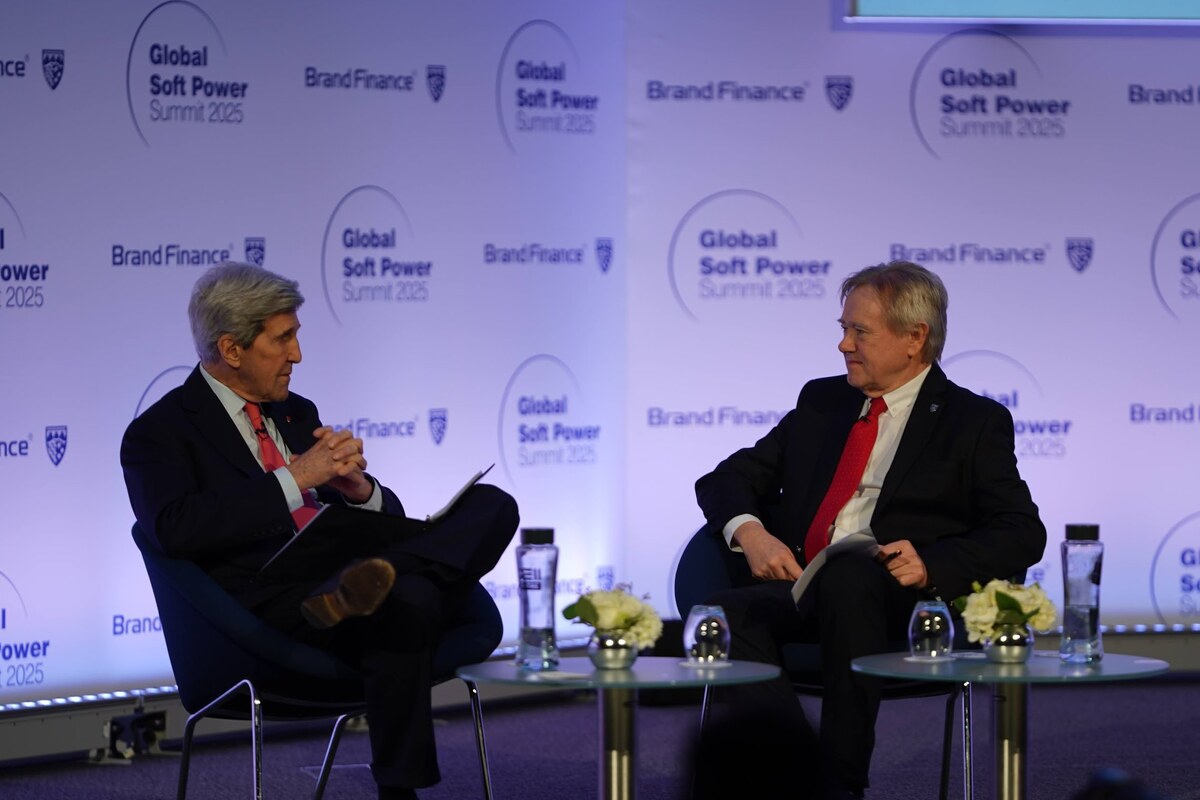
Former US Secretary of State John Kerry with the Chairman of Brand Finance David Haigh. (Brand Finance/File)
Speaking to Arab News, he said that although the survey measures perception rather than the direct causes behind it, “part of it is to do with the conflict in Gaza” and the “strong sentiments” the Palestinian cause evokes throughout the region.
“I think that sentiment is somewhat driven by that deep Arab feeling of, ‘We have to protect and be aligned with the Palestinians,’” he explained. “So, there’s probably some kind of internal conflict of feeling going on. And then we’ve also got the Iran situation relative to Syria and the Houthis. That whole dynamic in the Middle East has always been complicated, but it’s now complicated and explosive.”
Campbell linked this shift in perception to the Abraham Accords signed by the UAE during Donald Trump’s first presidency.
The survey was conducted between September and November, meaning major developments — such as the ceasefire in Lebanon, the end of the Assad regime in Syria, and the Gaza truce — have yet to be fully absorbed into the index.
The rapidly evolving situation in the region and other active conflict areas was a key focus at Thursday’s summit. Speakers, including former Polish President and Nobel Peace Prize Laureate Lech Walesa, former US Secretary of State John Kerry, and former Finnish Prime Minister Sanna Marin, underscored the resurgence of hard power — military and economic coercion — as a defining factor in how nations are perceived on the global stage.
Michael Clarke, distinguished fellow and former director-general of the defense and security think tank Royal United Services Institute, told Arab News that contrary to popular belief, “soft and hard power are not a seesaw where one goes up and the other goes down. They tend to go up or down together.” He stressed that while “we are seeing much greater emphasis on hard power politics,” nations should not overlook the role of soft power.

He argued that, as the world moves into an era of “new imperialism, soft power will go with that,” noting that hard power is most effective when complemented by soft power. Countries with strong military capabilities, he added, often “spend most of their time not fighting” because their influence stems from imitation and strategic deterrence — key elements of real soft power.
Highlighting Israel’s performance over the past two years, Clarke pointed to its military failures in Gaza as an example of how the misuse of hard power can erode soft power. He noted that Israel’s actions, perceived as lacking moral legitimacy, are seen as “intolerable to most other professional militaries” that integrate hard power into their broader strategic influence.
Looking ahead, Clarke said the long-term geopolitical impact of Israel’s recent actions remains uncertain, particularly as Trump’s second term begins. Amid the shifting power dynamics in the region, he suggested that Syria’s post-Assad transition could significantly influence its soft power standing in the coming year. This “remaking of the Middle East,” he added, may also present an opportunity for Gulf nations, particularly Saudi Arabia and the UAE, to enhance their soft power appeal as the region’s geopolitical landscape continues to evolve.
The US-Russia negotiations over Ukraine, held in Riyadh this week, were a key topic of discussion at the summit. As highlighted in this year’s Soft Power Index, both countries followed a similar trajectory to other nations involved in conflict, experiencing stagnation or, in Ukraine’s case, a decline after two years of gains.
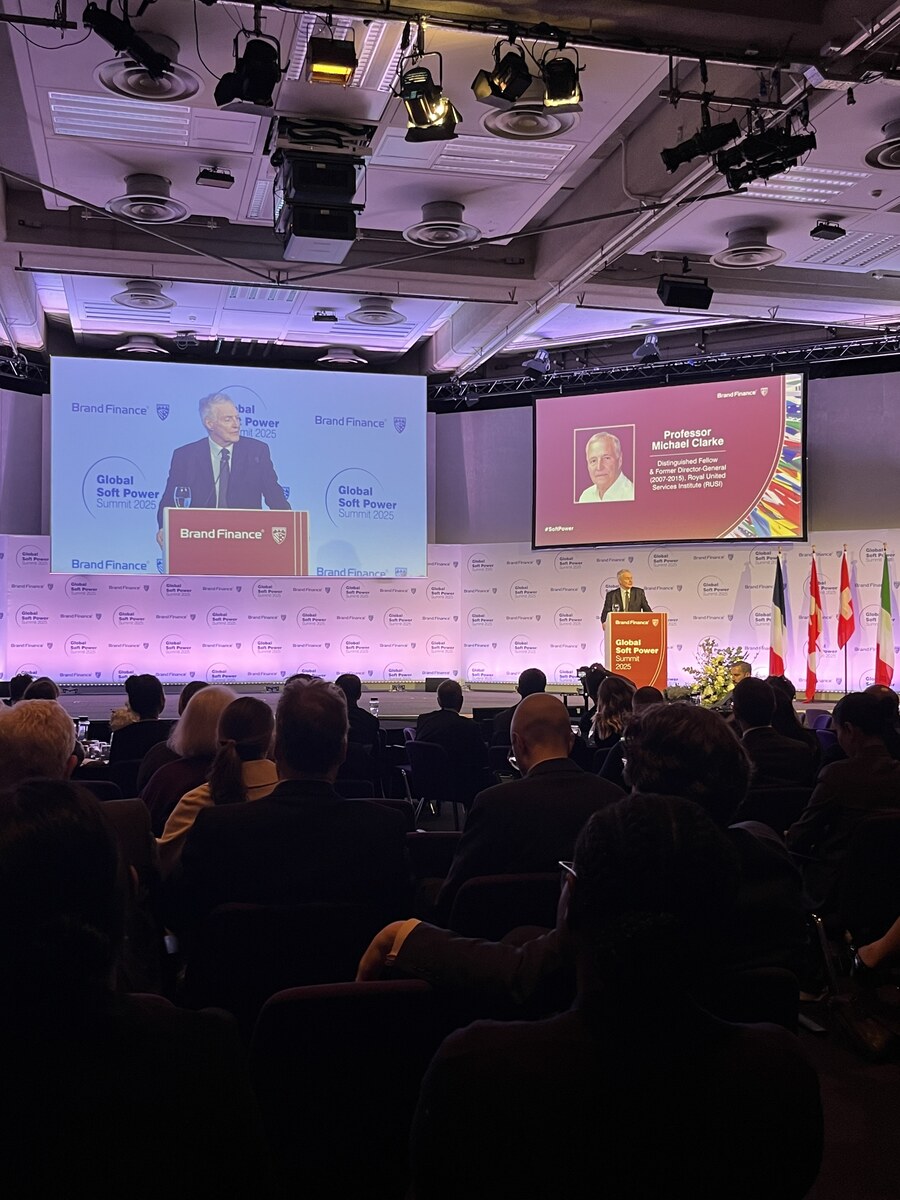
Professor Michael Clarke addressing the summit. (AN/File)
Speakers underscored that, in what Clarke described as a new “paradigm of international relations,” the UN’s role — already under strain due to its perceived failure to uphold its mandate — will be critical in fostering international cooperation on global challenges beyond the capacity of individual nations. The index reveals a growing divide, with stronger nations advancing rapidly while weaker ones fall further behind.
“With the exception of when the Security Council mandates the use of sanctions or force, most of what the UN does is powered by soft power. It is the power of convening,” Maher Nasser, commissioner-general of the UN at Expo 2025 and director of the Department of Global Communications, told Arab News. “It is the power of working towards consensus when not possible by majority votes. But the traces and the impact of the work that takes place in the UN (are) way beyond the issues of peace and security that people (tend to) focus on.”
Amid ongoing conflicts and shifting global dynamics, Nasser emphasized that the UN remains “the most representative platform on the planet,” stressing that lasting peace can only be achieved through “creating conditions for trust and using soft power to achieve objectives,” a principle at the heart of the UN’s mission.
This year’s index saw the US retain its top position, while China overtook the UK for second place. Among Arab nations, Egypt ranked 38th, Kuwait 40th, and Oman 49th. Morocco, Bahrain, and Jordan followed at 50th, 51st, and 58th, respectively, while Algeria placed 78th, Tunisia 79th, Lebanon 91st, and Yemen 122nd — climbing 27 places due to improvements in governance, international relations, and education and science. Syria (127th) and Libya (133rd) rounded out the rankings.


