Pakistan, EU officials discuss Middle East, Afghanistan situation among global security challenges

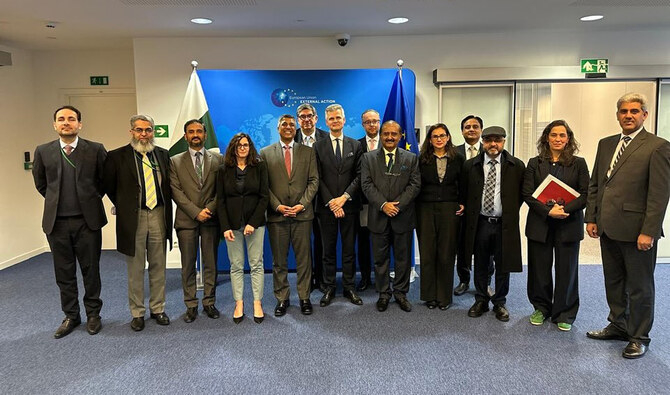
The handout photograph released by Pakistan’s foreign office on February 20, 2025 shows Pakistani and European Union officials pose for a group photo after the 9th Counter-Terrorism Dialogue in Brussels, Belgium. (MOFA)
Short Url
Updated 21 February 2025
Follow

Pakistan, EU officials discuss Middle East, Afghanistan situation among global security challenges

  • The talks were part of 2019 Strategic Engagement Plan between the EU and Pakistan, which seeks to enhance mutual engagement on security matters
  • Both sides exchanged views on countering of ‘violent extremism, recruitment and movement of foreign fighters, offline and online radicalization’

ISLAMABAD: Pakistan and the European Union (EU) officials held their 9th Counter-Terrorism Dialogue in Brussels and discussed regional and global challenges, including the situation in the Middle East and Afghanistan, the Pakistani foreign office said on Thursday.
The dialogue is part of the broader 2019 Strategic Engagement Plan between the EU and Pakistan, which seeks to enhance mutual engagement on security matters and regional cooperation. It reflects a shared determination to address the evolving challenges posed by militancy.
The development comes amid a turmoil in the Middle East resulting from Israeli military actions against several regional countries, including the war on Gaza, as well as fears among some nations, including Pakistan, about the resurgence of militant groups in Afghanistan.
Pakistan has repeatedly called on Israel and world powers for a permanent ceasefire in Gaza and withdrawal of Israeli forces from Lebanon and Syria. Islamabad has also accused Afghanistan of supporting militant groups amid a recent surge in militancy in Pakistan’s western regions, an allegation denied by Kabul.
“The European Union and Pakistan condemned terrorism in all its forms and confirmed their steadfast commitment to fight it. The Dialogue allowed for an exchange on regional and global challenges, including the security implications of the situation in Afghanistan and in other areas, like the Middle East,” the Pakistani foreign office said in a statement.
“Both parties confirmed the importance of a strong cooperation with international partners in multilateral fora. This includes the work in the United Nations’ framework and in the Global Counter-Terrorism Forum, which the EU has been co-chairing since 2022.”
Abdul Hameed, director-general for counter-terrorism at the Pakistani foreign ministry, led the Pakistan side, while the EU delegation was headed by Maciej Stadejek, director for security and defense policy at the European External Action Service.
“The European Union and Pakistan also discussed areas for exchange of best practices and for concrete cooperation, with a focus on common actions on prevention and countering of violent extremism, recruitment and movement of foreign fighters, offline and online radicalization, combating terrorism financing and more topics that are relevant to address the growing challenges posed by terrorism,” the foreign office added.


IMF board to meet tomorrow to consider $1.2 billion disbursement for Pakistan

Updated 11 sec ago
Follow

IMF board to meet tomorrow to consider $1.2 billion disbursement for Pakistan

  • Pakistan, IMF reached a Staff-Level Agreement for second review of $7 billion loan program 
  • Economists view disbursement crucial for cash-strapped Pakistan as it tackles economic crisis

ISLAMABAD: The International Monetary Fund’s (IMF) Executive Board will meet tomorrow, Monday, to consider and approve a $1.2 billion disbursement for Pakistan, according to the global lender’s official schedule. 

The meeting takes place nearly two months after the Fund reached a Staff-Level Agreement (SLA) with Pakistan for the second review of its $7 billion Extended Fund Facility (EFF) and the first review of its $1.4 billion Resilience and Sustainability Facility (RSF). 

The SLA followed a mission led by IMF’s Iva Petrova, who held discussions with Pakistani authorities during a Sept. 24–Oct. 8 visit to Karachi, Islamabad and Washington, DC.

“The International Monetary Fund’s (IMF) Executive Board will convene on Dec. 8 to consider Pakistan’s request for a $1.2 billion disbursement under the Extended Fund Facility (EFF) and the Resilience and Sustainability Facility (RSF), according to the Fund’s updated schedule,” the state-run Pakistan TV reported on Sunday.

Economists view IMF’s bailout packages as crucial for cash-strapped Pakistan, which has relied heavily on financing from bilateral partners such as Saudi Arabia, China and the United Arab Emirates, as well as multilateral lenders including the IMF, World Bank, Asian Development Bank and Islamic Development Bank. 

The South Asian country has been grappling with a prolonged macroeconomic crisis that has drained its financial resources and triggered a balance of payments crisis. Islamabad, however, has recorded some financial gains since 2022, which include recording a surplus in its current account and bringing inflation down considerably. 

Speaking to Arab News last month, Pakistan’s former finance adviser Khaqan Najeeb said the $1.2 billion disbursement will further stabilize Pakistan’s near-term external position and unlock additional official inflows. 

“Continued engagement also reinforces macro stability, as reflected in recent improvements in inflation, the current account, and reserve buffers,” Najeeb said. 

Pakistan came close to sovereign default in mid-2023, when foreign exchange reserves fell below three weeks of import cover, inflation surged to a record 38 percent in May, and the country struggled to secure external financing after delays in its IMF program. Fuel shortages, import restrictions, and a rapidly depreciating rupee added to the pressure, while ratings agencies downgraded Pakistan’s debt and warned of heightened default risk.

The crisis eased only after Pakistan reached a last-minute Stand-By Arrangement with the IMF in June 2023, unlocking emergency support and preventing an immediate default.