



KARACHI: Renowned Pakistani artist Amin Gulgee said on Wednesday his parents had wished to convert their residence in the port city of Karachi into a museum, a desire he fulfilled this week by establishing the Gulgee Museum and opening its doors to the public to preserve his father’s artwork.
Ismail Gulgee, Amin’s father, was one of the most recognized figures in Pakistan’s art community, known for his calligraphic and abstract expressionist paintings. Originally trained as an engineer, he transitioned to art and gained fame for his portrait paintings before shifting toward abstract work influenced by Islamic visual heritage.
His dynamic, large-scale paintings often featured thick, textured strokes, drawing inspiration from Sufism and traditional Islamic artistic motifs. Exhibiting his work in the United States, Europe and the Middle East, he achieved international recognition during his lifetime.
Tragically, in December 2007, Gulgee and his wife were found murdered in their home in Karachi, an incident that shocked the country. His legacy, however, endures, with his works displayed in galleries, private collections and public spaces in Pakistan and beyond.
“My parents demanded that after their demise, their place should be turned into a museum,” his son, a recognized artist himself, told Arab News, saying he started working on “reimagining” the place two years ago.
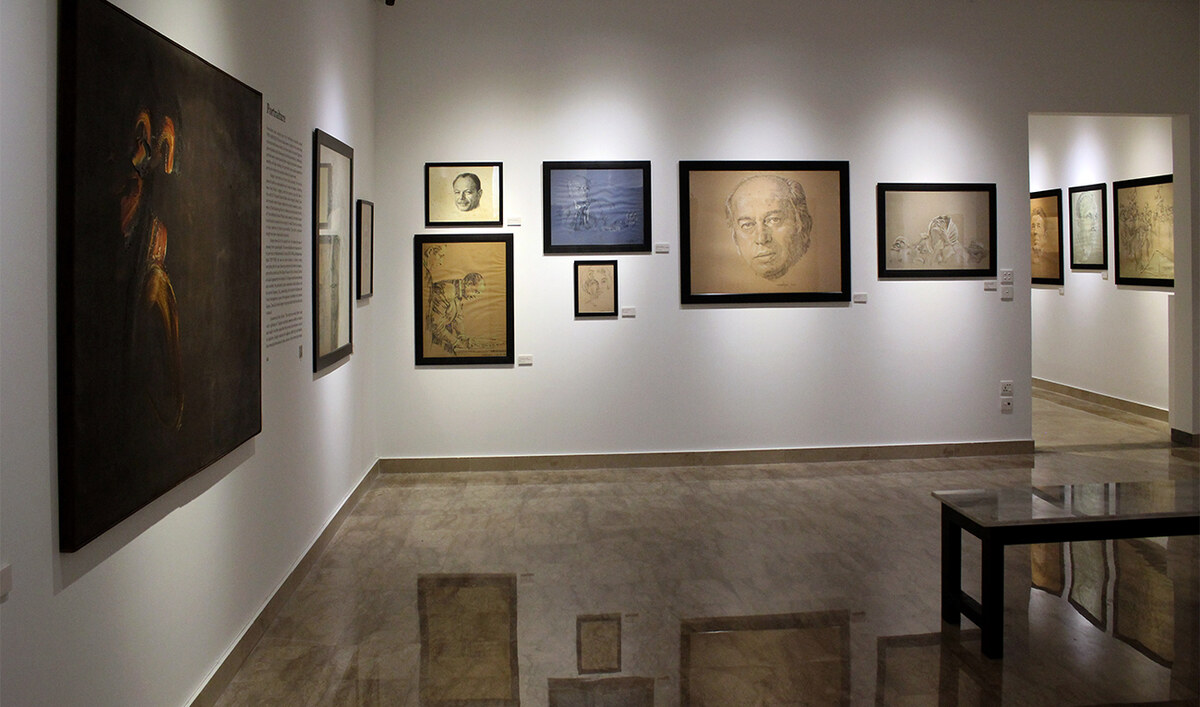
The photograph taken on February 18, 2025 shows art work displayed at the Gulgee Museum in Karachi, Pakistan. (AN)
The museum displays his father’s sketches, mosaics in lapis lazuli, paintings and sculptures.
“The collection comes from 1950 to 2007 with over 170 artworks,” he continued.
Amin is also the museum’s curator and has kept an archival collection of his father’s photographs, who witnessed the birth of Pakistan. The images feature Gulgee showing his work to President Charles de Gaulle of France in the 1960s and Benazir Bhutto in the 1990s, among others.
“I have divided the museum into 17 sections spread over 13 rooms on two floors, and I have written about each section,” he said. “Later, we are going to have a museum handbook that will come out. But for now, we have wall text in the museum, and we also have a QR code which translates all my English text into Urdu.”
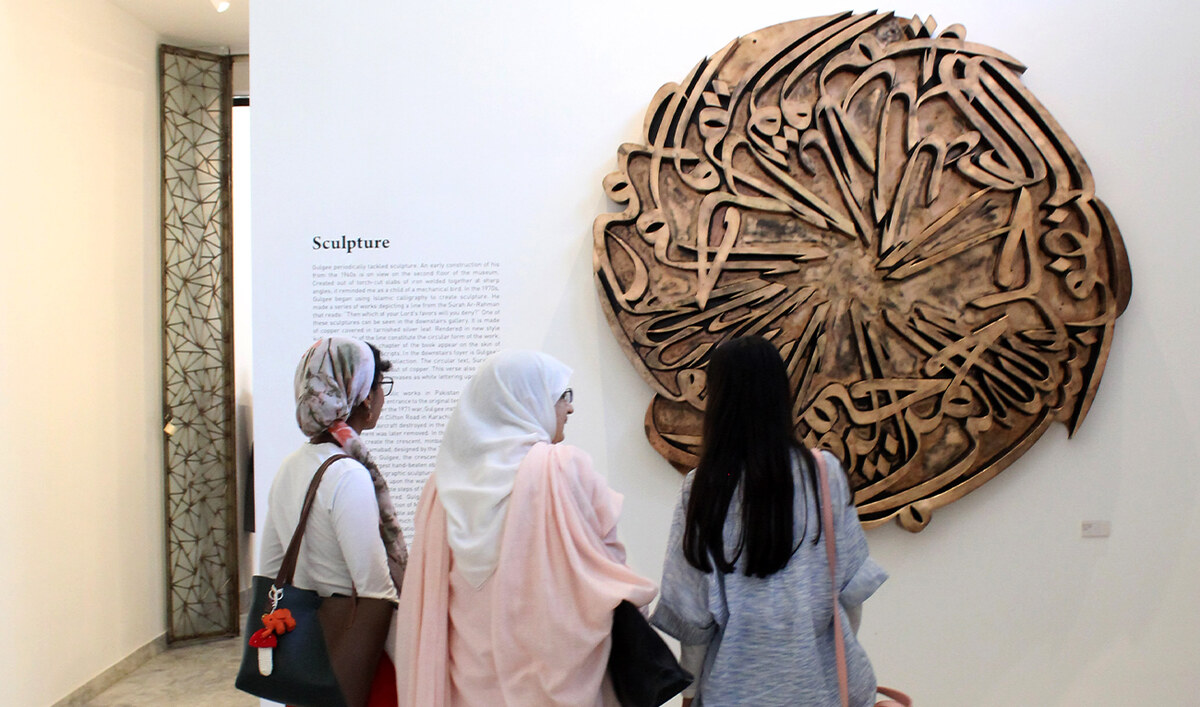
Visitors look at a sculpture showcasing Quranic calligraphy at the Gulgee Museum in Karachi, Pakistan, on February 19, 2025. (AN)
Amin went about transforming his parents’ home in collaboration with architect Samina Anjarwalla, who said that they broke a lot of walls, as the space previously comprised bedrooms, dressing rooms and bathrooms.
“The structure was a big challenge for us,” she told Arab News, adding that the idea was to preserve the country’s heritage along with Gulgee’s work.
“We kept [the building] very simple, very plain [and] very modern so that the work speaks for itself,” she added.
Karachi does not have many art museums, making it challenging to preserve artworks in many cases.
“I think it is wonderful for the city of Karachi [to have Gulgee Museum],” Mehreen Ilahi, who runs an art gallery called Majmua, told Arab News.
“Initiatives like these, including the different ways of preserving art, are extremely important,” she continued. “Other than this, Karachi only has the National Museum and Mohatta Palace Museum. It was very important that this became a museum because Gulgee is no longer alive, and his work must be preserved.”

The photograph taken on February 18, 2025 shows art work displayed at the Gulgee Museum in Karachi, Pakistan. (AN)
Asked about his future plans, Amin said there was a lot more to come.
“The next project of the museum is the Gulgee Museum Handbook, which is a 320-page book with 13 academic essays written on Ismail Gulgee,” he said. “We are about 80 percent done, and as soon as this opening is over, I go back to the project of the book.”


