Pakistan finmin assures facilitating foreign investors in meeting with Saudi Wafi Energy officials

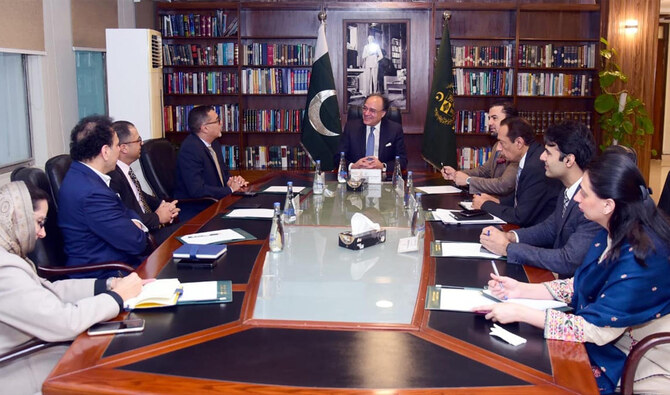
Pakistan’s Finance Minister Muhammad Aurangzeb (center) meets senior officials of Saudi Arabia’s Wafi Energy Pakistan and Asyad Holdings Group in Islamabad on February 20, 2025. (PID)
Short Url
Updated 21 February 2025
Follow

Pakistan finmin assures facilitating foreign investors in meeting with Saudi Wafi Energy officials

  • Wafi Energy made huge investments in Pakistan last year when it became Shell Pakistan’s majority shareholder
  • Saudi delegation informs Pakistan finmin about plans to expand investments in Pakistan, says Finance Division

ISLAMABAD: Pakistan’s Finance Minister Muhammad Aurangzeb this week met senior officials of Saudi Arabia’s Wafi Energy Pakistan and Asyad Holdings group, promising to facilitate foreign investors via fostering a business-friendly environment in the country, the Finance Division said. 

Wafi Energy, an affiliate of the Asyad Group, made huge investments in Pakistan when it became the majority shareholder of Shell Pakistan Limited (SPL) in November last year. The Saudi group now holds approximately 87.78 percent of the total issued share capital of SPL. 

Aurangzeb met Ghassan Al Amoudi, CEO of Asyad Holdings and Wafi Energy Pakistan Limited Chairman Zubair Shaikh on Thursday. He welcomed the delegation and appreciated both groups’ contributions to Pakistan’s energy and investment sectors, the Finance Division said. 

“He reaffirmed the government’s commitment to facilitating foreign investors and ensuring a business-friendly environment,” the statement said on Thursday. 

Aurangzeb spoke to the delegation about his recent visit to Saudi Arabia for the AlUla Conference 2025, commending Saudi Arabia’s strides in economic diversification and infrastructure development.

The Saudi delegation informed the minister about their plans to expand their investments in Pakistan, emphasizing that the South Asian country already hosts their largest investments, the Finance Division said. 

“They expressed confidence in Pakistan’s economic potential and shared their vision for further collaboration in the downstream petroleum sector and energy infrastructure,” the statement said. 

The delegation noted that investor and consumer confidence in Pakistan is returning, the Finance Division said. 

“The finance minister reiterated the government’s full support for foreign investors and its dedication to policies that foster investment, innovation, and sustainable economic progress,” the statement said. 

Pakistan has proactively tried to woo foreign investors and countries into investing in the country’s energy, infrastructure, real estate, agriculture, livestock and other priority sectors ever since it came close to defaulting on its international payments in 2023. 

Pakistan formed the Special Investment Facilitation Council (SIFC) in June 2023 to attract international investment in its priority sectors, particularly from Gulf countries. 

The SIFC is a hybrid civil-military body that aims to fast-track decisions related to international investment. Since its formation, Pakistan has signed several agreements in trade and investment with Saudi Arabia, UAE, Azerbaijan, Turkiye, China and other countries worth billions of dollars. 


Pakistan army hits Afghan Taliban drone storage facility, ammunition depot in Jalalabad

Updated 02 March 2026
Follow

Pakistan army hits Afghan Taliban drone storage facility, ammunition depot in Jalalabad

  • Around 435 Afghan Taliban fighters killed, over 630 injured in Pakistani military offensive, minister says
  • Several countries, global bodies have urged both sides to exercise restraint since the conflict began last week

ISLAMABAD: Pakistan’s army struck a drone storage facility and ammunition depot of Afghan Taliban in Jalalabad, a Pakistani security official said on Monday, following Pakistani strikes on more than 50 locations in Afghanistan amid ongoing hostilities between the neighbors.

Pakistan launched Operation ‘Ghazb lil Haq’ against Afghanistan on the night of Feb. 26 following an attack by Afghanistan on Pakistani military installations along their shared border.

The worst fighting between the two neighbors in years erupted after Pakistani airstrikes targeted what Islamabad called militant hideouts inside Afghanistan on Feb. 21-22, accusing Kabul of harboring Tehreek-e-Taliban Pakistan (TTP) militants behind the attacks on its soil. Afghanistan denies the charge.

A Pakistani security official, who requested anonymity, said the army was continuing “strong retaliatory action” against the Afghan Taliban and blew up multiple border posts, forcing them to abandon their positions.

“Pakistan forces are effectively targeting the bases and military installations of the Fitna Al-Khawarij and the Afghan Taliban,” he said.

“During the effective counter-operation of the Pakistani forces, the ammunition depot and drone storage site of Fitna Al-Khawarij (TTP) and the Afghan Taliban in Jalalabad was destroyed.”

Separately, Pakistan’s Information Minister Attaullah Tarar said more than 400 Afghan Taliban fighters had been killed and over 630 wounded in the Pakistani military offensive so far.

Pakistan destroyed around 188 check posts and captured 31, according to a post on X by Tarar. Over 180 tanks, armored vehicles and artillery guns were also destroyed in Pakistani air raids at 51 locations across Afghanistan.

On Sunday, Pakistani state media shared a video of what it said were Pakistani soldiers crossing into Afghanistan in the northwest to capture an Afghan post. Pakistan has seized a 32-square-kilometer area of Afghanistan, another Pakistani security official said.

Afghan officials earlier said that dozens of Pakistani soldiers had been killed and several Pakistan posts had been captured by their forces. None of the casualty figures or battlefield claims from either side could be independently verified.

Since the conflict began last week, diplomatic efforts have intensified, with several countries and international bodies calling on both sides to exercise restraint.

The United Nations, along with China and Russia, has called for calm, while US President Donald Trump said Pakistan has the right to defend itself against cross-border militancy.