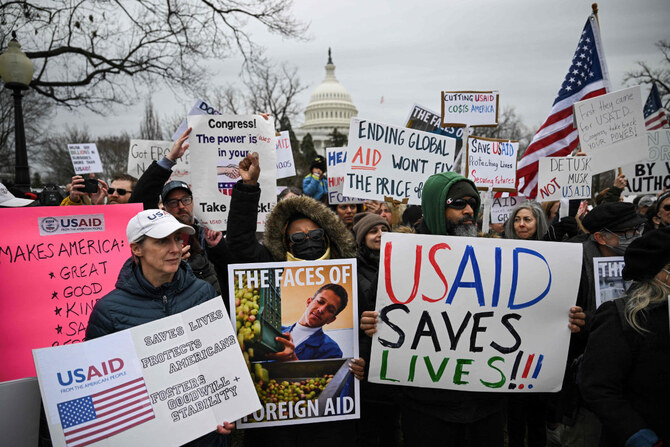
WASHINGTON: The Trump administration has kept withholding foreign aid despite a court order and must at least temporarily restore the funding to programs worldwide, a federal judge said Thursday.
Judge Amir H. Ali declined a request by nonprofit groups doing business with the US Agency for International Development to find Trump administration officials in contempt of his order, however.
The Washington, D.C., district court judge said administration officials had used his Feb. 13 order to temporarily lift the freeze on foreign aid to instead “come up with a new, post-hoc rationalization for the en masse suspension” of funding.
Despite the judge’s order to the contrary, USAID Deputy Secretary Pete Marocco, a Trump appointee, and other top officials had “continued their blanket suspension of funds,” Ali said.
The ruling comes in a lawsuit by the nonprofit groups challenging the Trump administration’s month-old cutoff of foreign assistance through USAID and the State Department, which shut down $60 billion in annual aid and development programs overseas almost overnight.
Even after Ali’s order, USAID staffers and contractors say the State Department and USAID still have not restored payments even on hundreds of millions of dollars already owed by the government.
Marocco and other administration officials defended the nonpayment in written arguments to the judge this week. They contended that they could lawfully stop or terminate payments under thousands of contracts without violating the judge’s order.
The Trump administration says it is now doing a program-by-program review of all State Department and USAID foreign assistance programs to see which ones meet the Trump administration’s agenda.
Aid organizations, and current and former USAID staffers in interviews and court affidavits, say the funding freeze and deep Trump administration purges of USAID staffers have brought US foreign assistance globally to a halt, forced thousands of layoffs and is driving government partners to financial collapse.

Trump administration is flouting an order to temporarily lift a freeze on foreign aid, judge says
Short Url
https://arab.news/56bu7
Trump administration is flouting an order to temporarily lift a freeze on foreign aid, judge says
- Judge Amir H. Ali noted that Trump's appointees to the State Department and USAID had “continued their blanket suspension of funds”
- The judge earlier issued a freeze order based on a lawsuit by the nonprofit groups challenging Trump's cutoff of US foreign assistance
China’s top diplomat to visit Somalia on Africa tour
- Stop in Mogadishu provides diplomatic boost after Israel became the first country to formally recognize breakaway Somaliland
- Tour focusses on Beijing's strategic trade access across eastern and southern Africa
BEIJING: China’s top diplomat began his annual New Year tour of Africa on Wednesday, focusing on strategic trade access across eastern and southern Africa as Beijing seeks to secure key shipping routes and resource supply lines.
Foreign Minister Wang Yi will travel to Ethiopia, Africa’s fastest-growing large economy; Somalia, a Horn of Africa state offering access to key global shipping lanes; Tanzania, a logistics hub linking minerals-rich central Africa to the Indian Ocean; and Lesotho, a small southern African economy squeezed by US trade measures. His trip this year runs until January 12.
Beijing aims to highlight countries it views as model partners of President Xi Jinping’s flagship “Belt and Road” infrastructure program and to expand export markets, particularly in young, increasingly affluent economies such as Ethiopia, where the IMF forecasts growth of 7.2 percent this year.
China, the world’s largest bilateral lender, faces growing competition from the European Union to finance African infrastructure, as countries hit by pandemic-era debt strains now seek investment over loans.
“The real litmus test for 2026 isn’t just the arrival of Chinese investment, but the ‘Africanization’ of that investment. As Wang Yi visits hubs like Ethiopia and Tanzania, the conversation must move beyond just building roads to building factories,” said Judith Mwai, policy analyst at Development Reimagined, an Africa-focussed consultancy.
“For African leaders, this tour is an opportunity to demand that China’s ‘small yet beautiful’ projects specifically target our industrial gaps, turning African raw materials into finished products on African soil, rather than just facilitating their exit,” she added.
On his start-of-year trip in 2025, Wang visited Namibia, the Republic of Congo, Chad and Nigeria.
His visit to Somalia will be the first by a Chinese foreign minister since the 1980s and is expected to provide Mogadishu with a diplomatic boost after Israel became the first country to formally recognize the breakaway Republic of Somaliland, a northern region that declared itself independent in 1991.
Beijing, which reiterated its support for Somalia after the Israeli announcement in December, is keen to reinforce its influence around the Gulf of Aden, the entrance to the Red Sea and a vital corridor for Chinese trade transiting the Suez Canal to Europe.
Further south, Tanzania is central to Beijing’s plan to secure access to Africa’s vast copper deposits. Chinese firms are refurbishing the Tazara Railway that runs through the country into Zambia. Li Qiang made a landmark trip to Zambia in November, the first visit by a Chinese premier in 28 years.
The railway is widely seen as a counterweight to the US and European Union-backed Lobito Corridor, which connects Zambia to Atlantic ports via Angola and the Democratic Republic of the Congo.
By visiting the southern African kingdom of Lesotho, Wang aims to highlight Beijing’s push to position itself as a champion of free trade. Last year, China offered tariff-free market access to its $19 trillion economy for the world’s poorest nations, fulfilling a pledge by Chinese President Xi Jinping at the 2024 China-Africa Cooperation summit in Beijing.
Lesotho, one of the world’s poorest nations with a gross domestic product of just over $2 billion, was among the countries hardest hit by US President Donald Trump’s sweeping tariffs last year, facing duties of up to 50 percent on its exports to the United States.
Foreign Minister Wang Yi will travel to Ethiopia, Africa’s fastest-growing large economy; Somalia, a Horn of Africa state offering access to key global shipping lanes; Tanzania, a logistics hub linking minerals-rich central Africa to the Indian Ocean; and Lesotho, a small southern African economy squeezed by US trade measures. His trip this year runs until January 12.
Beijing aims to highlight countries it views as model partners of President Xi Jinping’s flagship “Belt and Road” infrastructure program and to expand export markets, particularly in young, increasingly affluent economies such as Ethiopia, where the IMF forecasts growth of 7.2 percent this year.
China, the world’s largest bilateral lender, faces growing competition from the European Union to finance African infrastructure, as countries hit by pandemic-era debt strains now seek investment over loans.
“The real litmus test for 2026 isn’t just the arrival of Chinese investment, but the ‘Africanization’ of that investment. As Wang Yi visits hubs like Ethiopia and Tanzania, the conversation must move beyond just building roads to building factories,” said Judith Mwai, policy analyst at Development Reimagined, an Africa-focussed consultancy.
“For African leaders, this tour is an opportunity to demand that China’s ‘small yet beautiful’ projects specifically target our industrial gaps, turning African raw materials into finished products on African soil, rather than just facilitating their exit,” she added.
On his start-of-year trip in 2025, Wang visited Namibia, the Republic of Congo, Chad and Nigeria.
His visit to Somalia will be the first by a Chinese foreign minister since the 1980s and is expected to provide Mogadishu with a diplomatic boost after Israel became the first country to formally recognize the breakaway Republic of Somaliland, a northern region that declared itself independent in 1991.
Beijing, which reiterated its support for Somalia after the Israeli announcement in December, is keen to reinforce its influence around the Gulf of Aden, the entrance to the Red Sea and a vital corridor for Chinese trade transiting the Suez Canal to Europe.
Further south, Tanzania is central to Beijing’s plan to secure access to Africa’s vast copper deposits. Chinese firms are refurbishing the Tazara Railway that runs through the country into Zambia. Li Qiang made a landmark trip to Zambia in November, the first visit by a Chinese premier in 28 years.
The railway is widely seen as a counterweight to the US and European Union-backed Lobito Corridor, which connects Zambia to Atlantic ports via Angola and the Democratic Republic of the Congo.
By visiting the southern African kingdom of Lesotho, Wang aims to highlight Beijing’s push to position itself as a champion of free trade. Last year, China offered tariff-free market access to its $19 trillion economy for the world’s poorest nations, fulfilling a pledge by Chinese President Xi Jinping at the 2024 China-Africa Cooperation summit in Beijing.
Lesotho, one of the world’s poorest nations with a gross domestic product of just over $2 billion, was among the countries hardest hit by US President Donald Trump’s sweeping tariffs last year, facing duties of up to 50 percent on its exports to the United States.
© 2026 SAUDI RESEARCH & PUBLISHING COMPANY, All Rights Reserved And subject to Terms of Use Agreement.


