

Saudi artists ‘embrace the process’ at Tuwaiq sculpture exhibition

1 / 8
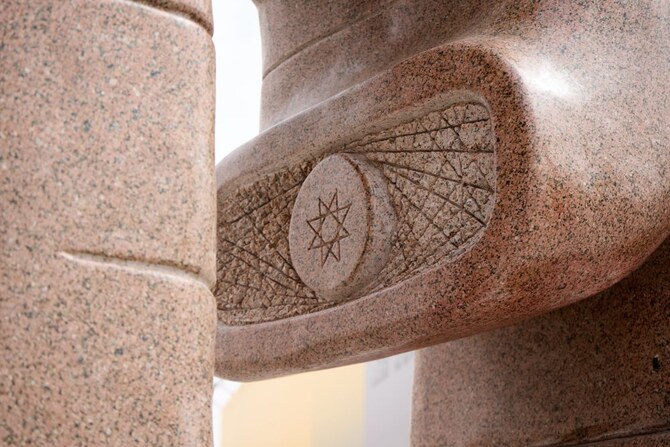
Saudi artist Ali Al-Tokhais’ sculpture Care and Interest in the Content. (Supplied)
2 / 8
Saudi artist Ali Al-Tokhais’ sculpture Care and Interest in the Content. (Supplied)
3 / 8
Saudi artist Ali Al-Tokhais’ sculpture Care and Interest in the Content. (Supplied)
4 / 8
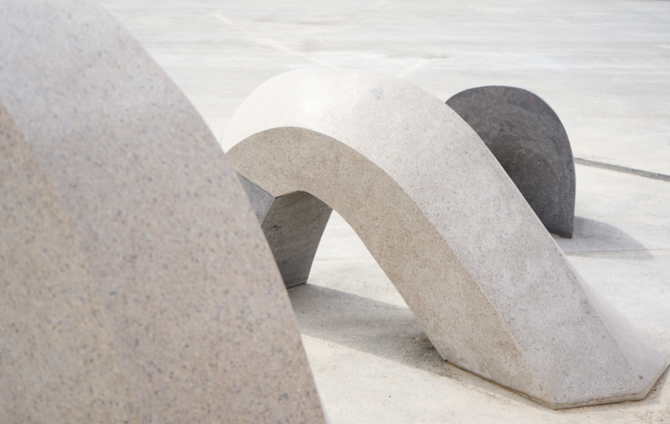
Saudi artist Rawan Al-Shehri’s piece titled Spontaneity. (Supplied)
5 / 8
Saudi artist Rawan Al-Shehri’s piece titled Spontaneity. (Supplied)
6 / 8
The Tuwaiq International Sculpture Symposium, a Riyadh Art initiative, aims to embellish the city with public artworks. (Supplied)
7 / 8
The Tuwaiq International Sculpture Symposium, a Riyadh Art initiative, aims to embellish the city with public artworks. (Supplied)
8 / 8
The Tuwaiq International Sculpture Symposium, a Riyadh Art initiative, aims to embellish the city with public artworks. (Supplied)
Short Url
Updated 20 February 2025
Follow

Saudi artists ‘embrace the process’ at Tuwaiq sculpture exhibition

  • Visitors flock to Roshn Front to check out latest creations by 30 international, local artists
  • Saudi artist Rawan Al-Shehri’s piece, titled Spontaneity, is composed of three large, curved pieces crafted with two different stones

RIYADH: At the sixth Tuwaiq International Sculpture Symposium — a Riyadh Art initiative to beautify the city with public artworks — visitors have flocked to Roshn Front to check out the latest creations by 30 international and local artists.

This year’s theme, “From Then to Now: Joy in the Struggle of Making,” has pushed artists to widen the idea of what a completed artwork really is, and encouraged them to consider ways in which the process of creation could be more engaging to a public audience.

During the opening of the symposium last month, at which 30 artists began their sculpting journey on raw stone, co-curator Sebastian Betancur-Montoya told Arab News: “Art tends to be this idea of the artist as a sort of genius and the ideas are kind of obscure. It’s not clear where things come from, or how things are made.

“I thought it was very interesting to create a space — this event — where the interest was not in the final product, but the whole creative, physical, and intellectual process behind those pieces.”

Saudi artist Rawan Al-Shehri’s piece, titled “Spontaneity,” is composed of three large, curved pieces crafted with two different stones. The piece is designed to promote playfulness and invite public interaction.

She told Arab News: “My work focuses on how artists can sometimes believe they must produce the perfect art piece, but I think the focus should be the process of building an art piece — the joy in it and being more natural, or in our element, during our work.

“We could be faced with challenges or hurdles that change or enhance, even, the work itself and make it unique.”

Rather than keeping the viewer at bay, she hopes that the work will pull them in, adding: “They can sit on parts of it, slide on a corner, or even climb on a piece.”

Saudi artist Ali Al-Tokhais’ sculpture “Care and Interest in the Content” draws inspiration from the positive and cohesive relationship between the leadership of the Kingdom and society.

The 3-meter sculpted piece of granite resembles a spiral, with 13 lines marking its center to symbolize the number of regions in the Kingdom — each rich in cultural, economic, and social diversity.

He told Arab News: “This sculpture embodies the spirit of Saudi Arabia in all its regions, with a forward-looking vision led by Vision 2030, which has focused on the development of both people and place, with the homeland becoming a safe haven for the diversity and multiplicity that distinguish the Kingdom’s regions within a unified national framework.”

Al-Tokhais’ art journey began with creating wood figures using carpentry and blacksmithing techniques. From there, the passion evolved, leading him into the world of stone sculpting in which he said he found “a means of expressing ideas and emotions” in the material.

He added: “I began to explore new dimensions of art that reflected both cultural and human identity.”

The exhibition is an invitation to explore the cultural and creative world embodied in each sculpture.

Al-Tokhais said: “It is a gathering where we share moments of beauty and deep reflection, further enhancing Riyadh’s position as a global destination for arts and creativity.”

He emphasized the importance of local and international art forums in enriching the art scene and enhancing the exchange of experiences among sculptors worldwide, adding: “Art forums have always provided exceptional opportunities for growth and development, as they allow artists to explore new methods and expand their creative horizons.

“Through my various contributions, both in Saudi Arabia and internationally, I have been able to develop my artistic vision and refine my techniques, which are reflected in my works and my unique style in sculpture.”

The exhibition mirrors the public engagement program of the live sculpting phase, which featured panel discussions, workshops, masterclasses, and guided tours — prompting visitors to further engage with the artists’ creative processes and the significance of contemporary sculpture until the event’s conclusion on Feb. 24.

Co-curator Dr. Manal Al-Harbi said at the opening: “The forum is not limited only to displaying sculptures, but rather provides a rich interactive experience through community activities that give the public the opportunity to learn about sculpting techniques, speak with artists, and participate in the creative process, which enhances interaction with the arts and makes them part of daily life.”


Kawthar Al-Atiyah: ‘My paintings speak first to the body, then to the mind’ 

Updated 19 December 2025
Follow

Kawthar Al-Atiyah: ‘My paintings speak first to the body, then to the mind’ 

  • The Saudi artist discusses her creative process and her responsibility to ‘represent Saudi culture’ 

RIYADH: Contemporary Saudi artist Kawthar Al-Atiyah uses painting, sculpture and immersive material experimentation to create her deeply personal works. And those works focus on one recurring question: What does emotion look like when it becomes physical?  

“My practice begins with the body as a site of memory — its weight, its tension, its quiet shifts,” Al-Atiyah tells Arab News. “Emotion is never abstract to me. It lives in texture, in light, in the way material breathes.”  

This philosophy shapes the immersive surfaces she creates, which often seem suspended between presence and absence. “There is a moment when the body stops being flesh and becomes presence, something felt rather than seen,” she says. “I try to capture that threshold.”  

Al-Atiyah, a graduate of Princess Nourah bint Abdulrahman University, has steadily built an international profile for herself. Her participation in VOLTA Art Fair at Art Basel in Switzerland, MENART Fair in Paris, and exhibitions in the Gulf and Europe have positioned her as a leading Saudi voice in contemporary art.  

Showing abroad has shaped her understanding of how audiences engage with vulnerability. “Across countries and cultures, viewers reacted to my work in ways that revealed their own memories,” she says. “It affirmed my belief that the primary language of human beings is emotion. My paintings speak first to the body, then to the mind.” 

Al-Atiyah says her creative process begins long before paint touches canvas. Instead of sketching, she constructs physical environments made of materials including camel bone, raw cotton, transparent fabrics, and fragments of carpet.  

“When a concept arrives, I build it in real space,” she says. “I sculpt atmosphere, objects, light and emotion before I sculpt paint.  

“I layer color the way the body stores experience,” she continues. “Some layers stay buried, others resurface unexpectedly. I stop only when the internal rhythm feels resolved.”  

This sensitivity to the unseen has drawn attention from international institutions. Forbes Middle East included her among the 100 Most Influential Women in the Arab World in 2024 and selected several of her pieces for exhibition.  

“One of the works was privately owned, yet they insisted on showing it,” she says. “For me, that was a strong sign of trust and recognition. It affirmed my responsibility to represent Saudi culture with honesty and depth.”  

Her recent year-long exhibition at Ithra deepened her understanding of how regional audiences interpret her work.  

'Veil of Light.' (Supplied) 

“In the Gulf, people respond strongly to embodied memory,” she says. “They see themselves in the quiet tensions of the piece, perhaps because we share similar cultural rhythms.”  

A documentary is now in production exploring her process, offering viewers a rare look into the preparatory world that precedes each canvas.  

“People usually see the final work. But the emotional architecture built before the painting is where the story truly begins,” she explains.  

Beyond her own practice, Al-Atiyah is committed to art education through her work with Misk Art Institute. “Teaching is a dialogue,” she says. “I do not focus on technique alone. I teach students to develop intuition, to trust their senses, to translate internal experiences into honest visual language.”  

 'Jamalensan.' (Supplied) 

She believes that artists should be emotionally aware as well as technically skilled. “I want them to connect deeply with themselves so that what they create resonates beyond personal expression and becomes part of a cultural conversation,” she explains.  

In Saudi Arabia’s rapidly growing art scene, Al-Atiyah sees her role as both storyteller and facilitator.  

“Art is not decoration, it is a language,” she says. “If my work helps someone remember something they have forgotten or feel something they have buried, then I have done what I set out to do.”