CAIRO: Egypt’s antiquities authority says it has found the ancient tomb of King Thutmose II, the first royal burial to be found since the famed discovery of Tutankhamun’s tomb in 1922.
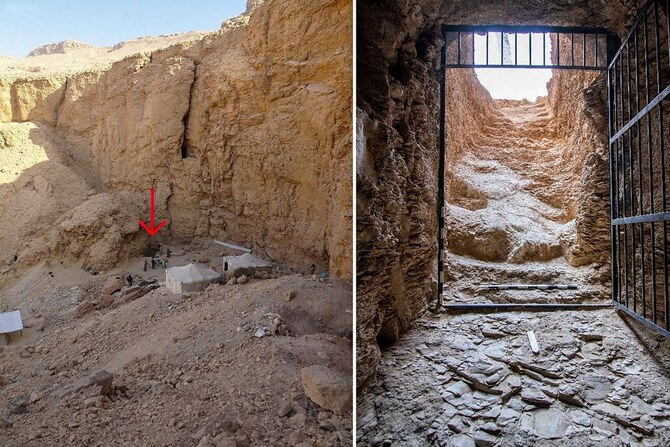
The tomb, discovered near the Valley of the Kings in Luxor in southern Egypt, belonged to King Thutmose II of the 18th dynasty, who lived nearly 3,500 years ago.
Thutmose II was an ancestor to Tutankhamun himself, and his half-sister and queen consort was Pharaoh Hatshepsut.
Her giant mortuary temple stands on the west bank of the Nile at Luxor a few kilometers (miles) from where the tomb of Thutmose II was found.
Although preliminary studies suggest its contents were moved in ancient times — leaving the tomb without the iconic mummy or gilded splendour of the Tutankhamun find — the antiquities ministry on Tuesday called the discovery “one of the most significant archaeological breakthroughs in recent years.”
It has been excavated by a joint Egyptian-British mission, led by the Supreme Council of Antiquities and the New Kingdom Research Foundation.
The tomb’s entrance was first located in 2022 in the Luxor mountains west of the Valley of the Kings, but was believed at the time to lead to the tomb of a royal wife.
But the team then found “fragments of alabaster jars inscribed with the name of Pharaoh Thutmose II, identified as the ‘deceased king’, alongside inscriptions bearing the name of his chief royal consort, Queen Hatshepsut,” confirming whose tomb it was, the ministry said.
Shortly after the king’s burial, water flooded the burial chamber, damaging the interior and leaving fragments of plaster that bore parts of the Book of Amduat, an ancient mortuary text on the underworld.
Some funerary furniture belonging to Thutmose II has also been recovered from the tomb in “the first-ever find” of its kind, according to the ministry.
It quoted mission chief Dr. Piers Latherland as saying the team will continue its work in the area, hoping to find the tomb’s original contents.

Egypt unveils first ancient royal tomb since Tutankhamun
https://arab.news/mdkjg
Egypt unveils first ancient royal tomb since Tutankhamun
- The tomb, discovered near the Valley of the Kings in Luxor in southern Egypt, belonged to King Thutmose II of the 18th dynasty
- Thutmose II was an ancestor to Tutankhamun himself
Israel confirms ban on 37 NGOs in Gaza
JERUSALEM: Israel on Thursday said 37 humanitarian agencies supplying aid in Gaza had not met a deadline to meet “security and transparency standards,” and would be banned from the territory, despite an international outcry.
The international NGOs, which had been ordered to disclose detailed information on their Palestinian staff, will now be required to cease operations by March 1.
The United Nations has warned that this will exacerbate the humanitarian crisis in the war-ravaged Palestinian territory.
“Organizations that have failed to meet required security and transparency standards will have their licenses suspended,” Israel’s Ministry of Diaspora Affairs and Combating Antisemitism said in a statement.
Several NGOS have said the requirements contravene international humanitarian law or endanger their independence.
Israel says the new regulation aims to prevent bodies it accuses of supporting terrorism from operating in the Palestinian territories.
Prominent humanitarian organizations hit by the ban include Doctors Without Borders (MSF), the Norwegian Refugee Council (NRC), World Vision International and Oxfam, according to a ministry list.
In MSF’s case, Israel accused it of having two employees who were members of Palestinian militant groups Islamic Jihad and Hamas.
MSF said this week the request to share a list of its staff “may be in violation of Israel’s obligations under international humanitarian law” and said it “would never knowingly employ people engaging in military activity.”
‘Critical requirement’
NRC spokesperson Shaina Low told AFP its local staff are “exhausted” and international staff “bring them an extra layer of help and security. Their presence is a protection.”
Submitting the names of local staff is “not negotiable,” she said. “We offered alternatives, they refused,” hse said, of the Israeli regulators.
The ministry said Thursday: “The primary failure identified was the refusal to provide complete and verifiable information regarding their employees, a critical requirement designed to prevent the infiltration of terrorist operatives into humanitarian structures.”
In March, Israel gave NGOs 10 months to comply with the new rules, which demand the “full disclosure of personnel, funding sources, and operational structures.”
The deadline expired on Wednesday.
The 37 NGOs “were formally notified that their licenses would be revoked as of January 1, 2026, and that they must complete the cessation of their activities by March 1, 2026,” the ministry said Thursday.
A ministry spokesperson told AFP that following the revocation of their licenses, aid groups could no longer bring assistance into Gaza from Thursday.
However, they could have their licenses reinstated if they submitted the required documents before March 1.
Minister of Diaspora Affairs and Combating Antisemitism Amichai Chikli said “the message is clear: humanitarian assistance is welcome — the exploitation of humanitarian frameworks for terrorism is not.”
‘Weaponization of bureaucracy’
On Thursday, 18 Israel-based left-wing NGOs denounced the decision to ban their international peers, saying “the new registration framework violates core humanitarian principles of independence and neutrality.”
“This weaponization of bureaucracy institutionalizes barriers to aid and forces vital organizations to suspend operations,” they said.
UN Palestinian refugee agency chief Philippe Lazzarini had said the move sets a “dangerous precedent.”
“Failing to push back against attempts to control the work of aid organizations will further undermine the basic humanitarian principles of neutrality, independence, impartiality and humanity underpinning aid work across the world,” he said on X.
On Tuesday, the foreign ministers of 10 countries, including France and Britain, urged Israel to “guarantee access” to aid in the Gaza Strip, where they said the humanitarian situation remains “catastrophic.”
A fragile ceasefire has been in place since October, following a deadly war waged by Israel in response to Hamas’s unprecedented October 7, 2023 attack on Israel.
Nearly 80 percent of buildings in Gaza have been destroyed or damaged by the war, according to UN data.
About 1.5 million of Gaza’s more than two million residents have lost their homes, said Amjad Al-Shawa, director of the Palestinian NGO Network in Gaza.


