

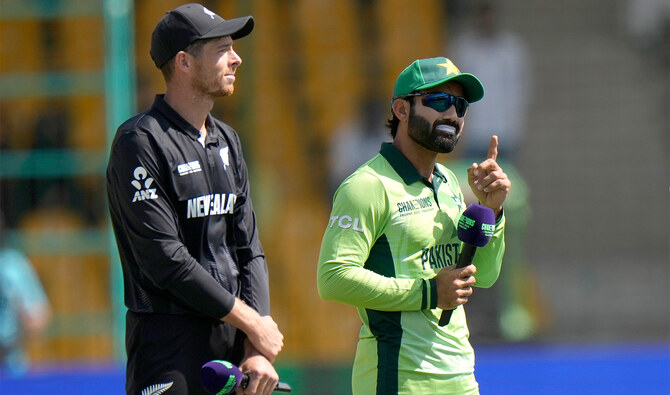
Pakistan opt to field against New Zealand as ICC Champions Trophy 2025 kicks off in Karachi

Pakistan's Mohammad Rizwan, right, and New Zealand's Mitchel Santner wait for coin toss before the start the ICC Champions Trophy cricket match between Pakistan and New Zealand, in Karachi, Pakistan, on Feb. 19, 2025. (AP)
Short Url
Updated 19 February 2025
Follow

Pakistan opt to field against New Zealand as ICC Champions Trophy 2025 kicks off in Karachi

  • Pakistan is hosting an ICC event for the first time in 29 years since the cricket World Cup 1996
  • The team defeated India in the final of the 2017 tournament under Sarfaraz Ahmed’s captaincy

KARACHI: Defending champions Pakistan won the toss and decided to field against New Zealand shortly before the ninth edition of the ICC Champions Trophy 2025 commenced at the National Stadium in Karachi on Wednesday.

The eight-team tournament will be played across three venues in Pakistan – Karachi, Lahore and Rawalpindi – as well as in Dubai, United Arab Emirates (UAE), from 19 February to 9 March.

Pakistan is hosting an ICC event for the first time since the ICC Cricket World Cup 1996, which concluded with the final at the Qaddafi Stadium, where Sri Lanka defeated Australia by seven wickets.

“We want to go to bowl first because we have seen since the last couple of matches that dew comes in the end,” Pakistan skipper Mohammad Rizwan said after winning the toss.

“If we think as defending champions, it will put us under a little bit more pressure,” he continued, responding to the question about how he felt to be back in the tournament won by his team. “We want to keep it simple. We just played a tri-series against these guys … This is a big tournament, and playing in Pakistan is a proud moment for us as well.”

Pakistan enter the championship as the defending champions, having beaten India in the final of the 2017 edition, led by Sarfaraz Ahmed. Fakhar Zaman was the player of the final for his imperious 114 off 106 deliveries, while Hasan Ali was named the player of the tournament for his tally of 13 wickets in five games.

In the lead-up to the ICC Champions Trophy, the three venues in Pakistan – Qaddafi Stadium Lahore, National Stadium Karachi and Rawalpindi Cricket Stadium – have undergone major upgradation, offering players and spectators world-class facilities.

The eight participating teams have been divided into two groups with hosts Pakistan, Bangladesh, India and New Zealand pooled in Group A while Group B comprises Afghanistan, current ODI World Cup champions Australia, England and South Africa.

Following their opening encounter against New Zealand, Pakistan will play their next two group matches on 23 February against India in Dubai and on 27 February against Bangladesh in Rawalpindi.

In the group stage, three matches apiece will be played in Dubai, Karachi, Lahore and Rawalpindi.

The first semifinal will be played on March 4 in Dubai. The newly-upgraded Qaddafi Stadium in Lahore will host the second semifinal on March 5. If India do not qualify, the final will take place at the Qaddafi Stadium on March 9.

However, if they qualify, it will be held at the Dubai International Cricket Stadium.

Apart from winning this tournament in 2017, Pakistan has also reached the semifinals of this competition on three occasions in 2000, 2004 and 2009.


Sindh assembly passes resolution rejecting move to separate Karachi

Updated 21 February 2026
Follow

Sindh assembly passes resolution rejecting move to separate Karachi

  • Chief Minister Shah cites constitutional safeguards against altering provincial boundaries
  • Calls to separate Karachi intensified amid governance concerns after a mall fire last month

ISLAMABAD: The provincial assembly of Pakistan’s southern Sindh province on Saturday passed a resolution rejecting any move to separate Karachi, declaring its territorial integrity “non-negotiable” amid political calls to carve the city out as a separate administrative unit.

The resolution comes after fresh demands by the Muttahida Qaumi Movement (MQM) and other voices to grant Karachi provincial or federal status following governance challenges highlighted by the deadly Gul Plaza fire earlier this year that killed 80 people.

Karachi, Pakistan’s largest and most densely populated city, is the country’s main commercial hub and contributes a significant share to the national economy.

Chief Minister Syed Murad Ali Shah tabled the resolution in the assembly, condemning what he described as “divisive statements” about breaking up Sindh or detaching Karachi.

“The province that played a foundational role in the creation of Pakistan cannot allow the fragmentation of its own historic homeland,” Shah told lawmakers, adding that any attempt to divide Sindh or separate Karachi was contrary to the constitution and democratic norms.

Citing Article 239 of Pakistan’s 1973 Constitution, which requires the consent of not less than two-thirds of a provincial assembly to alter provincial boundaries, Shah said any such move could not proceed without the assembly’s approval.

“If any such move is attempted, it is this Assembly — by a two-thirds majority — that will decide,” he said.

The resolution reaffirmed that Karachi would “forever remain” an integral part of Sindh and directed the provincial government to forward the motion to the president, prime minister and parliamentary leadership for record.

Shah said the resolution was not aimed at anyone but referred to the shifting stance of MQM in the debate while warning that opposing the resolution would amount to supporting the division of Sindh.

The party has been a major political force in Karachi with a significant vote bank in the city and has frequently criticized Shah’s provincial administration over its governance of Pakistan’s largest metropolis.

Taha Ahmed Khan, a senior MQM leader, acknowledged that his party had “presented its demand openly on television channels with clear and logical arguments” to separate Karachi from Sindh.

“It is a purely constitutional debate,” he told Arab News by phone. “We are aware that the Pakistan Peoples Party, which rules the province, holds a two-thirds majority and that a new province cannot be created at this stage. But that does not mean new provinces can never be formed.”

Calls to alter Karachi’s status have periodically surfaced amid longstanding complaints over governance, infrastructure and administrative control in the megacity, though no formal proposal to redraw provincial boundaries has been introduced at the federal level.